
Homework Answers

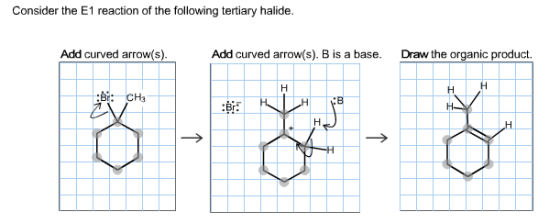
Consider the E1 reaction of the following tertiary halide add curved arros add curved arrow B...
 Consider the E1 reaction of
the following tertiary halide add curved arros add curved arrow B
is a base draw the organic product
Consider the E1 reaction of the following tertiary halide. ld curved arrow(s) Add curved arrow(s). B is a base. Draw the organic product. :B :Br:
Consider the E1 reaction of
the following tertiary halide add curved arros add curved arrow B
is a base draw the organic product
Consider the E1 reaction of the following tertiary halide. ld curved arrow(s) Add curved arrow(s). B is a base. Draw the organic product. :B :Br:
Categorise this alkyl halide as primary / secondary / tertiary, and identify the most electrophilic (8+)...
 Categorise this alkyl halide as primary / secondary / tertiary, and identify the most electrophilic (8+) location within the molecule. a Br е Select one: Secondary alkyl halide; the electrophilic location is b Secondary alkyl halide; the electrophilic location is a Tertiary alkyl halide; the electrophilic location is a Primary alkyl halide; the electrophilic location is a 0 Tertiary alkyl halide; the electrophilic location is e
HO Regarding the following reaction: 1) a. Classify the alkyl halide as tertiary, secondary, or primary....
 HO Regarding the following reaction: 1) a. Classify the alkyl halide as tertiary, secondary, or primary. b. Based on your answers to la, deduce whether the alkyl halide would be suitable for (i) only S2 reactions, (ii) only Ss 1 reactions, or (1) both/either S2 or S1 reactions. 2) a. Classify the nucleophile (the electron-sharer) as either strong or weak b. Based on your answer to 2a, deduce whether the nucleophile would be suitable for (i) only Sw2 reactions, (1)...
why must synthesized crude tertiary alkyl halide be dried carefully with calcium chloride before the distillation...
why must synthesized crude tertiary alkyl halide be dried carefully with calcium chloride before the distillation for purifying purpose? (try to answer what kind of reaction could be happening with water and alkyl halide?)
Match the following statements with reaction mechanism SN1, SN2, E1, or E2. A statement may be...
 Match the following statements with reaction mechanism
SN1, SN2, E1, or E2. A statement may be true
for one or more mechanisms.
a. The mechanism involves carbocation intermediates. b. The mechanism has two steps. c. The reaction rate increases with better leaving groups. d. The reaction rate increases when the solvent is changed from CH3OH to (CH3)2SO e. The reaction rate depends on the concentration of only the alkyl halide. f. The mechanism is concerted. g. The reaction of CH3CH2Br...
Match the following statements with reaction mechanism
SN1, SN2, E1, or E2. A statement may be true
for one or more mechanisms.
a. The mechanism involves carbocation intermediates. b. The mechanism has two steps. c. The reaction rate increases with better leaving groups. d. The reaction rate increases when the solvent is changed from CH3OH to (CH3)2SO e. The reaction rate depends on the concentration of only the alkyl halide. f. The mechanism is concerted. g. The reaction of CH3CH2Br...
Draw the structural formula for a compound that contains a tertiary alcohol, a secondary alkyl halide,...
Draw the structural formula for a compound that contains a tertiary alcohol, a secondary alkyl halide, and primary, secondary and tertiary hydrogens. a. Indicate the number of beta-hydrogens relative the alkyl halide. b. Name the compound you just drew.
Experiment 4: Synthesis of a tertiary alkyl halide Page 5 of 6 Experiment 4: Synthesis of...
 Experiment 4: Synthesis of a tertiary alkyl halide Page 5 of
6
Experiment 4: Synthesis of a tertiary alkyl halide Page 5 of 6 Assuming that all other experimental conditions are the same; explain if an S,1 reaction would still occur if the following changes were made. If an Sk1 reaction would still occur: then state the IUPAC name and draw the structure of the product formed compare the rate of reaction to the rate of the original reaction (in...
Experiment 4: Synthesis of a tertiary alkyl halide Page 5 of
6
Experiment 4: Synthesis of a tertiary alkyl halide Page 5 of 6 Assuming that all other experimental conditions are the same; explain if an S,1 reaction would still occur if the following changes were made. If an Sk1 reaction would still occur: then state the IUPAC name and draw the structure of the product formed compare the rate of reaction to the rate of the original reaction (in...
Experiment 4: Synthesis of a tertiary alkyl halide Page 3 of 6 Distillation is a technique that is to purify liquid com...
 Experiment 4: Synthesis of a tertiary alkyl halide Page 3 of 6 Distillation is a technique that is to purify liquid compounds. Use theoretical data to explain how distillation is used to separate the target product in this reaction from any residual unreacted starting material in the reaction. [2 marks]
Tertiary alcohols undergo elimination via an E1 mechanism since the tertiary carbocation intermediate is especially stable....
 Tertiary alcohols undergo elimination via an E1 mechanism since the tertiary carbocation intermediate is especially stable. Zaitsev's rule is followed in the elimination to give the more substituted alkene as the major product Draw curved arrows to show the movement of elections in this step of the mechanism
When determining which mechanism (E1 or E2) occurs, the following process is helpful: 1) Determine the...
 When determining which mechanism (E1 or E2) occurs, the following process is helpful: 1) Determine the substitution (methyl, 1º, 2º, or 3“) of the alkyl halide 2) Determine the strength of the nucleophile Please fill out the following table, indicating the category of reaction (E1 or E2) that will occur in each set of alkyl halides and nucleophiles. If no reaction occurs, write 'NR: Alkyl Halide Strong Base Weak Base Methyl 1° 20 3° For each of the following reactions,...
 Consider the E1 reaction of
the following tertiary halide add curved arros add curved arrow B
is a base draw the organic product
Consider the E1 reaction of the following tertiary halide. ld curved arrow(s) Add curved arrow(s). B is a base. Draw the organic product. :B :Br:
Consider the E1 reaction of
the following tertiary halide add curved arros add curved arrow B
is a base draw the organic product
Consider the E1 reaction of the following tertiary halide. ld curved arrow(s) Add curved arrow(s). B is a base. Draw the organic product. :B :Br:
 Categorise this alkyl halide as primary / secondary / tertiary, and identify the most electrophilic (8+) location within the molecule. a Br е Select one: Secondary alkyl halide; the electrophilic location is b Secondary alkyl halide; the electrophilic location is a Tertiary alkyl halide; the electrophilic location is a Primary alkyl halide; the electrophilic location is a 0 Tertiary alkyl halide; the electrophilic location is e
 HO Regarding the following reaction: 1) a. Classify the alkyl halide as tertiary, secondary, or primary. b. Based on your answers to la, deduce whether the alkyl halide would be suitable for (i) only S2 reactions, (ii) only Ss 1 reactions, or (1) both/either S2 or S1 reactions. 2) a. Classify the nucleophile (the electron-sharer) as either strong or weak b. Based on your answer to 2a, deduce whether the nucleophile would be suitable for (i) only Sw2 reactions, (1)...
 Match the following statements with reaction mechanism
SN1, SN2, E1, or E2. A statement may be true
for one or more mechanisms.
a. The mechanism involves carbocation intermediates. b. The mechanism has two steps. c. The reaction rate increases with better leaving groups. d. The reaction rate increases when the solvent is changed from CH3OH to (CH3)2SO e. The reaction rate depends on the concentration of only the alkyl halide. f. The mechanism is concerted. g. The reaction of CH3CH2Br...
Match the following statements with reaction mechanism
SN1, SN2, E1, or E2. A statement may be true
for one or more mechanisms.
a. The mechanism involves carbocation intermediates. b. The mechanism has two steps. c. The reaction rate increases with better leaving groups. d. The reaction rate increases when the solvent is changed from CH3OH to (CH3)2SO e. The reaction rate depends on the concentration of only the alkyl halide. f. The mechanism is concerted. g. The reaction of CH3CH2Br...
 Experiment 4: Synthesis of a tertiary alkyl halide Page 5 of
6
Experiment 4: Synthesis of a tertiary alkyl halide Page 5 of 6 Assuming that all other experimental conditions are the same; explain if an S,1 reaction would still occur if the following changes were made. If an Sk1 reaction would still occur: then state the IUPAC name and draw the structure of the product formed compare the rate of reaction to the rate of the original reaction (in...
Experiment 4: Synthesis of a tertiary alkyl halide Page 5 of
6
Experiment 4: Synthesis of a tertiary alkyl halide Page 5 of 6 Assuming that all other experimental conditions are the same; explain if an S,1 reaction would still occur if the following changes were made. If an Sk1 reaction would still occur: then state the IUPAC name and draw the structure of the product formed compare the rate of reaction to the rate of the original reaction (in...
 Experiment 4: Synthesis of a tertiary alkyl halide Page 3 of 6 Distillation is a technique that is to purify liquid compounds. Use theoretical data to explain how distillation is used to separate the target product in this reaction from any residual unreacted starting material in the reaction. [2 marks]
 Tertiary alcohols undergo elimination via an E1 mechanism since the tertiary carbocation intermediate is especially stable. Zaitsev's rule is followed in the elimination to give the more substituted alkene as the major product Draw curved arrows to show the movement of elections in this step of the mechanism
 When determining which mechanism (E1 or E2) occurs, the following process is helpful: 1) Determine the substitution (methyl, 1º, 2º, or 3“) of the alkyl halide 2) Determine the strength of the nucleophile Please fill out the following table, indicating the category of reaction (E1 or E2) that will occur in each set of alkyl halides and nucleophiles. If no reaction occurs, write 'NR: Alkyl Halide Strong Base Weak Base Methyl 1° 20 3° For each of the following reactions,...
Most questions answered within 3 hours.
-
Where is the error in this code sequence?
String s1 = "Hello";
String s2 = "ello";...
asked 10 months ago -
Financial data for Joel de Paris, Inc., for last year
follow:
Joel de Paris, Inc.
Balance...
asked 10 months ago -
Consider this reaction:
Al2(SO4)3 (aq)+ BaCl3
(aq) Al2Cl6 (aq)- +
3BaSO4(s) . What is the...
asked 10 months ago -
Suppose that Savneet is considering increasing her
recent random sample from 20 car rentals to 40...
asked 10 months ago -
Trucks arrive at an unloading terminal at an average rate of 120
per hour.
Trucks arrive...
asked 10 months ago -
Why are methanol and ethanol completely soluble in water while
octanol is not very little soluble....
asked 10 months ago -
A facilities manager at a university reads in a research report
that the mean amount of...
asked 10 months ago -
When the CuSO4 is rehydrated by adding water to the anhydrous
compound, is this an endothermic...
asked 10 months ago -
A ray of sunlight is passing from diamond into crown glass; the
angle of incidence is...
asked 10 months ago -
A block of mass 0.249 kg is placed on top of a light, vertical
spring of...
asked 10 months ago -
how do the kidneys compensate in the presences of acidosis
a) trigger hyperventilate
b) reserve acid...
asked 10 months ago -
Question 501 pts
The rental rate of capital to the firm increases. Which of the
following...
asked 10 months ago