
Homework Answers
Add Answer to:
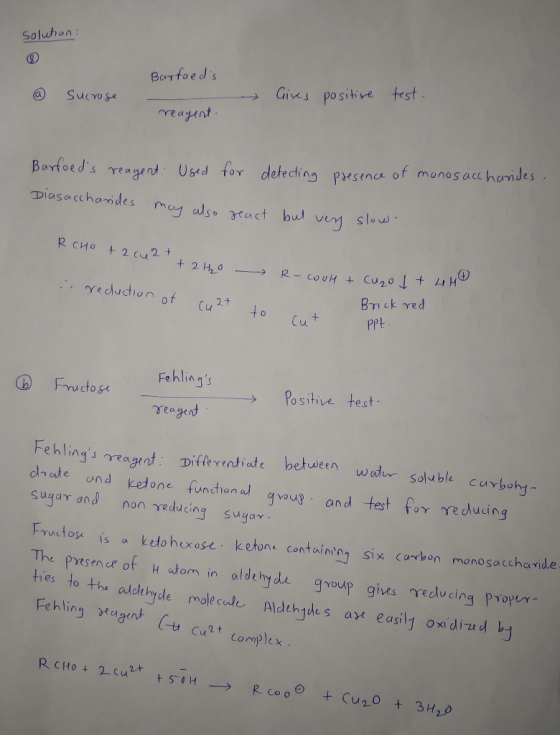
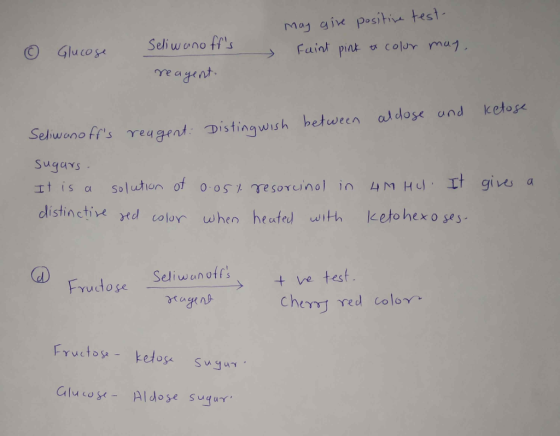
8. Predict whether or not a reaction will occur. Write the predicted results (time, color, etc.,)...
PRE-LABORATORY ASSIGNMENT Carbohydrates 1. Draw the structures of fructose (ring structures) present in a solution at...
 PRE-LABORATORY ASSIGNMENT Carbohydrates 1. Draw the structures of fructose (ring structures) present in a solution at equilibrium. 2. An unknown carbohydrate showed a positive test reaction when tested with Fehling's reagent, turned red when reacted with Seliwanoff's reagent, and reacted quickly with Barfoed's reagent. What conclusions can be made about this compound? 3. What test could be used to differentiate between the compounds in each set? a. sucrose and maltose b. fructose and glucose c. lactose and glucose
What Was - starch hydrolysis results in formation of Formed glucose, fructose etc. based on the...
 What Was - starch hydrolysis results in formation of Formed glucose, fructose etc. based on the enzym Upon I mode of action. The color of Fehlings Digestion? sovhon turns to yedbi cause the Sugarne - copped (11) to copper in fenungs sowho PROBLEMS 1. What purpose does amylase serve in the hydrolysis of starch? Why did the color of the iodine test change over time? Be specific about the reaction that is occurring (substrate and product). 2. Should there be...
Experiment 33 PART B. SOME REACTIONS OF CARBOHYDRATES Spor Test Results with Carbohydrates Sucrose Carbohyd- Starch...
 Experiment 33 PART B. SOME REACTIONS OF CARBOHYDRATES Spor Test Results with Carbohydrates Sucrose Carbohyd- Starch Fructose Glucose rate class Benedict's test Fehling's test Tollens test Glucose oxidase test Iodine test What class of carbohydrate can be expected to give a positive test with the spot tests below? Benedict's glucose oxidase Fehling's iodine Tollens Hydrolysis of polysaccharides Test Results Results of Result from Benedict's test strips Solution Result from iodine test Initial starch Initial sucrose Initial cellulose Final starch Final...
Please, fill in first table for Seliwanoff's Test for Ketoses. Additional info is found in the...
 Please, fill in first table for Seliwanoff's Test for Ketoses.
Additional info is found in the images following table. (Second
table is info and image following).
Part C: Seliwanoff's Test for Ketoses Seliwanoff's Test Results Test Tube Sample Prediction Ketose? (Y/N) Observations Distilled water Peach / no change Glucose Peach to red slowly Fructose deep red solution very quickly Sucrose deep red solution quickly Lactose Peach to red slowly Starch Peach to red very slowly Mystery sample Peach to red...
Please, fill in first table for Seliwanoff's Test for Ketoses.
Additional info is found in the images following table. (Second
table is info and image following).
Part C: Seliwanoff's Test for Ketoses Seliwanoff's Test Results Test Tube Sample Prediction Ketose? (Y/N) Observations Distilled water Peach / no change Glucose Peach to red slowly Fructose deep red solution very quickly Sucrose deep red solution quickly Lactose Peach to red slowly Starch Peach to red very slowly Mystery sample Peach to red...
Predict whether the following reactions will occur or not. For those that do occur complete and...
 Predict whether the following reactions will occur or not. For those that do occur complete and balance the equation. Write "No Reaction" for those that do not occur. Include all subscripts ((s), (aq), etc.). 2. CoCaBr Al_Ni(NO), () What is the molarity of a silver() nitrate solution if 50.00 ml of the silverll) nitrate solution is reacted with magnesium, producing 3.580 g of dry silver metal? Include the balanced molecular equation in the space provided. 3. Balanced Molecular Equation:
15. Predict whether each reaction will occur spontaneously or not. If it does occur, write a...
 15. Predict whether each reaction will occur spontaneously or not. If it does occur, write a balanced equation. a) Mg(s) + ZnCl2(aq) → b) Cu(s) + AlBr3(aq) → c) Al(s) + CuCl(aq) →
TIL. PRE-LAB QUESTIONS - Experiment 8 1. a) Complete the table below. X1/ Xy/ 2 14...
 TIL. PRE-LAB QUESTIONS - Experiment 8 1. a) Complete the table below. X1/ Xy/ 2 14 8 25 16 b) On graph paper plot y vs. x (appropriately labeling all axes as well as graphing the best fitting line/curve to the data points). c) Is the relationship between the y and x data pairs linear or non-linear? d) Is the relationship between the y and x data pairs direct or inverse? e) Which expression of k (k=y/x or k=xy) corresponds...
Predict whether a precipitation reaction will occur in each of the following situations. Write a net...
Predict whether a precipitation reaction will occur in each of the following situations. Write a net ionic equation for each reaction that occurs. (a) NiCl2(aq) + (NH4)2S(aq) → ? (b) Na2CrO4(aq) + Pb(NO3)2(aq) → ? (c) AgClO4(aq) + CaBr2(aq) → ? (d) ZnCl2(aq) + K2CO3(aq) → ?
(A) Predict whether the change in entropy (ΔS) is positive, negative or near zero for the...
(A) Predict whether the change in entropy (ΔS) is positive, negative or near zero for the following processes at 298K. Provide a molecular level explanation or justification for your prediction. (B) Calculate the change in entropy (ΔS) for the following processes at 298K. i. H2O (s) → H2O (l), melting of ice. ii. Formation reaction for steam (water vapor, H2O (g)). iii. C3H8 (l) → C3H8 (aq), Liquid propane going to aqueous propane. iv. The hydrolysis of the dipeptide glycylglycine...
(A) Predict whether the change in entropy (ΔS) is positive, negative or near zero for the...
(A) Predict whether the change in entropy (ΔS) is positive, negative or near zero for the following processes at 298K. Provide a molecular level explanation or justification for your prediction . (B) Now calculate the change in entropy (ΔS) for the following processes at 298K . Write a brief explanation on how your predicted vs. calculated results compare. i. H2O (s) → H2O (l), melting of ice. ii. Formation reaction for steam (water vapor, H2O (g)). iii. C3H8 (l) →...
 PRE-LABORATORY ASSIGNMENT Carbohydrates 1. Draw the structures of fructose (ring structures) present in a solution at equilibrium. 2. An unknown carbohydrate showed a positive test reaction when tested with Fehling's reagent, turned red when reacted with Seliwanoff's reagent, and reacted quickly with Barfoed's reagent. What conclusions can be made about this compound? 3. What test could be used to differentiate between the compounds in each set? a. sucrose and maltose b. fructose and glucose c. lactose and glucose
 What Was - starch hydrolysis results in formation of Formed glucose, fructose etc. based on the enzym Upon I mode of action. The color of Fehlings Digestion? sovhon turns to yedbi cause the Sugarne - copped (11) to copper in fenungs sowho PROBLEMS 1. What purpose does amylase serve in the hydrolysis of starch? Why did the color of the iodine test change over time? Be specific about the reaction that is occurring (substrate and product). 2. Should there be...
 Experiment 33 PART B. SOME REACTIONS OF CARBOHYDRATES Spor Test Results with Carbohydrates Sucrose Carbohyd- Starch Fructose Glucose rate class Benedict's test Fehling's test Tollens test Glucose oxidase test Iodine test What class of carbohydrate can be expected to give a positive test with the spot tests below? Benedict's glucose oxidase Fehling's iodine Tollens Hydrolysis of polysaccharides Test Results Results of Result from Benedict's test strips Solution Result from iodine test Initial starch Initial sucrose Initial cellulose Final starch Final...
 Please, fill in first table for Seliwanoff's Test for Ketoses.
Additional info is found in the images following table. (Second
table is info and image following).
Part C: Seliwanoff's Test for Ketoses Seliwanoff's Test Results Test Tube Sample Prediction Ketose? (Y/N) Observations Distilled water Peach / no change Glucose Peach to red slowly Fructose deep red solution very quickly Sucrose deep red solution quickly Lactose Peach to red slowly Starch Peach to red very slowly Mystery sample Peach to red...
Please, fill in first table for Seliwanoff's Test for Ketoses.
Additional info is found in the images following table. (Second
table is info and image following).
Part C: Seliwanoff's Test for Ketoses Seliwanoff's Test Results Test Tube Sample Prediction Ketose? (Y/N) Observations Distilled water Peach / no change Glucose Peach to red slowly Fructose deep red solution very quickly Sucrose deep red solution quickly Lactose Peach to red slowly Starch Peach to red very slowly Mystery sample Peach to red...
 Predict whether the following reactions will occur or not. For those that do occur complete and balance the equation. Write "No Reaction" for those that do not occur. Include all subscripts ((s), (aq), etc.). 2. CoCaBr Al_Ni(NO), () What is the molarity of a silver() nitrate solution if 50.00 ml of the silverll) nitrate solution is reacted with magnesium, producing 3.580 g of dry silver metal? Include the balanced molecular equation in the space provided. 3. Balanced Molecular Equation:
 15. Predict whether each reaction will occur spontaneously or not. If it does occur, write a balanced equation. a) Mg(s) + ZnCl2(aq) → b) Cu(s) + AlBr3(aq) → c) Al(s) + CuCl(aq) →
 TIL. PRE-LAB QUESTIONS - Experiment 8 1. a) Complete the table below. X1/ Xy/ 2 14 8 25 16 b) On graph paper plot y vs. x (appropriately labeling all axes as well as graphing the best fitting line/curve to the data points). c) Is the relationship between the y and x data pairs linear or non-linear? d) Is the relationship between the y and x data pairs direct or inverse? e) Which expression of k (k=y/x or k=xy) corresponds...
Most questions answered within 3 hours.
-
Where is the error in this code sequence?
String s1 = "Hello";
String s2 = "ello";...
asked 10 months ago -
Financial data for Joel de Paris, Inc., for last year
follow:
Joel de Paris, Inc.
Balance...
asked 10 months ago -
Consider this reaction:
Al2(SO4)3 (aq)+ BaCl3
(aq) Al2Cl6 (aq)- +
3BaSO4(s) . What is the...
asked 10 months ago -
Suppose that Savneet is considering increasing her
recent random sample from 20 car rentals to 40...
asked 10 months ago -
Trucks arrive at an unloading terminal at an average rate of 120
per hour.
Trucks arrive...
asked 10 months ago -
Why are methanol and ethanol completely soluble in water while
octanol is not very little soluble....
asked 10 months ago -
A facilities manager at a university reads in a research report
that the mean amount of...
asked 10 months ago -
When the CuSO4 is rehydrated by adding water to the anhydrous
compound, is this an endothermic...
asked 10 months ago -
A ray of sunlight is passing from diamond into crown glass; the
angle of incidence is...
asked 10 months ago -
A block of mass 0.249 kg is placed on top of a light, vertical
spring of...
asked 10 months ago -
how do the kidneys compensate in the presences of acidosis
a) trigger hyperventilate
b) reserve acid...
asked 10 months ago -
Question 501 pts
The rental rate of capital to the firm increases. Which of the
following...
asked 10 months ago