
Homework Answers
Let
- L be the event that a lost hiker wears an emergency locator.
- NL be the event that a lost hiker does not wear an emergency locator.
- F be the event that a lost hiker is lost
- NF be the event that a lost hiker is not found
From the table we know the following joint probabilities (cell values of the table)
We also know the following marginal probabilities (column and row totals)
a) The probability of a lost hiker wearing a locator (event L) and not being found (event NF) is
b) the probability that a lost hiker would wear a locator (event L) is the marginal probability of L
From a total of 1000 lost hikers, the number expected to wear a locator is
c) First we need to find the the probability that a lost hiker is found (event F), given that the hiker doesn't wear a locator (event NL) and it is given by
Now if we multiply the above by 1000 we will get the required number
ans: From a total of 1000 lost hikers who don't wear a locator, the number expected to be found is 385.
d) If the hiker is found (event F), the probability that the hiker was wearing a locator is same as
the probability that the hiker was wearing a locator (event L) given that the hiker is found (event F)
e) Let us construct the tree diagram with the event if a lost hiker wears locator as the first set of branches
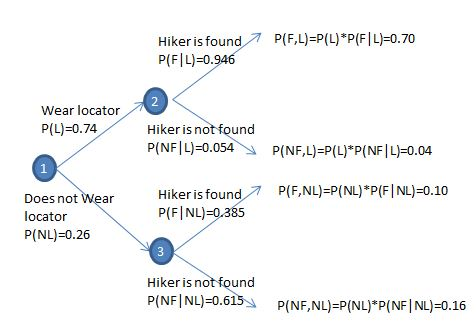
Node 1: We know the marginal probability that a lost hiker would be wearing a locator is P(L)=0.74
The marginal probability that a lost hiker would not be wearing a locator is P(NL)=0.26
Node 2: Given that the lost hiker is wearing a locator, the probability that a hiker is found is
Given that the lost hiker is wearing a locator, the probability that a hiker is not found is
Node 3: Given that the lost hiker is not wearing a locator, the probability that a hiker is found is
Given that the lost hiker is not wearing a locator, the probability that a hiker is not found is
Add Answer to:
Need to show work
2. Hikers in remote regions sometimes carry with them an emergency locater....
Show work when solving 2. Hikers in remote regions sometimes carry with them an emergency locater....
 Show work when solving
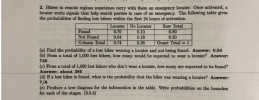
2. Hikers in remote regions sometimes carry with them an emergency locater. Once activated, a locater emits signals that help search parties in case of an emergency. The following table gives the probabilities of finding lost hikers within the first 24 hours of activation. Locater No Locater Row Total 0.10 Found Not Found 0.04 0.16 Column Total 0.7426 Grand Total -1 0.80 0.20 0.70 (a) Find the probability of a lost hiker wearing a locater and...
Show work when solving
2. Hikers in remote regions sometimes carry with them an emergency locater. Once activated, a locater emits signals that help search parties in case of an emergency. The following table gives the probabilities of finding lost hikers within the first 24 hours of activation. Locater No Locater Row Total 0.10 Found Not Found 0.04 0.16 Column Total 0.7426 Grand Total -1 0.80 0.20 0.70 (a) Find the probability of a lost hiker wearing a locater and...
Need to show work 16. Let Y-number of broken eggs in a carton. The probability distribution...
 Need to show work
16. Let Y-number of broken eggs in a carton. The probability distribution for Y is given in the table below. Note: a carton of eggs contains 12 eggs. Probability | 0.7 1015 0.06 0.05 0.04 (a) Compute the expected value of Y and explain its meaning. Answer: E(Y) 0.58 (b) If 1,000 egg cartons are inspected, what would be the expected number of broken eggs found? Answer: 580 (c) Why is it that u is not...
Need to show work
16. Let Y-number of broken eggs in a carton. The probability distribution for Y is given in the table below. Note: a carton of eggs contains 12 eggs. Probability | 0.7 1015 0.06 0.05 0.04 (a) Compute the expected value of Y and explain its meaning. Answer: E(Y) 0.58 (b) If 1,000 egg cartons are inspected, what would be the expected number of broken eggs found? Answer: 580 (c) Why is it that u is not...
Have to show work for every problem 4. A company uses three plants to produce a...
 Have to show work for every problem
4. A company uses three plants to produce a new computer chip. Plant A produces 30% of the chips. Plant B produces 45% of the chips. The rest of the chips are produced by plant C. Each plant has its own defectiv rate. These are: plant A produces 3% defective chips, plant B produces 1% defective chips, plant C produces 5% defective chips. Hint: draw a tree diagram. (a) Construct a tree diagram...
Have to show work for every problem
4. A company uses three plants to produce a new computer chip. Plant A produces 30% of the chips. Plant B produces 45% of the chips. The rest of the chips are produced by plant C. Each plant has its own defectiv rate. These are: plant A produces 3% defective chips, plant B produces 1% defective chips, plant C produces 5% defective chips. Hint: draw a tree diagram. (a) Construct a tree diagram...
Students must show work to receive full credit. 1. Differentiate “Empirical Probability” and “Classical Probability”. 2....
Students must show work to receive full credit. 1. Differentiate “Empirical Probability” and “Classical Probability”. 2. Define “Independent Events”, “Mutually Exclusive Events”, and “Collectively Exhaustive Events”. 3. Suppose there are 15 red marbles and 5 blue marbles in a box. (3.a) If an individual randomly selects two marbles without replacement, what is the probability that both marbles are red? (3.b) If an individual randomly selects two marbles with replacement, what is the probability that both marbles are red? 4. Solve...
 Show work when solving
2. Hikers in remote regions sometimes carry with them an emergency locater. Once activated, a locater emits signals that help search parties in case of an emergency. The following table gives the probabilities of finding lost hikers within the first 24 hours of activation. Locater No Locater Row Total 0.10 Found Not Found 0.04 0.16 Column Total 0.7426 Grand Total -1 0.80 0.20 0.70 (a) Find the probability of a lost hiker wearing a locater and...
Show work when solving
2. Hikers in remote regions sometimes carry with them an emergency locater. Once activated, a locater emits signals that help search parties in case of an emergency. The following table gives the probabilities of finding lost hikers within the first 24 hours of activation. Locater No Locater Row Total 0.10 Found Not Found 0.04 0.16 Column Total 0.7426 Grand Total -1 0.80 0.20 0.70 (a) Find the probability of a lost hiker wearing a locater and...
 Need to show work
16. Let Y-number of broken eggs in a carton. The probability distribution for Y is given in the table below. Note: a carton of eggs contains 12 eggs. Probability | 0.7 1015 0.06 0.05 0.04 (a) Compute the expected value of Y and explain its meaning. Answer: E(Y) 0.58 (b) If 1,000 egg cartons are inspected, what would be the expected number of broken eggs found? Answer: 580 (c) Why is it that u is not...
Need to show work
16. Let Y-number of broken eggs in a carton. The probability distribution for Y is given in the table below. Note: a carton of eggs contains 12 eggs. Probability | 0.7 1015 0.06 0.05 0.04 (a) Compute the expected value of Y and explain its meaning. Answer: E(Y) 0.58 (b) If 1,000 egg cartons are inspected, what would be the expected number of broken eggs found? Answer: 580 (c) Why is it that u is not...
 Have to show work for every problem
4. A company uses three plants to produce a new computer chip. Plant A produces 30% of the chips. Plant B produces 45% of the chips. The rest of the chips are produced by plant C. Each plant has its own defectiv rate. These are: plant A produces 3% defective chips, plant B produces 1% defective chips, plant C produces 5% defective chips. Hint: draw a tree diagram. (a) Construct a tree diagram...
Have to show work for every problem
4. A company uses three plants to produce a new computer chip. Plant A produces 30% of the chips. Plant B produces 45% of the chips. The rest of the chips are produced by plant C. Each plant has its own defectiv rate. These are: plant A produces 3% defective chips, plant B produces 1% defective chips, plant C produces 5% defective chips. Hint: draw a tree diagram. (a) Construct a tree diagram...
Most questions answered within 3 hours.
-
Where is the error in this code sequence?
String s1 = "Hello";
String s2 = "ello";...
asked 10 months ago -
Financial data for Joel de Paris, Inc., for last year
follow:
Joel de Paris, Inc.
Balance...
asked 10 months ago -
Consider this reaction:
Al2(SO4)3 (aq)+ BaCl3
(aq) Al2Cl6 (aq)- +
3BaSO4(s) . What is the...
asked 10 months ago -
Suppose that Savneet is considering increasing her
recent random sample from 20 car rentals to 40...
asked 10 months ago -
Trucks arrive at an unloading terminal at an average rate of 120
per hour.
Trucks arrive...
asked 10 months ago -
Why are methanol and ethanol completely soluble in water while
octanol is not very little soluble....
asked 10 months ago -
A facilities manager at a university reads in a research report
that the mean amount of...
asked 10 months ago -
When the CuSO4 is rehydrated by adding water to the anhydrous
compound, is this an endothermic...
asked 10 months ago -
A ray of sunlight is passing from diamond into crown glass; the
angle of incidence is...
asked 10 months ago -
A block of mass 0.249 kg is placed on top of a light, vertical
spring of...
asked 10 months ago -
how do the kidneys compensate in the presences of acidosis
a) trigger hyperventilate
b) reserve acid...
asked 10 months ago -
Question 501 pts
The rental rate of capital to the firm increases. Which of the
following...
asked 10 months ago