
Homework Answers
Answer: There is no net production of oxaloacetate
Comment: The TCA cycle start with condensation of acetyl group (of acetyl-CoA) and oxaloacetate to for intermediate and ultimately oxaloacetate is generated. SO the reaction starts with one oxaloacetate and at the end of the reaction, one oxaloacetate is generated. So there is no change in the oxaloacetate molecule. So the net change is zero even four cycles of TCA too.
See figure

Add Answer to:
in 4 passes of the TCA cycle, how many net molecules of Oxaloacetate are produced 16...
1) How many CO2 molecules are produced by pyruvate dehydrogenase and the TCA cycle per molecule...
1) How many CO2 molecules are produced by pyruvate dehydrogenase and the TCA cycle per molecule of glyceraldehydes-3-phosphate that goes through glycolysis, pyruvate dehydrogenase, and the TCA cycle? a.1 b.2 c.3 d.4 e.5 f.6 How many NADPH molecules are produced by pyruvate dehydrogenase and the TCA cycle per molecule of phosphoenolpyruvate that goes through glycolysis, pyruvate dehydrogenase, and the TCA cycle? a.3 b.4 c.6 d.8 e.0
Krebs cycle Starting with one molecule of pyruvate and ending with oxaloacetate, how many ATP molecules...
Krebs cycle Starting with one molecule of pyruvate and ending with oxaloacetate, how many ATP molecules and NADH and FADH2 are formed in citric acid cycle
How many FADH2 molecules are produced from a single glucose molecule during glycolysis and TCA? A....
How many FADH2 molecules are produced from a single glucose molecule during glycolysis and TCA? A. 0 B. 2 C. 8 D. 10
The product of the complete oxidation of carbon in the TCA cycle is: a. oxaloacetate b....
The product of the complete oxidation of carbon in the TCA cycle is: a. oxaloacetate b. acetyl coa c. citrate d. CO2 e. None of the above In addition to glucose which of the following sugars can enter glycosis a. celobiose b. ribose c. galactose d. b & c e. all of the above In anaerobic metabolism, what is the fate of pyruvate produced by glycolysis a. converted to ethanol b. converted to lactate c. converted to acetyl-COA d. a...
5. What are some historical experiments that demonstrate how the TCA cycle is not linear and...
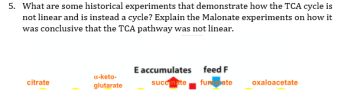 5. What are some historical experiments that demonstrate how the TCA cycle is not linear and is instead a cycle? Explain the Malonate experiments on how it was conclusive that the TCA pathway was not linear. E accumulates succinate a-keto- glutarate feed F furate citrate oxaloacetate
a. The metabolism of glucose by glycolysis to acetyl-coenzyme A, followed by the TCA cycle, releases...
a. The metabolism of glucose by glycolysis to acetyl-coenzyme A, followed by the TCA cycle, releases CO2 molecules by oxidative decarboxylation reactions. Write down the oxidative decarboxylation reactions that result in CO2 production. Name the enzyme involved in each reaction and give the names and complete structures of all reactants and products. Only abbreviated names of enzyme cofactors are required. (b) From the steps drawn in part (a) above, how many total ATP molecules would be produced from oxidative phosphorylation?
During the citric acid cycle (TCA) how many times the cycle must turn until an entire...
During the citric acid cycle (TCA) how many times the cycle must turn until an entire GLUCOSE molecule is completely oxidized? A.) 2 B.) 4 C.) 1 D.) 3
How many molecules of FADH_2 are produced by the complete catabolism of one molecule of glucose?...
 How many molecules of FADH_2 are produced by the complete catabolism of one molecule of glucose? 1 2 4 8 16 The majority of ATP produced during the catabolism of glucose is formed during? oxidative phosphorylation glycolysis the citric acid cycle lipogenesis acetly-CoA formation
16. How many ATP's are produced per Acetyl-CoA? 17. How many ATP's (include ATP equivalents) and...
 16. How many ATP's are produced per Acetyl-CoA? 17. How many ATP's (include ATP equivalents) and CO2 molecules are produced per glucose operating under aerobic? Anabolic and Catalytic Functions of the Citric Acid Cycle 18. Use Figure 14-16 to describe how the Citric Acid Cycle supplies the precursors for the synthesis of amino acids, glucose, and fatty acids.
How many molecules of ATP are produced per acetyl CoA completing the citric acid cycle? a)...
How many molecules of ATP are produced per acetyl CoA completing the citric acid cycle? a) 1 b) 2 c) 10 d) 12
 5. What are some historical experiments that demonstrate how the TCA cycle is not linear and is instead a cycle? Explain the Malonate experiments on how it was conclusive that the TCA pathway was not linear. E accumulates succinate a-keto- glutarate feed F furate citrate oxaloacetate
 How many molecules of FADH_2 are produced by the complete catabolism of one molecule of glucose? 1 2 4 8 16 The majority of ATP produced during the catabolism of glucose is formed during? oxidative phosphorylation glycolysis the citric acid cycle lipogenesis acetly-CoA formation
 16. How many ATP's are produced per Acetyl-CoA? 17. How many ATP's (include ATP equivalents) and CO2 molecules are produced per glucose operating under aerobic? Anabolic and Catalytic Functions of the Citric Acid Cycle 18. Use Figure 14-16 to describe how the Citric Acid Cycle supplies the precursors for the synthesis of amino acids, glucose, and fatty acids.
Most questions answered within 3 hours.
-
Where is the error in this code sequence?
String s1 = "Hello";
String s2 = "ello";...
asked 11 months ago -
Financial data for Joel de Paris, Inc., for last year
follow:
Joel de Paris, Inc.
Balance...
asked 11 months ago -
Consider this reaction:
Al2(SO4)3 (aq)+ BaCl3
(aq) Al2Cl6 (aq)- +
3BaSO4(s) . What is the...
asked 11 months ago -
Suppose that Savneet is considering increasing her
recent random sample from 20 car rentals to 40...
asked 11 months ago -
Trucks arrive at an unloading terminal at an average rate of 120
per hour.
Trucks arrive...
asked 11 months ago -
Why are methanol and ethanol completely soluble in water while
octanol is not very little soluble....
asked 11 months ago -
A facilities manager at a university reads in a research report
that the mean amount of...
asked 11 months ago -
When the CuSO4 is rehydrated by adding water to the anhydrous
compound, is this an endothermic...
asked 11 months ago -
A ray of sunlight is passing from diamond into crown glass; the
angle of incidence is...
asked 11 months ago -
A block of mass 0.249 kg is placed on top of a light, vertical
spring of...
asked 11 months ago -
how do the kidneys compensate in the presences of acidosis
a) trigger hyperventilate
b) reserve acid...
asked 11 months ago -
Question 501 pts
The rental rate of capital to the firm increases. Which of the
following...
asked 11 months ago