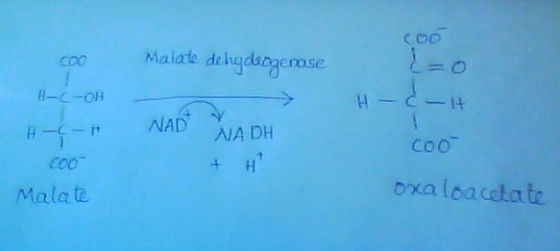
Write the overall reaction for Step 8 of the TCA cycle (malate -> oxaloacetate), showing the...
Homework Answers
Malate is oxidised to produce Oxaloacetate. In the citric acid cycle the starting compound by malate dehydrogenase. During the oxidation, NAD+ is reduced to NADH + H+.
ATP generation
Total ATP = 12 ATP
- 3 NAD+ = 9 ATP
- 1 FAD = 2 ATP
- 1 ATP = 1 ATP
In this cycle the acetyl group and water converted into carbon dioxide and energised forms of the other reactant
Add Answer to:
Write the overall reaction for Step 8 of the TCA cycle (malate
-> oxaloacetate), showing the...
Write the overall reaction for Step 6 of the TCA cycle (succinate -> fumarate), showing structures...
Write the overall reaction for Step 6 of the TCA cycle (succinate -> fumarate), showing structures for succinate and fumarate. What other molecule is involved in Step 6 and what is it converted to (acronyms are fine)? What type of bonds are breaking and what type is forming in Step 6? How do you know that carbon is being oxidized in this step?
A) Write the overall reaction for step 5 of the TCA Cycle (succinyl-CoA -> succinate), showing structures for succiny...
A) Write the overall reaction for step 5 of the TCA Cycle (succinyl-CoA -> succinate), showing structures for succinyl- CoA and succinate. Be sure to include the other molecules that take part in this step (there should be another reactant besides succinyl-CoA and two other products besides succinate). B) Step 5 is an example of an acyl transfer reaction. Circle the atoms in succinyl-CoA that make up the acyl group being transferred.
The reaction catalyzed by malate dehydrogenase, Malate + NAD+ → oxaloacetate + NADH + H+ has...
The reaction catalyzed by malate dehydrogenase, Malate + NAD+ → oxaloacetate + NADH + H+ has a ΔG°′ value of +29.7 kJ · mol−1. (a) Would this reaction occur spontaneously in a cell? (b) How does the citrate synthase reaction (described in Problem 7) promote the malate dehydrogenase reac- tion in the cell? What is the overall change in free energy for the two reactions? 7. Citrate synthase catalyzes the reaction Oxaloacetate + acetyl-CoA → citrate + HS-CoA The standard...
In the citric acid cycle, malate is dehydrogenated to oxaloacetate in a highly endergonic reaction with...
In the citric acid cycle, malate is dehydrogenated to oxaloacetate in a highly endergonic reaction with a ΔG’o of +30 kJ mol-1: L‐malate + NAD+ ⇌ oxaloacetate + NADH + H+ A. Calculate the equilibrium constant K’eq of this reaction. What is the implication of this result? B. Let us suppose that you have gathered two sets of data concerning the malate dehydrogenase reaction: (a) From one set of data obtained from three different model systems (rat, mouse and pig)...
What is the chemical reaction that involves oxaloacetate and acetyl-coa in the tca cycle? a. hydration...
What is the chemical reaction that involves oxaloacetate and acetyl-coa in the tca cycle? a. hydration b. oxidation c. reduction d. hydrolysis e. none of the above
The product of the complete oxidation of carbon in the TCA cycle is: a. oxaloacetate b....
The product of the complete oxidation of carbon in the TCA cycle is: a. oxaloacetate b. acetyl coa c. citrate d. CO2 e. None of the above In addition to glucose which of the following sugars can enter glycosis a. celobiose b. ribose c. galactose d. b & c e. all of the above In anaerobic metabolism, what is the fate of pyruvate produced by glycolysis a. converted to ethanol b. converted to lactate c. converted to acetyl-COA d. a...
Part B Use the structures given in the cycle shown before this part identify the enzymes involved in each step of the citric acid cycle by completing each sentence Match the words in the left column...
 Part B Use the structures given in the cycle shown before this part identify the enzymes involved in each step of the citric acid cycle by completing each sentence Match the words in the left column to the appropriate blanks in the sentences on the right. View Available Hint(s) Reset Help isocitrate dehydrogenase aconitase citrate synthase fumarate hydratase succinate dehydrogenase succinyl-CoA synthetase a-ketoglutarate dehydrogenase malate dehydrogenase In step 1, oxaloacetate condenses with acetyl-CoA to form citrate, which is catalyzed by...
QUESTION 8 Consider the reaction: Malate + NAD → Oxaloacetate + NADH (AG'º = +29.7 kJ/mol)...
 QUESTION 8 Consider the reaction: Malate + NAD → Oxaloacetate + NADH (AG'º = +29.7 kJ/mol) A cell at 25°C has the following concentrations of these compounds: malate = 0.5 mm oxaloacetate=0.00002 mM • NAD = 1 mM NADH = 0.04 mm . Is the reaction spontaneous? QUESTION 9 Consider the reaction: 1,3-Bisphosphoglycerate (1,3-BPG) + ADP→ 3-Phosphoglycerate (3-PG) + ATP (AG' = -18.9 kJ/mol) A cell at 25°C has the following concentrations of these compounds: 1,3-BPG = 0.003 Mm ADP...
Study Guestions-TCA Cycle 1. A. Glucose 2 lactic acid Glucose + 602-구 c0g + H2O which of the rea...
 Please answer #1,2&3
Study Guestions-TCA Cycle 1. A. Glucose 2 lactic acid Glucose + 602-구 c0g + H2O which of the reactions above will provide the greatest amount of free energy for biological functions of an organism? what biochemical processes are involved in reaction A and reaction B? Provide a detailed answer. 2. Draw the structures of three tricarboxylic acids involved in the TCA cycle.What are the complete reactions, including nzymes that produce these compounds? . The molecules of con...
Please answer #1,2&3
Study Guestions-TCA Cycle 1. A. Glucose 2 lactic acid Glucose + 602-구 c0g + H2O which of the reactions above will provide the greatest amount of free energy for biological functions of an organism? what biochemical processes are involved in reaction A and reaction B? Provide a detailed answer. 2. Draw the structures of three tricarboxylic acids involved in the TCA cycle.What are the complete reactions, including nzymes that produce these compounds? . The molecules of con...
(35 pts) The overall objective of metabolism is to generate energy in the form of ATP by oxidizing carbon and reducing oxygen. (a) (2 pts) Write chemical reaction for the only oxidation step i...
 (35 pts) The overall objective of metabolism is to generate energy in the form of ATP by oxidizing carbon and reducing oxygen. (a) (2 pts) Write chemical reaction for the only oxidation step in glycolysis with full chemical structures of the reactant(s) and product(s), list the name(s) of the enzyme(s) and cofactor(s) involved in the equation. Indicate which carbons are oxidized in the chemical structures (b) (8 pts) Write the chemical reactions for all oxidation steps for citrate acid cycle...
 Part B Use the structures given in the cycle shown before this part identify the enzymes involved in each step of the citric acid cycle by completing each sentence Match the words in the left column to the appropriate blanks in the sentences on the right. View Available Hint(s) Reset Help isocitrate dehydrogenase aconitase citrate synthase fumarate hydratase succinate dehydrogenase succinyl-CoA synthetase a-ketoglutarate dehydrogenase malate dehydrogenase In step 1, oxaloacetate condenses with acetyl-CoA to form citrate, which is catalyzed by...
 QUESTION 8 Consider the reaction: Malate + NAD → Oxaloacetate + NADH (AG'º = +29.7 kJ/mol) A cell at 25°C has the following concentrations of these compounds: malate = 0.5 mm oxaloacetate=0.00002 mM • NAD = 1 mM NADH = 0.04 mm . Is the reaction spontaneous? QUESTION 9 Consider the reaction: 1,3-Bisphosphoglycerate (1,3-BPG) + ADP→ 3-Phosphoglycerate (3-PG) + ATP (AG' = -18.9 kJ/mol) A cell at 25°C has the following concentrations of these compounds: 1,3-BPG = 0.003 Mm ADP...
 Please answer #1,2&3
Study Guestions-TCA Cycle 1. A. Glucose 2 lactic acid Glucose + 602-구 c0g + H2O which of the reactions above will provide the greatest amount of free energy for biological functions of an organism? what biochemical processes are involved in reaction A and reaction B? Provide a detailed answer. 2. Draw the structures of three tricarboxylic acids involved in the TCA cycle.What are the complete reactions, including nzymes that produce these compounds? . The molecules of con...
Please answer #1,2&3
Study Guestions-TCA Cycle 1. A. Glucose 2 lactic acid Glucose + 602-구 c0g + H2O which of the reactions above will provide the greatest amount of free energy for biological functions of an organism? what biochemical processes are involved in reaction A and reaction B? Provide a detailed answer. 2. Draw the structures of three tricarboxylic acids involved in the TCA cycle.What are the complete reactions, including nzymes that produce these compounds? . The molecules of con...
 (35 pts) The overall objective of metabolism is to generate energy in the form of ATP by oxidizing carbon and reducing oxygen. (a) (2 pts) Write chemical reaction for the only oxidation step in glycolysis with full chemical structures of the reactant(s) and product(s), list the name(s) of the enzyme(s) and cofactor(s) involved in the equation. Indicate which carbons are oxidized in the chemical structures (b) (8 pts) Write the chemical reactions for all oxidation steps for citrate acid cycle...
Most questions answered within 3 hours.
-
Where is the error in this code sequence?
String s1 = "Hello";
String s2 = "ello";...
asked 10 months ago -
Financial data for Joel de Paris, Inc., for last year
follow:
Joel de Paris, Inc.
Balance...
asked 10 months ago -
Consider this reaction:
Al2(SO4)3 (aq)+ BaCl3
(aq) Al2Cl6 (aq)- +
3BaSO4(s) . What is the...
asked 10 months ago -
Suppose that Savneet is considering increasing her
recent random sample from 20 car rentals to 40...
asked 10 months ago -
Trucks arrive at an unloading terminal at an average rate of 120
per hour.
Trucks arrive...
asked 10 months ago -
Why are methanol and ethanol completely soluble in water while
octanol is not very little soluble....
asked 10 months ago -
A facilities manager at a university reads in a research report
that the mean amount of...
asked 10 months ago -
When the CuSO4 is rehydrated by adding water to the anhydrous
compound, is this an endothermic...
asked 10 months ago -
A ray of sunlight is passing from diamond into crown glass; the
angle of incidence is...
asked 10 months ago -
A block of mass 0.249 kg is placed on top of a light, vertical
spring of...
asked 10 months ago -
how do the kidneys compensate in the presences of acidosis
a) trigger hyperventilate
b) reserve acid...
asked 10 months ago -
Question 501 pts
The rental rate of capital to the firm increases. Which of the
following...
asked 10 months ago