The questions I need help with are in bold
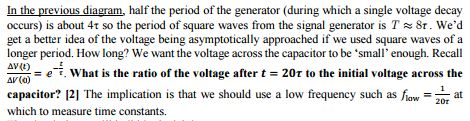
![volts coulomb coulomb Resistance. Capacitance]-[Resistance]. [Capacitance] time. Thus, the dimensions of RC are the dimensions of time. Since RC is also a charge/time constant, r RC is called the time constant of the circuit.) This constant is an important one: it controls the rate of discharge of the capacitor (through the resistor). Because 4V RI, the voltage across the capacitor is AV(t) RIoeT e AV (00eT (where Av(0) e Rlo) Av(t) AV(0)e F doesnt look as neat as 1(t) loe but it is the relation that youll verify experimentally. How can you change the time constant if the capacitance of the circuit is fixed? Ill. If we succeed in measuring the time constant during the experiment, well have verified that AV(t) AV(0)e T The relation AV(t) AV(0)e T says that the voltage drops asymptotically to zero as t oo We might ask the question: how long do we have to wait until the voltage across the capacitor is zero? but the answer will be After an infinite time Initially, how large is AV(t) After an AV(0) nfinitely long time, what is the value of AV(0) 121 Saying that the time t for AV(t) to be zero AV(t) (o) will be t oo is always true but doesnt allow us to see the fact that some voltage decays are very fast and others are slower. We can characterize the rate of voltage decay by saying how long we have to wait for AV(t) to become acertain fraction of its initial value. To pursue this, we need to recall that, AV(t) AV (0) AV(e) Suppose that we want to know how long we have to wait unti becomes Well call AV(0) 20 1/20 that time ti/2o and have This will allow us to solve for t Find t in 1/20 1/20 AV(o) terms of T. Will t be changed if the time constant for the circuit is increased? If it 1/20 changes, explain how. 12l The choice of the fraction is arbitrary. We could choose it to be and usually do when (0) dealing with radioactive decay. If we make this choice then the time for the voltage to fall to half of its initial value is called the half-life (and is written 1/2. There is a relation between AV(t) half-life and time constant that can be shown using e T. If t 1/2 then AV(o) AV(o) AV(t) e to show that t rln2. 1/2 Now use AV(o)](http://img.homeworklib.com/questions/5067c4c0-c1b1-11ea-a0d4-bd80a54ba7a2.png?x-oss-process=image/resize,w_560)
Homework Answers
The time constant of an RC circuit is given by Hence if
capacitance is fixed, the time constant can be varied by varying
thr resistance value.
While discharging the capacitor, The voltage V is given by
Hence V(0) =V0.
. After a long time, t=infinity, V(infinity)=0
.
t1/20 says that the capacitor is discharged 1/20 of its initial voltage.
Hence
On solving this, we get,
Yes if time constant increases, t1/20 increases by a
factor of ln(20)=3
Similarly, for t1/2 ,
. Hence on rearranging this like in the above expression, we get
.
at t>=5 time constants, the value of voltage approaches almost
zero. Hence at t=20 time constants, The voltage across the
capacitor is decayed mostlly and can be approximated to zero. Hence
the ratio will also be zero.
Add Answer to:
The questions I need help with are in bold
[Resistance-Capacitance] = [Resistance] middot [Capacitance] = volta/amp...
The relation Delta V(t) = Delta V(0)e^-t/tau says that the voltage drops asymptotically to zero as...
 The relation Delta V(t) = Delta V(0)e^-t/tau says that the voltage drops asymptotically to zero as t rightarrow infinity. We might ask the question: "how long do we have to wait until the voltage across the capacitor is zero?" but the answer will be "After an infinite time". Initially, how large is Delta V(t)/Delta V(0)? After an infinitely long time, what is the value of Delta V(t)/Delta V(0)? [2] Saying that "the time t for Delta V(t)/Delta V(0) to be...
A simply RC circuit made up of a capacitor with capacitance C and resistor with resistance...
A simply RC circuit made up of a capacitor with capacitance C and resistor with resistance R = 15 kΩ is attached to a battery with emf E = 24 V. If time constant is 25 µs, what is the capacitance C and the time it takes for the voltage across the capacitor to reach 16 V after the switch is closed at t = 0?
7 A circuit consists of a resistor of resistance R, and a capacitor of capacitance C,...
 7 A circuit consists of a resistor of resistance R, and a capacitor of capacitance C, connected in series, and is described by the first order differential equation - + y = E where E is the constant e.m.f. and v is the voltage across the capacitor. Given that v(O) = 0, show by using the integrating factor method that v = E(1 - e-t/(RC))
Determine the equivalent resistance R and the equivalent capacitance C
 In Circuit \(\mathrm{A}\) in Figure 3, each resistor has a resistance of \(1 \mathrm{k} \Omega\) and each capacitor has a capacitance of \(2 \mu \mathrm{F}\). Circuit A can be simplified to the equivalent Circuit B in Figure 3 .(a) Determine the equivalent resistance R and the equivalent capacitance C. Write your final answers in the blank spaces below Circuit B in Figure 3 .For the remainder of this question, refer to Circuit \(\mathrm{B}\). In Circuit \(\mathrm{B}\), the capacitor is allowed to charge...
A capacitor with capacitance C is charged to a voltage V and connected (with caution) across...
A capacitor with capacitance C is charged to a voltage V and connected (with caution) across a resistor R. After some time elapses, the voltage is less than half the original value. What determines how long it takes for this to happen. a.) the voltage V, and C but not R b.) the product of R and C c.) the fraction 1/RC d.) the ratio C/R
Problem 7 A resistor with resistance R, battery with voltage AV, capacitor with capacitance C, and...
 Problem 7 A resistor with resistance R, battery with voltage AV, capacitor with capacitance C, and switch are connected in series. The switch is closed at t = 0. The time constant of the circuit is T. What is the initial voltage across the resistor immediately after the student is closed? Select One of the Following: (a) o (b) AV (c) TAV (d) AV/T (e) AV/(R+C) Problem 8 A capacitor is charged to potential difference V and then allowed to...
8. Capacitance in circuits, RC circuits When a voltage source Vo is applied to a capacitor...
 8. Capacitance in circuits, RC circuits When a voltage source Vo is applied to a capacitor in a circuit which has a resistance R, a charge Q CV will build up across the capacitor. This does not happen instantaneously, but takes some time. The charge builds up exponentially with a characteristic time r = RC. Charging: V = v. 1 - e-t/RC) Discharging: Vc = V e-t/RC Page 2 of 3 When t = RC , the exponential is lle,...
RC Circuits If you have an RC circuit with a resistance of 200 ohms and a...
RC Circuits If you have an RC circuit with a resistance of 200 ohms and a capacitance of 35 microfarads, what is the time constant? Time Constant= ? s This time constant represents how much time it will take to reach 63% of maximum. If the RC circuit is connected to an EMF of 12.0 V, what will be its voltage after 5.0 ms? Voltage after 5.0 ms= ? V Draw what the voltage looks like in a charging RC...
Problem 4 Capacitor Voltage (V) vs Time (s) 140 120 100 e 80 60 40 20...
 Problem 4 Capacitor Voltage (V) vs Time (s) 140 120 100 e 80 60 40 20 10 Time (s) 20 15 This graph shows the voltage across a discharging capacitor, which follows the rule: 1.) Using the information in the graph, what is the value of Vo? 10 2.) What is the halftime for the voltage decay (the time at which the voltage reaches half its initial value)? Read the value from the graph to the nearest whole number of...
Experiment 7 - The Resistor Capacitor Circuit Learning Objectives: Understand the short and long time behavior...
 Experiment 7 - The Resistor Capacitor Circuit Learning Objectives: Understand the short and long time behavior of circuits containing capacitors. Understand the and the mathematical relationshin between the current through the circuit as a function time, resistance, capacitance, and potential difference 1. Understanding the models for the behavior of a capacitor in a circuit A capacitor is a device that stores energy in a circuit as potential energy in an electric field. In the simple circuit drawn on the night,...
 The relation Delta V(t) = Delta V(0)e^-t/tau says that the voltage drops asymptotically to zero as t rightarrow infinity. We might ask the question: "how long do we have to wait until the voltage across the capacitor is zero?" but the answer will be "After an infinite time". Initially, how large is Delta V(t)/Delta V(0)? After an infinitely long time, what is the value of Delta V(t)/Delta V(0)? [2] Saying that "the time t for Delta V(t)/Delta V(0) to be...
 7 A circuit consists of a resistor of resistance R, and a capacitor of capacitance C, connected in series, and is described by the first order differential equation - + y = E where E is the constant e.m.f. and v is the voltage across the capacitor. Given that v(O) = 0, show by using the integrating factor method that v = E(1 - e-t/(RC))
 In Circuit \(\mathrm{A}\) in Figure 3, each resistor has a resistance of \(1 \mathrm{k} \Omega\) and each capacitor has a capacitance of \(2 \mu \mathrm{F}\). Circuit A can be simplified to the equivalent Circuit B in Figure 3 .(a) Determine the equivalent resistance R and the equivalent capacitance C. Write your final answers in the blank spaces below Circuit B in Figure 3 .For the remainder of this question, refer to Circuit \(\mathrm{B}\). In Circuit \(\mathrm{B}\), the capacitor is allowed to charge...
 Problem 7 A resistor with resistance R, battery with voltage AV, capacitor with capacitance C, and switch are connected in series. The switch is closed at t = 0. The time constant of the circuit is T. What is the initial voltage across the resistor immediately after the student is closed? Select One of the Following: (a) o (b) AV (c) TAV (d) AV/T (e) AV/(R+C) Problem 8 A capacitor is charged to potential difference V and then allowed to...
 8. Capacitance in circuits, RC circuits When a voltage source Vo is applied to a capacitor in a circuit which has a resistance R, a charge Q CV will build up across the capacitor. This does not happen instantaneously, but takes some time. The charge builds up exponentially with a characteristic time r = RC. Charging: V = v. 1 - e-t/RC) Discharging: Vc = V e-t/RC Page 2 of 3 When t = RC , the exponential is lle,...
 Problem 4 Capacitor Voltage (V) vs Time (s) 140 120 100 e 80 60 40 20 10 Time (s) 20 15 This graph shows the voltage across a discharging capacitor, which follows the rule: 1.) Using the information in the graph, what is the value of Vo? 10 2.) What is the halftime for the voltage decay (the time at which the voltage reaches half its initial value)? Read the value from the graph to the nearest whole number of...
 Experiment 7 - The Resistor Capacitor Circuit Learning Objectives: Understand the short and long time behavior of circuits containing capacitors. Understand the and the mathematical relationshin between the current through the circuit as a function time, resistance, capacitance, and potential difference 1. Understanding the models for the behavior of a capacitor in a circuit A capacitor is a device that stores energy in a circuit as potential energy in an electric field. In the simple circuit drawn on the night,...
Most questions answered within 3 hours.
-
Where is the error in this code sequence?
String s1 = "Hello";
String s2 = "ello";...
asked 10 months ago -
Financial data for Joel de Paris, Inc., for last year
follow:
Joel de Paris, Inc.
Balance...
asked 10 months ago -
Consider this reaction:
Al2(SO4)3 (aq)+ BaCl3
(aq) Al2Cl6 (aq)- +
3BaSO4(s) . What is the...
asked 10 months ago -
Suppose that Savneet is considering increasing her
recent random sample from 20 car rentals to 40...
asked 10 months ago -
Trucks arrive at an unloading terminal at an average rate of 120
per hour.
Trucks arrive...
asked 10 months ago -
Why are methanol and ethanol completely soluble in water while
octanol is not very little soluble....
asked 10 months ago -
A facilities manager at a university reads in a research report
that the mean amount of...
asked 10 months ago -
When the CuSO4 is rehydrated by adding water to the anhydrous
compound, is this an endothermic...
asked 10 months ago -
A ray of sunlight is passing from diamond into crown glass; the
angle of incidence is...
asked 10 months ago -
A block of mass 0.249 kg is placed on top of a light, vertical
spring of...
asked 10 months ago -
how do the kidneys compensate in the presences of acidosis
a) trigger hyperventilate
b) reserve acid...
asked 10 months ago -
Question 501 pts
The rental rate of capital to the firm increases. Which of the
following...
asked 10 months ago