Recursive Descent Parsing Consider the following BNF grammar: A -> I = E E -> P...
Recursive Descent Parsing
Consider the following BNF grammar:
A -> I = E
E -> P O P | P
O -> + | - | * | / | **
P -> I | L | UI | UL | (E)
U -> + | - | !
I -> C | CI
C -> a | b | ... | y | z
L -> D | DL
D -> 0 | 1 | ... | 8 | 9
Using the technique described in class implement a recursive descent parser that recognizes strings in this language. Input should be from a file called input.txt and output should be to a file called output.txt. An example session might look like this (these strings are not necessarily in the language):
The string "a=a+b-c*d" is in the language.
The string "a=a//b++c" is not in the language.
You must implement the project in C++ Implementations that do not include a solution in language will, at best, receive half credit. To simplify things you will not have to handle whitespace when parsing the string, i.e. " " and similiar are illegal characters in this language. All strings should read from a file called "input.txt" and written to a file called "output.txt".
input.txt file will be
a=+0
a=!b
a=b+0
a=b++c
a=b**c
a=(((b)))
a=((b+c)*(d+e))
a=b+
a=b+c*d
a=b+c*d^e
a=(b+c)*(d+e))
a=((b+c)*(d+e)
Homework Answers


Add Answer to:
Recursive Descent Parsing
Consider the following BNF grammar:
A -> I = E
E -> P...
NEED THIS SOON. Recursive Descent Parsing Consider the following BNF grammar: A -> I = E...
NEED THIS SOON. Recursive Descent Parsing Consider the following BNF grammar: A -> I = E E -> P O P | P O -> + | - | * | / | ** P -> I | L | UI | UL | (E) U -> + | - | ! I -> C | CI C -> a | b | ... | y | z L -> D | DL D -> 0 | 1 | ......
If someone can help me with the recursive descent parsing, it woule be very helpful. This...
If someone can help me with the recursive descent parsing, it woule be very helpful. This problem should be completed with only c without using lex or yacc. Problem — LL(1) Grammars and Recursive Descent Parsing The Grammar:: <program> ::= program <block> . <block> ::= begin <stmtlist> end <stmtlist> ::= <stmt> <morestmts> <morestmts> ::= ; <stmtlist <stmt> ::= <assign> | <ifstmt> | <whilestmt> | <block> <assign> ::= <variable> = <expr> <ifstmt> ::= if <testexpr> then <stmt> else <stmt> <whilestmt> ::= while <testexpr> do <stmt> <testexpr>...
Problem I. Parsing. Consider the grammar SAg BC (1) A a A A CB B dBc...
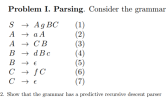 Problem I. Parsing. Consider the grammar SAg BC (1) A a A A CB B dBc 2. Show that the grammar has a predictive recursive descent parser
Please help me with the coding for LL(1)!! The given grammar was: P → PL |...
 Please help me with the coding for LL(1)!!
The given grammar was:
P → PL | L
L → N; | M; | C
N → print E
M → print "W"
W → TW | ε
C → if E {P} | if E {P} else {P}
E → (EOE) | V (note: this has a variable O)
O → + | - | * V → 0 | 1 | 2 | 3 (note: this has a terminal...
Please help me with the coding for LL(1)!!
The given grammar was:
P → PL | L
L → N; | M; | C
N → print E
M → print "W"
W → TW | ε
C → if E {P} | if E {P} else {P}
E → (EOE) | V (note: this has a variable O)
O → + | - | * V → 0 | 1 | 2 | 3 (note: this has a terminal...
(Do not forget to consider $) (€ stand for empty string) E → TE E' →+TE'...
 (Do not forget to consider $) (€ stand for empty string) E → TE E' →+TE' E T → FT T' → *FT' € F→ (E) id num 5.- ( 11 points) Armed with a predictive parsing table of question 4, it is easy to write a recursive- descent parser. Write, using pseudocode or C-syntax, the fragment of parser to parse l' and E'.
Please write a recursive descent parser (including a lexical analyzer) for the following EBNF in C....
Please write a recursive descent parser (including a lexical analyzer) for the following EBNF in C. Your program codes should be runnable. <exprs> -> <expr>; {<expr>;} <expr> -> <term> { (+ | -) <term> } <term> -> <factor> { (*|/ ) <factor> } <factor> -> <exp> {^ <exp>} <exp> -> id | int_lit | real_lit | (<expr>) where, ^ indicates the power operation, id is a legal identifier name, int_lit represents any positive integer number, and real_lit represents any positive...
Question 1 Consider the following BNF grammar: Not complete Marked out of 3.00 p Flag question...
 Question 1 Consider the following BNF grammar: Not complete Marked out of 3.00 p Flag question <letter> ::= "a" | "b" | "C" | "d" | "e" | "F" | "g" | "h" | "1" ";" | "K" | "1" | "m" | "n" | "0" | "p" | "q" | "r" | "S" | "t" || "u" | "V" | "W" | "x" | "y" | "z" <digit> ::= "O" | "1" | "2" | "3" | "4" |...
Consider the following BNF grammar that we saw in class: EXP ::= EXP + TERM ...
Consider the following BNF grammar that we saw in class: EXP ::= EXP + TERM | EXP - TERM | TERM TERM ::= TERM * FACTOR | TERM / FACTOR | FACTOR FACTOR ::= ( EXP ) | DIGIT DIGIT ::= 0 | 1 | 2 | 3 (a) Translate into EBNF. (b) Draw syntax diagrams. (c) What are the two requirements on a grammar for a predictive parser to be able to...
Let Σ = {0, 1). (a) Give a recursive definition of Σ., the set of strings from the alphabet Σ. (b) Prove that for every n E N there are 2" strings of length n in '. (c) Give a recursive d...
 Let Σ = {0, 1). (a) Give a recursive definition of Σ., the set of strings from the alphabet Σ. (b) Prove that for every n E N there are 2" strings of length n in '. (c) Give a recursive definition of I(s), the length of a string s E Σ For a bitstring s, let O(s) and I(s) be number of zeroes and ones, respectively, that occur in s. So for example if s = 01001, then 0(s)...
Q6) Consider the following grammar for arithmetic expressions. F ? (E) l i Using top-down parsing,...
 Q6) Consider the following grammar for arithmetic expressions. F ? (E) l i Using top-down parsing, find a leftmost derivation in this grammar for the expression i/i + . Show your work. 10 Points
 Problem I. Parsing. Consider the grammar SAg BC (1) A a A A CB B dBc 2. Show that the grammar has a predictive recursive descent parser
 Please help me with the coding for LL(1)!!
The given grammar was:
P → PL | L
L → N; | M; | C
N → print E
M → print "W"
W → TW | ε
C → if E {P} | if E {P} else {P}
E → (EOE) | V (note: this has a variable O)
O → + | - | * V → 0 | 1 | 2 | 3 (note: this has a terminal...
Please help me with the coding for LL(1)!!
The given grammar was:
P → PL | L
L → N; | M; | C
N → print E
M → print "W"
W → TW | ε
C → if E {P} | if E {P} else {P}
E → (EOE) | V (note: this has a variable O)
O → + | - | * V → 0 | 1 | 2 | 3 (note: this has a terminal...
 (Do not forget to consider $) (€ stand for empty string) E → TE E' →+TE' E T → FT T' → *FT' € F→ (E) id num 5.- ( 11 points) Armed with a predictive parsing table of question 4, it is easy to write a recursive- descent parser. Write, using pseudocode or C-syntax, the fragment of parser to parse l' and E'.
 Question 1 Consider the following BNF grammar: Not complete Marked out of 3.00 p Flag question <letter> ::= "a" | "b" | "C" | "d" | "e" | "F" | "g" | "h" | "1" ";" | "K" | "1" | "m" | "n" | "0" | "p" | "q" | "r" | "S" | "t" || "u" | "V" | "W" | "x" | "y" | "z" <digit> ::= "O" | "1" | "2" | "3" | "4" |...
 Let Σ = {0, 1). (a) Give a recursive definition of Σ., the set of strings from the alphabet Σ. (b) Prove that for every n E N there are 2" strings of length n in '. (c) Give a recursive definition of I(s), the length of a string s E Σ For a bitstring s, let O(s) and I(s) be number of zeroes and ones, respectively, that occur in s. So for example if s = 01001, then 0(s)...
 Q6) Consider the following grammar for arithmetic expressions. F ? (E) l i Using top-down parsing, find a leftmost derivation in this grammar for the expression i/i + . Show your work. 10 Points
Most questions answered within 3 hours.
-
Where is the error in this code sequence?
String s1 = "Hello";
String s2 = "ello";...
asked 11 months ago -
Financial data for Joel de Paris, Inc., for last year
follow:
Joel de Paris, Inc.
Balance...
asked 11 months ago -
Consider this reaction:
Al2(SO4)3 (aq)+ BaCl3
(aq) Al2Cl6 (aq)- +
3BaSO4(s) . What is the...
asked 11 months ago -
Suppose that Savneet is considering increasing her
recent random sample from 20 car rentals to 40...
asked 11 months ago -
Trucks arrive at an unloading terminal at an average rate of 120
per hour.
Trucks arrive...
asked 11 months ago -
Why are methanol and ethanol completely soluble in water while
octanol is not very little soluble....
asked 11 months ago -
A facilities manager at a university reads in a research report
that the mean amount of...
asked 11 months ago -
When the CuSO4 is rehydrated by adding water to the anhydrous
compound, is this an endothermic...
asked 11 months ago -
A ray of sunlight is passing from diamond into crown glass; the
angle of incidence is...
asked 11 months ago -
A block of mass 0.249 kg is placed on top of a light, vertical
spring of...
asked 11 months ago -
how do the kidneys compensate in the presences of acidosis
a) trigger hyperventilate
b) reserve acid...
asked 11 months ago -
Question 501 pts
The rental rate of capital to the firm increases. Which of the
following...
asked 11 months ago