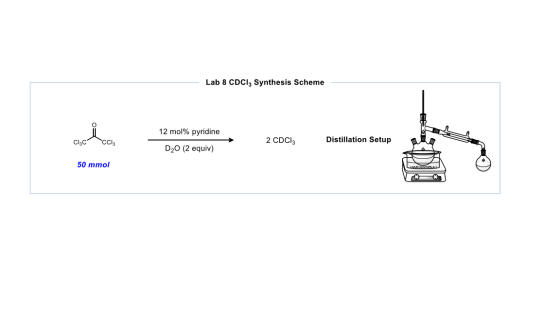
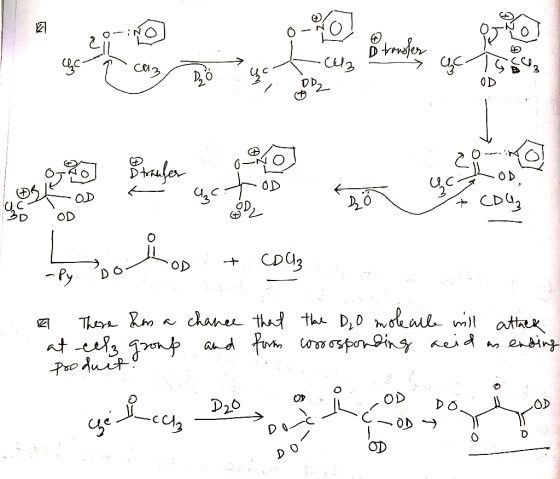
(1) Draw the mechanism for the transformation one molecule of hexachloroacetone to 2 molecules of CDCl3 in the presence of deuterated water (D2O) and pyridine.
(4) What are some byproducts of the reaction that may form?
Homework Answers
Add Answer to:
(1) Draw the mechanism for the transformation one molecule of
hexachloroacetone to 2 molecules of CDCl3...
Draw the mechanism for the transformation one molecule of hexachloroacetone to 2 molecules of CDCl3 in...
Draw the mechanism for the transformation one molecule of hexachloroacetone to 2 molecules of CDCl3 in the presence of deuterated water (D2O) and pyridine.
2-methylocta-4,6-dien-1-amine Assignment 1: Draw your molecule from IUPAC name
 2-methylocta-4,6-dien-1-amineAssignment 1: Draw your molecule from IUPAC
name Using the given IUPAC name, draw your molecule Complete the cover page (p.1) of your portfolio with the
following:o Structural formula of the moleculeo IUPAC name Use a thin, clear binder or report cover to protect the
portfolio Submit the following in the binder:o Cover page as described above (page 1)Assignment 2: Formula, Molar Mass and Functional
Groups On a page titled Expanded Structural Formula draw the expanded
structure of themolecule.o Show...
2-methylocta-4,6-dien-1-amineAssignment 1: Draw your molecule from IUPAC
name Using the given IUPAC name, draw your molecule Complete the cover page (p.1) of your portfolio with the
following:o Structural formula of the moleculeo IUPAC name Use a thin, clear binder or report cover to protect the
portfolio Submit the following in the binder:o Cover page as described above (page 1)Assignment 2: Formula, Molar Mass and Functional
Groups On a page titled Expanded Structural Formula draw the expanded
structure of themolecule.o Show...
Molecules 1 and 2 combine to form molecule 3 and the reaction proceeds faster in the...
Molecules 1 and 2 combine to form molecule 3 and the reaction proceeds faster in the presence of enzyme 4. Molecule 5 was found to block the formation of 3. You want to find out the mechanism of action of molecule 5 so you add more 1 and 2 to the mix. To your delight, the block of the formation of 3 is removed. Molecule 5... A. lowers the energy of activation needed for the reaction that combines 1 and...
Synthesis of cyclohexane lab 1) Draw the mechanism of the reaction (2) Explain how cyclohexene could...
Synthesis of cyclohexane lab 1) Draw the mechanism of the reaction (2) Explain how cyclohexene could form at the beginning of this reaction. Use a mechanism to support your answer. (3) Look up the IR spectra for cyclohexanol and cyclohexanone and discuss their key differences. Draw or attach the IR spectra. (4) Did you perform a ketone test? If so, discuss your results
1) Choose one molecule from the set and create an 8-step synthesis scheme using the chosen...
 1) Choose one molecule from the set and create an 8-step synthesis scheme using the chosen molecule as your starting material. You need to write the complete set of reagents and draw the product expected from each step. Reagents typically used together are considered one step, eg. 1) LAH 2) H.O should be considered as one step Your 8 steps must include at least one reaction from each of the chapters, aldehydes and ketones, carboxylic acid derivatives, alcohols. You can...
My molecule is 8-ethyldeca-2, 4- diene. Why is the following mechanism incorrect and what does the...
 My molecule is 8-ethyldeca-2, 4- diene. Why is the
following mechanism incorrect and what does the correct scheme look
like?
Incorrect Mechanism (The mechanism is for the formation of the 1,4 product. Please ignore the 1,2 product). mavo + H-Br - R Br Assignment 6: Mechanism Correction > On a page titled Incorrect Mechanism print the incorrect mechanism provided for your molecule on Blackboard. For the mechanism you will focus on the reaction of the portion of the molecule drawn...
My molecule is 8-ethyldeca-2, 4- diene. Why is the
following mechanism incorrect and what does the correct scheme look
like?
Incorrect Mechanism (The mechanism is for the formation of the 1,4 product. Please ignore the 1,2 product). mavo + H-Br - R Br Assignment 6: Mechanism Correction > On a page titled Incorrect Mechanism print the incorrect mechanism provided for your molecule on Blackboard. For the mechanism you will focus on the reaction of the portion of the molecule drawn...
Organic chemistry lab on Oxidation Puzzle Sample Questions 1. 2. 4. Write a mechanism for the...
 Organic chemistry lab on Oxidation Puzzle
Sample Questions 1. 2. 4. Write a mechanism for the reaction of 2-butanol with sodium hypochlorite in an acetic acid solution. Provide two disadvantages associated with using dichromate for the process of oxidation (i.e. justify why you will be using NaOCl instead of dichromate). What is the purpose of adding NaHSO, solution to the reaction? Draw all of the possible products which could form if two equivalents of NaOCI are used in the oxidation...
Organic chemistry lab on Oxidation Puzzle
Sample Questions 1. 2. 4. Write a mechanism for the reaction of 2-butanol with sodium hypochlorite in an acetic acid solution. Provide two disadvantages associated with using dichromate for the process of oxidation (i.e. justify why you will be using NaOCl instead of dichromate). What is the purpose of adding NaHSO, solution to the reaction? Draw all of the possible products which could form if two equivalents of NaOCI are used in the oxidation...
need help with the boxed bullet point. writing the chemical reaction scheme for the experiment. Synthesis of an A...
 need help with the boxed bullet point. writing the chemical
reaction scheme for the experiment.
Synthesis of an Alkyl Halide: A Nucleophilic Substitution Reaction, Part I Pre-lab Assignment for Synthesis of an Alkyl Halide: A Nucleophilic Substitution Reaction, Part 1 1. From The Organic Chem Lab Survival Manual ( edition) by Zubrick • Review pages 201-204: Standard Reflux. • Review pages 127-140: Extraction • Review pages 164-189: Distillation, Simple Distillation. The Distillation Example, and The Distillation Mistake. 2. Read this...
need help with the boxed bullet point. writing the chemical
reaction scheme for the experiment.
Synthesis of an Alkyl Halide: A Nucleophilic Substitution Reaction, Part I Pre-lab Assignment for Synthesis of an Alkyl Halide: A Nucleophilic Substitution Reaction, Part 1 1. From The Organic Chem Lab Survival Manual ( edition) by Zubrick • Review pages 201-204: Standard Reflux. • Review pages 127-140: Extraction • Review pages 164-189: Distillation, Simple Distillation. The Distillation Example, and The Distillation Mistake. 2. Read this...
Page 1 Synthesis using Carbonyl O-Substitution Chemistry Preamble This experiment involves the synthesis of target molecules...
 Page 1 Synthesis using Carbonyl O-Substitution Chemistry Preamble This experiment involves the synthesis of target molecules using a-substitution chemistry. You are assigned two target molecules, one of which is best synthesized by an alkylation approach, while the other is best synthesized by an addition or condensation approach. You must do the following: 1. Perform a retrosynthetic analysis on the two target molecules assigned to you. In each case the organic starting material (what you have to work backwards toward) depends...
Experiment Write Up Proposal You will write up a synthesis procedure for one reaction that could...
 Experiment Write Up Proposal You will write up a synthesis procedure for one reaction that could be potentially run in a face- to-face Chem 2321 lab session. Your proposal will include an introduction and procedure. The procedure will include step-by-step instructions for running the reaction (including reaction monitoring), work-up. (product isolation and purification), and analysis (characterization). You will need to include sample calculations for percent yield and provide sample spectra analysis. You must upload your proposal as a single document...
 2-methylocta-4,6-dien-1-amineAssignment 1: Draw your molecule from IUPAC
name Using the given IUPAC name, draw your molecule Complete the cover page (p.1) of your portfolio with the
following:o Structural formula of the moleculeo IUPAC name Use a thin, clear binder or report cover to protect the
portfolio Submit the following in the binder:o Cover page as described above (page 1)Assignment 2: Formula, Molar Mass and Functional
Groups On a page titled Expanded Structural Formula draw the expanded
structure of themolecule.o Show...
2-methylocta-4,6-dien-1-amineAssignment 1: Draw your molecule from IUPAC
name Using the given IUPAC name, draw your molecule Complete the cover page (p.1) of your portfolio with the
following:o Structural formula of the moleculeo IUPAC name Use a thin, clear binder or report cover to protect the
portfolio Submit the following in the binder:o Cover page as described above (page 1)Assignment 2: Formula, Molar Mass and Functional
Groups On a page titled Expanded Structural Formula draw the expanded
structure of themolecule.o Show...
 1) Choose one molecule from the set and create an 8-step synthesis scheme using the chosen molecule as your starting material. You need to write the complete set of reagents and draw the product expected from each step. Reagents typically used together are considered one step, eg. 1) LAH 2) H.O should be considered as one step Your 8 steps must include at least one reaction from each of the chapters, aldehydes and ketones, carboxylic acid derivatives, alcohols. You can...
 My molecule is 8-ethyldeca-2, 4- diene. Why is the
following mechanism incorrect and what does the correct scheme look
like?
Incorrect Mechanism (The mechanism is for the formation of the 1,4 product. Please ignore the 1,2 product). mavo + H-Br - R Br Assignment 6: Mechanism Correction > On a page titled Incorrect Mechanism print the incorrect mechanism provided for your molecule on Blackboard. For the mechanism you will focus on the reaction of the portion of the molecule drawn...
My molecule is 8-ethyldeca-2, 4- diene. Why is the
following mechanism incorrect and what does the correct scheme look
like?
Incorrect Mechanism (The mechanism is for the formation of the 1,4 product. Please ignore the 1,2 product). mavo + H-Br - R Br Assignment 6: Mechanism Correction > On a page titled Incorrect Mechanism print the incorrect mechanism provided for your molecule on Blackboard. For the mechanism you will focus on the reaction of the portion of the molecule drawn...
 Organic chemistry lab on Oxidation Puzzle
Sample Questions 1. 2. 4. Write a mechanism for the reaction of 2-butanol with sodium hypochlorite in an acetic acid solution. Provide two disadvantages associated with using dichromate for the process of oxidation (i.e. justify why you will be using NaOCl instead of dichromate). What is the purpose of adding NaHSO, solution to the reaction? Draw all of the possible products which could form if two equivalents of NaOCI are used in the oxidation...
Organic chemistry lab on Oxidation Puzzle
Sample Questions 1. 2. 4. Write a mechanism for the reaction of 2-butanol with sodium hypochlorite in an acetic acid solution. Provide two disadvantages associated with using dichromate for the process of oxidation (i.e. justify why you will be using NaOCl instead of dichromate). What is the purpose of adding NaHSO, solution to the reaction? Draw all of the possible products which could form if two equivalents of NaOCI are used in the oxidation...
 need help with the boxed bullet point. writing the chemical
reaction scheme for the experiment.
Synthesis of an Alkyl Halide: A Nucleophilic Substitution Reaction, Part I Pre-lab Assignment for Synthesis of an Alkyl Halide: A Nucleophilic Substitution Reaction, Part 1 1. From The Organic Chem Lab Survival Manual ( edition) by Zubrick • Review pages 201-204: Standard Reflux. • Review pages 127-140: Extraction • Review pages 164-189: Distillation, Simple Distillation. The Distillation Example, and The Distillation Mistake. 2. Read this...
need help with the boxed bullet point. writing the chemical
reaction scheme for the experiment.
Synthesis of an Alkyl Halide: A Nucleophilic Substitution Reaction, Part I Pre-lab Assignment for Synthesis of an Alkyl Halide: A Nucleophilic Substitution Reaction, Part 1 1. From The Organic Chem Lab Survival Manual ( edition) by Zubrick • Review pages 201-204: Standard Reflux. • Review pages 127-140: Extraction • Review pages 164-189: Distillation, Simple Distillation. The Distillation Example, and The Distillation Mistake. 2. Read this...
 Page 1 Synthesis using Carbonyl O-Substitution Chemistry Preamble This experiment involves the synthesis of target molecules using a-substitution chemistry. You are assigned two target molecules, one of which is best synthesized by an alkylation approach, while the other is best synthesized by an addition or condensation approach. You must do the following: 1. Perform a retrosynthetic analysis on the two target molecules assigned to you. In each case the organic starting material (what you have to work backwards toward) depends...
 Experiment Write Up Proposal You will write up a synthesis procedure for one reaction that could be potentially run in a face- to-face Chem 2321 lab session. Your proposal will include an introduction and procedure. The procedure will include step-by-step instructions for running the reaction (including reaction monitoring), work-up. (product isolation and purification), and analysis (characterization). You will need to include sample calculations for percent yield and provide sample spectra analysis. You must upload your proposal as a single document...
Most questions answered within 3 hours.
-
Where is the error in this code sequence?
String s1 = "Hello";
String s2 = "ello";...
asked 10 months ago -
Financial data for Joel de Paris, Inc., for last year
follow:
Joel de Paris, Inc.
Balance...
asked 10 months ago -
Consider this reaction:
Al2(SO4)3 (aq)+ BaCl3
(aq) Al2Cl6 (aq)- +
3BaSO4(s) . What is the...
asked 10 months ago -
Suppose that Savneet is considering increasing her
recent random sample from 20 car rentals to 40...
asked 10 months ago -
Trucks arrive at an unloading terminal at an average rate of 120
per hour.
Trucks arrive...
asked 10 months ago -
Why are methanol and ethanol completely soluble in water while
octanol is not very little soluble....
asked 10 months ago -
A facilities manager at a university reads in a research report
that the mean amount of...
asked 10 months ago -
When the CuSO4 is rehydrated by adding water to the anhydrous
compound, is this an endothermic...
asked 10 months ago -
A ray of sunlight is passing from diamond into crown glass; the
angle of incidence is...
asked 10 months ago -
A block of mass 0.249 kg is placed on top of a light, vertical
spring of...
asked 10 months ago -
how do the kidneys compensate in the presences of acidosis
a) trigger hyperventilate
b) reserve acid...
asked 10 months ago -
Question 501 pts
The rental rate of capital to the firm increases. Which of the
following...
asked 10 months ago