Molecules 1 and 2 combine to form molecule 3 and the reaction proceeds faster in the...
Molecules 1 and 2 combine to form molecule 3 and the reaction proceeds faster in the presence of enzyme 4. Molecule 5 was found to block the formation of 3. You want to find out the mechanism of action of molecule 5 so you add more 1 and 2 to the mix. To your delight, the block of the formation of 3 is removed. Molecule 5...
A. lowers the energy of activation needed for the reaction that combines 1 and 2 into 3.
B. is a noncompetitive inhibitor of enzyme 4.
C. binds to the same site on enzyme 4 as either 1 or 2 does.
D. binds to an allosteric site on enzyme 4.
E. is the same molecule as either 1 or 2.
Homework Answers
The correct answer is option C that is it binds to the same site on enzyme 4 as either 1 or 2.
Both 1 and 2 are substrates for enzyme 4 and molecule 5 is a competitive inhibitor of the same enzyme. When the substrate concentration is increased, it competes with the inhibitor molecule and binds to the active site and don't let inhibitor bind to the active site.
Add Answer to:
Molecules 1 and 2 combine to form molecule 3 and the reaction
proceeds faster in the...
Question 3 Answer saved Points out of 5 P Flag question FIND THE BEST FIT AMONG...
 Question 3 Answer saved Points out of 5 P Flag question FIND THE BEST FIT AMONG THE FOLLOWING PAIRS ENZYME SUBSTRATE COMPLEX ILLUSTRATES THE INDUCED FI MODEL OF OPERATION • ENZYME COMPETITIVE INHIBITION SUBSTRATE Choose... PREVENTS SUBSTRATE BINDING VIA ACTIVE SITE INVOLVES AN ALLOSTERIC MOLECULE OF INHIBITION ILLUSTRATES THE INDUCED FIT MODEL OF OPERATION LOWERS ACTIVATION ENERGY FOR A REACTION ALWAYS CONSUMED IN AN ENZYMATIC REACTION NONCOMPETITIVE INHIBITION
1 2 3 4 5 6 7 8 9 Part A Which of the following is/are...
 1
2
3
4
5
6
7
8
9
Part A Which of the following is/are means whereby a catalyst can lower the activation energy of a reaction? quantum tunneling decreasing the number of reactive molecules permanently binding substrates inefficient collisions altering the temperature within the cell to one appropriate for reactions to proceed Subrnit Request Answer Part A An enzyme Obinds substrates in a manner that facilitates the formation of product decreases the rate of a reaction. is always...
1
2
3
4
5
6
7
8
9
Part A Which of the following is/are means whereby a catalyst can lower the activation energy of a reaction? quantum tunneling decreasing the number of reactive molecules permanently binding substrates inefficient collisions altering the temperature within the cell to one appropriate for reactions to proceed Subrnit Request Answer Part A An enzyme Obinds substrates in a manner that facilitates the formation of product decreases the rate of a reaction. is always...
Question 1 2 pts How does a noncompetitive inhibitor decrease the rate of an enzyme-catalyzed reaction?...
 Question 1 2 pts How does a noncompetitive inhibitor decrease the rate of an enzyme-catalyzed reaction? by decreasing the free-energy change of the reaction catalyzed by the enzyme by binding to an allosteric site, thus changing the shape of the active site of the enzyme by binding to the active site of the enzyme, thus preventing binding of the normal substrate by binding to the substrate, thus changing its shape so that it no longer binds to the active site...
Reset Help noncompetitive enzyme irreversible acetylcholinesterase competitive active site 1. A inhibitor binds to a site...
 Reset Help noncompetitive enzyme irreversible acetylcholinesterase competitive active site 1. A inhibitor binds to a site on the enzyme that is not the active site. 2. Insecticides and nerve gases act as irreversible inhibitors of nerve conduction. an enzyme needed for 3. A inhibitor has a structure that is so similar to the substrate that it can bond to the enzyme just like the substrate. 4. Usually, an nhibitor forms a covalent bond with an amino acid side group within...
1. A catalyst enhances the reaction rate by: a. Adding energy to the reaction b. Increasing...
 1. A catalyst enhances the reaction rate by: a. Adding energy to the reaction b. Increasing the activation energy required for the reaction c. Reducing the activation energy required for the reaction d. Improving binding of the product to the active site 2. Numerical answer: During aerobic respiration how many ATP molecules are produced by the oxidation of a single molecule of pyruvate? 3. The trace elements magnesium and zinc, which are required for bacterial growth, are typically used as:...
0.01 M A PFK-1 wity 2 mM ATT 02 M AMT -2 MATT 0 1.0 20...
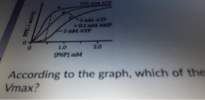 0.01 M A PFK-1 wity 2 mM ATT 02 M AMT -2 MATT 0 1.0 20 (RSP) MM According to the graph, which of the Vmax? According to the graph, which of the following best explains why curve C reaches AMP has a weak affinity for the regulatory site so ATP does not interfere with the reaction. ATP has a better affinity for the catalytic domain than the regulatory domain, thus binds in active site when concentrations of ATP are...
The enzyme phosphofructokinase-1 (PFK-1) catalyzes the 3rd reaction in glycolysis. When AMP concentrations are very high,...
The enzyme phosphofructokinase-1 (PFK-1) catalyzes the 3rd reaction in glycolysis. When AMP concentrations are very high, AMP binds to PFK-1, activating it. This is an example of: 1) competitive inhibition 2) allosteric activation 3) allosteric inhibition 4) direct feedback inhibition 5) end-product inhibition 6) both allosteric inhibition and end-product inhibition
The molecule 1, is well known mechanism based inhibitor for one of the PLP containing enzyme....
 The molecule 1, is well known mechanism based inhibitor for one of the PLP containing enzyme. The molecule can adopt either pathway A or B, and can lead to I or II adduct formation. One adduct was formed from 1 covalently linked to pyridoxal 5-phosphate (PLP) (I) while the other adduct was formed with the inhibitor covalently linked to Lysine246, the active site lysine. NH 0 o,po HN н. Lys HN Co.
12. Which of the following statements is true of enzyme catalysts? A B C To be...
 12. Which of the following statements is true of enzyme catalysts? A B C To be effective, they must be present at the same concentration as their substrate. They can increase the equilibrium constant for a given reaction by a thousand-fold or more. They lower the activation energy for conversion of substrate to product. Their catalytic activity is independent of pH. They are generally equally active on D and L isomers of a given substrate. D E 13. In competitive...
3. It is uncommon for one molecule to act as both an activator and inhibitor in...
 3. It is uncommon for one molecule to act as both an activator and inhibitor in metabolism. Which of the following molecules both activates glycolysis and inhibits gluconeogenesis? A. NAD B. Fructose 1,6-bisphosphate C. Pyruvate D. Fructose 2,6-bisphosphate E. Glucose 6-phosphate 4. Regulation of phosphorylase is by phosphorylation. However, this covalent modification increases or decreases activity without completely inhibiting it. The velocity plot is sigmoidal. What statement can be made about this enzyme? A. It likely follows a Michaelis-Menten kinetic....
 Question 3 Answer saved Points out of 5 P Flag question FIND THE BEST FIT AMONG THE FOLLOWING PAIRS ENZYME SUBSTRATE COMPLEX ILLUSTRATES THE INDUCED FI MODEL OF OPERATION • ENZYME COMPETITIVE INHIBITION SUBSTRATE Choose... PREVENTS SUBSTRATE BINDING VIA ACTIVE SITE INVOLVES AN ALLOSTERIC MOLECULE OF INHIBITION ILLUSTRATES THE INDUCED FIT MODEL OF OPERATION LOWERS ACTIVATION ENERGY FOR A REACTION ALWAYS CONSUMED IN AN ENZYMATIC REACTION NONCOMPETITIVE INHIBITION
 1
2
3
4
5
6
7
8
9
Part A Which of the following is/are means whereby a catalyst can lower the activation energy of a reaction? quantum tunneling decreasing the number of reactive molecules permanently binding substrates inefficient collisions altering the temperature within the cell to one appropriate for reactions to proceed Subrnit Request Answer Part A An enzyme Obinds substrates in a manner that facilitates the formation of product decreases the rate of a reaction. is always...
1
2
3
4
5
6
7
8
9
Part A Which of the following is/are means whereby a catalyst can lower the activation energy of a reaction? quantum tunneling decreasing the number of reactive molecules permanently binding substrates inefficient collisions altering the temperature within the cell to one appropriate for reactions to proceed Subrnit Request Answer Part A An enzyme Obinds substrates in a manner that facilitates the formation of product decreases the rate of a reaction. is always...
 Question 1 2 pts How does a noncompetitive inhibitor decrease the rate of an enzyme-catalyzed reaction? by decreasing the free-energy change of the reaction catalyzed by the enzyme by binding to an allosteric site, thus changing the shape of the active site of the enzyme by binding to the active site of the enzyme, thus preventing binding of the normal substrate by binding to the substrate, thus changing its shape so that it no longer binds to the active site...
 Reset Help noncompetitive enzyme irreversible acetylcholinesterase competitive active site 1. A inhibitor binds to a site on the enzyme that is not the active site. 2. Insecticides and nerve gases act as irreversible inhibitors of nerve conduction. an enzyme needed for 3. A inhibitor has a structure that is so similar to the substrate that it can bond to the enzyme just like the substrate. 4. Usually, an nhibitor forms a covalent bond with an amino acid side group within...
 1. A catalyst enhances the reaction rate by: a. Adding energy to the reaction b. Increasing the activation energy required for the reaction c. Reducing the activation energy required for the reaction d. Improving binding of the product to the active site 2. Numerical answer: During aerobic respiration how many ATP molecules are produced by the oxidation of a single molecule of pyruvate? 3. The trace elements magnesium and zinc, which are required for bacterial growth, are typically used as:...
 0.01 M A PFK-1 wity 2 mM ATT 02 M AMT -2 MATT 0 1.0 20 (RSP) MM According to the graph, which of the Vmax? According to the graph, which of the following best explains why curve C reaches AMP has a weak affinity for the regulatory site so ATP does not interfere with the reaction. ATP has a better affinity for the catalytic domain than the regulatory domain, thus binds in active site when concentrations of ATP are...
 The molecule 1, is well known mechanism based inhibitor for one of the PLP containing enzyme. The molecule can adopt either pathway A or B, and can lead to I or II adduct formation. One adduct was formed from 1 covalently linked to pyridoxal 5-phosphate (PLP) (I) while the other adduct was formed with the inhibitor covalently linked to Lysine246, the active site lysine. NH 0 o,po HN н. Lys HN Co.
 12. Which of the following statements is true of enzyme catalysts? A B C To be effective, they must be present at the same concentration as their substrate. They can increase the equilibrium constant for a given reaction by a thousand-fold or more. They lower the activation energy for conversion of substrate to product. Their catalytic activity is independent of pH. They are generally equally active on D and L isomers of a given substrate. D E 13. In competitive...
 3. It is uncommon for one molecule to act as both an activator and inhibitor in metabolism. Which of the following molecules both activates glycolysis and inhibits gluconeogenesis? A. NAD B. Fructose 1,6-bisphosphate C. Pyruvate D. Fructose 2,6-bisphosphate E. Glucose 6-phosphate 4. Regulation of phosphorylase is by phosphorylation. However, this covalent modification increases or decreases activity without completely inhibiting it. The velocity plot is sigmoidal. What statement can be made about this enzyme? A. It likely follows a Michaelis-Menten kinetic....
Most questions answered within 3 hours.
-
Where is the error in this code sequence?
String s1 = "Hello";
String s2 = "ello";...
asked 10 months ago -
Financial data for Joel de Paris, Inc., for last year
follow:
Joel de Paris, Inc.
Balance...
asked 10 months ago -
Consider this reaction:
Al2(SO4)3 (aq)+ BaCl3
(aq) Al2Cl6 (aq)- +
3BaSO4(s) . What is the...
asked 10 months ago -
Suppose that Savneet is considering increasing her
recent random sample from 20 car rentals to 40...
asked 10 months ago -
Trucks arrive at an unloading terminal at an average rate of 120
per hour.
Trucks arrive...
asked 10 months ago -
Why are methanol and ethanol completely soluble in water while
octanol is not very little soluble....
asked 10 months ago -
A facilities manager at a university reads in a research report
that the mean amount of...
asked 10 months ago -
When the CuSO4 is rehydrated by adding water to the anhydrous
compound, is this an endothermic...
asked 10 months ago -
A ray of sunlight is passing from diamond into crown glass; the
angle of incidence is...
asked 10 months ago -
A block of mass 0.249 kg is placed on top of a light, vertical
spring of...
asked 10 months ago -
how do the kidneys compensate in the presences of acidosis
a) trigger hyperventilate
b) reserve acid...
asked 10 months ago -
Question 501 pts
The rental rate of capital to the firm increases. Which of the
following...
asked 10 months ago