
Homework Answers
Add Answer to:
Be sure to answer all parts. Specify whether the oxides BaO and So, are acidic, basic,...
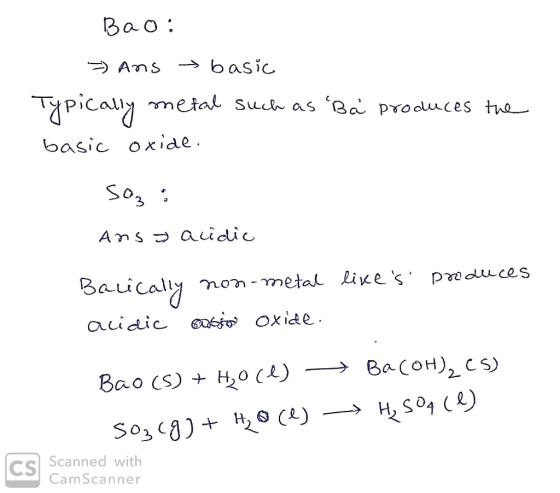
? acidic V basic ? amphoteric So3: acidic basic amphoteric Write a balanced molecular equation, including...
 ? acidic V basic ? amphoteric So3: acidic basic amphoteric Write a balanced molecular equation, including physical states, for the reaction of each oxide with excess water Bao(s ) + H 2 0(1) ?? ? SO 3 (g)+ H 200)-
Determine whether each of the following oxides is acidic, basic, or amphoteric. Use balanced chemical equations...
Determine whether each of the following oxides is acidic, basic, or amphoteric. Use balanced chemical equations to support your answer. (a) MgO (b) SO3 (c) Ga2O3 (d) Na2O (e) H2O (f) P4O10
6. Consider the oxides: SO2 and SrO (a) One is a basic oxide the other is...
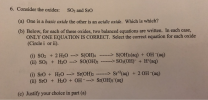 6. Consider the oxides: SO2 and SrO (a) One is a basic oxide the other is an acidic oxide. Which is which? (b) Below, for each of these oxides, two balanced equations are written. In each case, ONLY ONE EQUATION IS CORRECT. Select the correct equation for each oxide (Circle i or ii). (i) SO2 + 2 H20 s(OH) S(OH)s(a) + OH -(aq) (ii) SO2 + H20 > SO(O)2> SO2(OH) H*(aq) i) SrO+ H2O >Sr(OH)2Sr (aq) 2 OH (aq) (ii)...
For these three oxides, state whether each one is acidic, basic or amphoteric. Explain how cation...
For these three oxides, state whether each one is acidic, basic or amphoteric. Explain how cation oxidation state can be used to help predict acid/base behavior. CrO CrO3 Cr2O3 (a) Briefly explain what amphoterism means; (b) Choose an amphoteric molecular compound and indicate its chemical reaction with an acid and with a base.
9. State whether the following oxides are acidic, basic, neutral, or amphoteric: CO2, P2O5, SO3, MgO,...
9. State whether the following oxides are acidic, basic, neutral, or amphoteric: CO2, P2O5, SO3, MgO, K2O, Al2O3, CO. 10. Preferably without consulting reference material, write out the halogens as they appear in the periodic table, and indicate the trends in (a) physical state (s, l, or g) at room temperature and pressure, (b) electronegativity, (c) hardness of the halide ion, (d) colour.
Queston 3 (or2 Question 9 (of 22) Be sure to answer all parts. Write a balanced...
 Queston 3 (or2 Question 9 (of 22) Be sure to answer all parts. Write a balanced equation (including physical states) for the following reaction: Sodium carbonate, upon heating, produces sodium oxide and carbon dioxide.
please answer all parts of this question and explain everything 1. a. Using Pauling's Rules estimate...
 please answer all parts of this question and explain
everything
1. a. Using Pauling's Rules estimate the pkı values for each of the following acids. List the following acids in order of acid strength in aqueous solution: HRcO4 HzSbO4 H2SO3 H2SO4 b. Which of the following oxides are likely to be acidic, basic or amphoteric? Write balanced equations for their reaction with water and acid or base if amphoteric). i) As2O3 ii) TeO2 ill) VO
please answer all parts of this question and explain
everything
1. a. Using Pauling's Rules estimate the pkı values for each of the following acids. List the following acids in order of acid strength in aqueous solution: HRcO4 HzSbO4 H2SO3 H2SO4 b. Which of the following oxides are likely to be acidic, basic or amphoteric? Write balanced equations for their reaction with water and acid or base if amphoteric). i) As2O3 ii) TeO2 ill) VO
help! Be sure to answer all parts. Enter a net ionic equation for the following reaction...
 help!
Be sure to answer all parts. Enter a net ionic equation for the following reaction (including states of matter): CaCl2(aq) + MnSO4(aq) → Write the net ionic equation (including physical states) for the reaction of NaBr(ag) with AgNO3(aq). Click in the answer box to activate the palette. Be sure to answer all parts. Calculate the number of g of o, that will react with 6.28 mol of CzHg. Enter your answer in scientific notation. The balanced equation is: C3Hg(8)...
help!
Be sure to answer all parts. Enter a net ionic equation for the following reaction (including states of matter): CaCl2(aq) + MnSO4(aq) → Write the net ionic equation (including physical states) for the reaction of NaBr(ag) with AgNO3(aq). Click in the answer box to activate the palette. Be sure to answer all parts. Calculate the number of g of o, that will react with 6.28 mol of CzHg. Enter your answer in scientific notation. The balanced equation is: C3Hg(8)...
Be sure to answer all parts. Determine whether each salt forms an acidic, basic, or neutral...
 Be sure to answer all parts. Determine whether each salt forms an acidic, basic, or neutral solution when it dissolves in water. a. NaI (select) b. NHANO3 (select) с. MgBr> (select) TABLE 91 Relative Strength of Acids and Their Conjugate Bases
71, Rank the following oxides in terms of acidity from least (#1) to most (#5) acidic(3)....
 71, Rank the following oxides in terms of acidity from least (#1) to most (#5) acidic(3). Cs2O Al203 C2O P2Os Oxide Rank Li20 Pick one of the above examples and write a balanced equation for its reaction with water (2). Ilustrate how it reacts (mechanistically - use curly arrows to show electron movement) with water to form either an acid or a base(2). Be sure to include all electrons in your Lewis structures /5 2. Rank the following cations in...
 ? acidic V basic ? amphoteric So3: acidic basic amphoteric Write a balanced molecular equation, including physical states, for the reaction of each oxide with excess water Bao(s ) + H 2 0(1) ?? ? SO 3 (g)+ H 200)-
 6. Consider the oxides: SO2 and SrO (a) One is a basic oxide the other is an acidic oxide. Which is which? (b) Below, for each of these oxides, two balanced equations are written. In each case, ONLY ONE EQUATION IS CORRECT. Select the correct equation for each oxide (Circle i or ii). (i) SO2 + 2 H20 s(OH) S(OH)s(a) + OH -(aq) (ii) SO2 + H20 > SO(O)2> SO2(OH) H*(aq) i) SrO+ H2O >Sr(OH)2Sr (aq) 2 OH (aq) (ii)...
 Queston 3 (or2 Question 9 (of 22) Be sure to answer all parts. Write a balanced equation (including physical states) for the following reaction: Sodium carbonate, upon heating, produces sodium oxide and carbon dioxide.
 please answer all parts of this question and explain
everything
1. a. Using Pauling's Rules estimate the pkı values for each of the following acids. List the following acids in order of acid strength in aqueous solution: HRcO4 HzSbO4 H2SO3 H2SO4 b. Which of the following oxides are likely to be acidic, basic or amphoteric? Write balanced equations for their reaction with water and acid or base if amphoteric). i) As2O3 ii) TeO2 ill) VO
please answer all parts of this question and explain
everything
1. a. Using Pauling's Rules estimate the pkı values for each of the following acids. List the following acids in order of acid strength in aqueous solution: HRcO4 HzSbO4 H2SO3 H2SO4 b. Which of the following oxides are likely to be acidic, basic or amphoteric? Write balanced equations for their reaction with water and acid or base if amphoteric). i) As2O3 ii) TeO2 ill) VO
 help!
Be sure to answer all parts. Enter a net ionic equation for the following reaction (including states of matter): CaCl2(aq) + MnSO4(aq) → Write the net ionic equation (including physical states) for the reaction of NaBr(ag) with AgNO3(aq). Click in the answer box to activate the palette. Be sure to answer all parts. Calculate the number of g of o, that will react with 6.28 mol of CzHg. Enter your answer in scientific notation. The balanced equation is: C3Hg(8)...
help!
Be sure to answer all parts. Enter a net ionic equation for the following reaction (including states of matter): CaCl2(aq) + MnSO4(aq) → Write the net ionic equation (including physical states) for the reaction of NaBr(ag) with AgNO3(aq). Click in the answer box to activate the palette. Be sure to answer all parts. Calculate the number of g of o, that will react with 6.28 mol of CzHg. Enter your answer in scientific notation. The balanced equation is: C3Hg(8)...
 Be sure to answer all parts. Determine whether each salt forms an acidic, basic, or neutral solution when it dissolves in water. a. NaI (select) b. NHANO3 (select) с. MgBr> (select) TABLE 91 Relative Strength of Acids and Their Conjugate Bases
 71, Rank the following oxides in terms of acidity from least (#1) to most (#5) acidic(3). Cs2O Al203 C2O P2Os Oxide Rank Li20 Pick one of the above examples and write a balanced equation for its reaction with water (2). Ilustrate how it reacts (mechanistically - use curly arrows to show electron movement) with water to form either an acid or a base(2). Be sure to include all electrons in your Lewis structures /5 2. Rank the following cations in...
Most questions answered within 3 hours.
-
Where is the error in this code sequence?
String s1 = "Hello";
String s2 = "ello";...
asked 10 months ago -
Financial data for Joel de Paris, Inc., for last year
follow:
Joel de Paris, Inc.
Balance...
asked 10 months ago -
Consider this reaction:
Al2(SO4)3 (aq)+ BaCl3
(aq) Al2Cl6 (aq)- +
3BaSO4(s) . What is the...
asked 10 months ago -
Suppose that Savneet is considering increasing her
recent random sample from 20 car rentals to 40...
asked 10 months ago -
Trucks arrive at an unloading terminal at an average rate of 120
per hour.
Trucks arrive...
asked 10 months ago -
Why are methanol and ethanol completely soluble in water while
octanol is not very little soluble....
asked 10 months ago -
A facilities manager at a university reads in a research report
that the mean amount of...
asked 10 months ago -
When the CuSO4 is rehydrated by adding water to the anhydrous
compound, is this an endothermic...
asked 10 months ago -
A ray of sunlight is passing from diamond into crown glass; the
angle of incidence is...
asked 10 months ago -
A block of mass 0.249 kg is placed on top of a light, vertical
spring of...
asked 10 months ago -
how do the kidneys compensate in the presences of acidosis
a) trigger hyperventilate
b) reserve acid...
asked 10 months ago -
Question 501 pts
The rental rate of capital to the firm increases. Which of the
following...
asked 10 months ago