e) Explain why the tax multiplier is smaller than the fiscal multiplier. f) If you were...
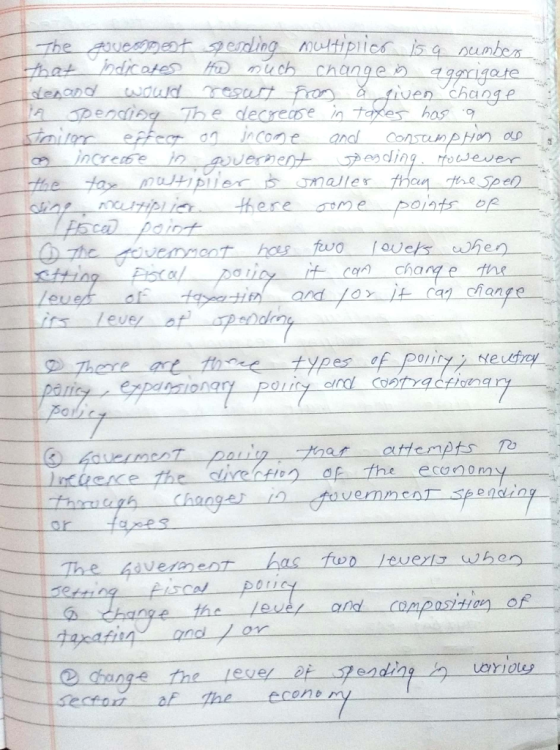
e) Explain why the tax multiplier is smaller than the fiscal multiplier.
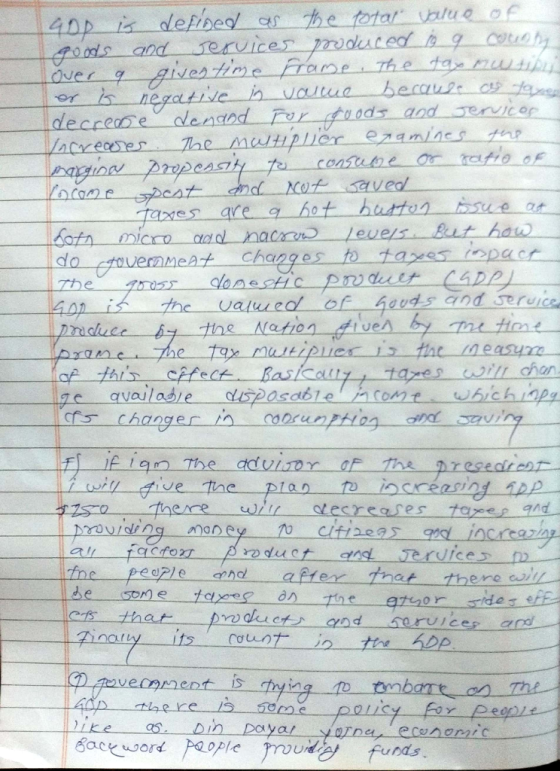
f) If you were the economic advisor to the president, which policy will you propose to the president to achieve the $250 increase in GDP target? Increase in government spending or tax cut? Why?
g) What policy is the government trying to embark on?
Homework Answers
Add Answer to:
e) Explain why the tax multiplier is smaller than the fiscal
multiplier.
f) If you were...
1. Suppose the MPC is 0.8 and the crowding out effect is $30 billion. The government...
1. Suppose the MPC is 0.8 and the crowding out effect is $30 billion. The government aims to increase GDP by $250 billion. a) Calculate the fiscal multiplier b) how much the government needs to increase spending to increase GDP by $250 billion c) Calculate the tax cut multiplier, d) How much the government needs to cut taxes to increase GDP by $250 billion? e) Explain why the tax multiplier is smaller than the fiscal multiplier. f) If you were...
Why is the multiplier for a change in taxes smaller than for a change in spending?...
 Why is the multiplier for a change in taxes smaller than for a change in spending? a. A change in taxes has no effect on aggregate demand, only on aggregate supply. b. A change in taxes directly affects government spending as well, lowering the multiplier. c. A change in taxes affects spending directly, but at a slower rate than spending does. d. A change in taxes affects disposable income and then consumption rather than spending directly. e. All of the...
22. Why is the multiplier for a change in taxes smaller than for a change in spendi...
22. Why is the multiplier for a change in taxes smaller than for a change in spending? a. A change in taxes has no effect on aggregate demand, only on aggregate supply. b. A change in taxes directly affects government spending as well, lowering the multiplier. c. A change in taxes affects spending directly, but at a slower rate than spending does. d. A change in taxes affects disposable income and then consumption rather than spending directly....
1. When countries have severe debt problems: fiscal policy is an especially good idea. expansionary fiscal...
1. When countries have severe debt problems: fiscal policy is an especially good idea. expansionary fiscal policy can reduce real growth. it makes no difference for fiscal policy. they can continue to borrow forever without any adverse consequences. 2. Increases in government spending financed through additional borrowing will typically: lead to higher taxes. lead to higher interest rates. stimulate both consumption and investment. provide more stimulus than when government spending is financed through higher taxes. 3. In a recession, automatic...
3. In early 2009, economists estimated a spending multiplier m- 1.5, and they also concluded that GDP had fell 2.1 trillion dollars below the "full employment GDP". The new government the...
 3. In early 2009, economists estimated a spending multiplier m- 1.5, and they also concluded that GDP had fell 2.1 trillion dollars below the "full employment GDP". The new government then managed to pass through Congress a fiscal stimulus package amounting to about 0.75 trillion dollars of new spending composed of new government purchases and tax cuts in approximately equal parts. Would you expect this new spending to be sufficient to bridge the gap between actual and potential GDP? (In...
assume the following applies to a country: y= 10,000 C= 8,000 S= 1,000 G= 1,000 T=...
assume the following applies to a country: y= 10,000 C= 8,000 S= 1,000 G= 1,000 T= 0 Assume that households consume 90 percent of their income and save 10 percenr of their income. That is C= .9YD and S= .1YD. 1) If 10,000 is full employment equilibrium level of Y, what fiscal policy would you recommend? be specific on the amount of change in fiscal policy . 2) if full employment GDP is 22,000 what fiscal policy would you recommend?...
36 37 Fiscal policy refers to changes in A) state and local taxes and purchases that...
 36 37 Fiscal policy refers to changes in A) state and local taxes and purchases that are intended to achieve macroeconomic policy objectives. B) federal taxes and purchases that are intended to achieve macroeconomic policy objectives. C) federal taxes and purchases that are intended to fund the war on terrorism. D) the money supply and interest rates that are intended to achieve macroeconomic policy objectives. 3957 Which of the following is an objective of fiscal policy? A) energy independence from...
Suppose that the consumption function is C = 14 + 0.8Yd, the investment is fixed at...
Suppose that the consumption function is C = 14 + 0.8Yd, the investment is fixed at 12, and the government spending is equal to 10. Yd denotes the aggregate disposable income. The tax imposed is also equal to 10 and fixed. (1) Solve the equilibrium GDP. (2) How large is the fiscal multiplier, ∆Y/∆G? (3) Explain economically why the fiscal multiplier is greater than 1. Suppose next that taxes are imposed proportionally to the aggregate income, Y , with a...
Fiscal policy is the governments tax and spend policy. It is called discretionary fiscal policy because...
Fiscal policy is the governments tax and spend policy. It is called discretionary fiscal policy because it is at the discretion of Congress. All money bills originate in the House of Representatives. The basis of fiscal policy is the GDP (Gross Domestic Product) model which is also known as the aggregate expenditures model----GDP=C+Ig+Xn+G. This is supposed to measure the dollar amount of all goods and services produced in this country in one year. The C is consumer spending---that's you and me...
14. (2 pt) Explain the effect of a discretionary cut in taxes of $40 billion on...
 14. (2 pt) Explain the effect of a discretionary cut in taxes of $40 billion on the economy when the economy's MPC is .75. How does this discretionary fiscal policy differ from a discretionary increase in government spending of $40 billion? A tax cut of $40 billion will result in initial increase in consumption of S billion). (Note that $10Bil. is saved based on marginal propensity to save (MPS), that is 25 (because 1-MPC-MPS). Then .25 x $40-$10 billion). This...
 Why is the multiplier for a change in taxes smaller than for a change in spending? a. A change in taxes has no effect on aggregate demand, only on aggregate supply. b. A change in taxes directly affects government spending as well, lowering the multiplier. c. A change in taxes affects spending directly, but at a slower rate than spending does. d. A change in taxes affects disposable income and then consumption rather than spending directly. e. All of the...
 3. In early 2009, economists estimated a spending multiplier m- 1.5, and they also concluded that GDP had fell 2.1 trillion dollars below the "full employment GDP". The new government then managed to pass through Congress a fiscal stimulus package amounting to about 0.75 trillion dollars of new spending composed of new government purchases and tax cuts in approximately equal parts. Would you expect this new spending to be sufficient to bridge the gap between actual and potential GDP? (In...
 36 37 Fiscal policy refers to changes in A) state and local taxes and purchases that are intended to achieve macroeconomic policy objectives. B) federal taxes and purchases that are intended to achieve macroeconomic policy objectives. C) federal taxes and purchases that are intended to fund the war on terrorism. D) the money supply and interest rates that are intended to achieve macroeconomic policy objectives. 3957 Which of the following is an objective of fiscal policy? A) energy independence from...
 14. (2 pt) Explain the effect of a discretionary cut in taxes of $40 billion on the economy when the economy's MPC is .75. How does this discretionary fiscal policy differ from a discretionary increase in government spending of $40 billion? A tax cut of $40 billion will result in initial increase in consumption of S billion). (Note that $10Bil. is saved based on marginal propensity to save (MPS), that is 25 (because 1-MPC-MPS). Then .25 x $40-$10 billion). This...
Most questions answered within 3 hours.
-
Where is the error in this code sequence?
String s1 = "Hello";
String s2 = "ello";...
asked 10 months ago -
Financial data for Joel de Paris, Inc., for last year
follow:
Joel de Paris, Inc.
Balance...
asked 10 months ago -
Consider this reaction:
Al2(SO4)3 (aq)+ BaCl3
(aq) Al2Cl6 (aq)- +
3BaSO4(s) . What is the...
asked 10 months ago -
Suppose that Savneet is considering increasing her
recent random sample from 20 car rentals to 40...
asked 10 months ago -
Trucks arrive at an unloading terminal at an average rate of 120
per hour.
Trucks arrive...
asked 10 months ago -
Why are methanol and ethanol completely soluble in water while
octanol is not very little soluble....
asked 10 months ago -
A facilities manager at a university reads in a research report
that the mean amount of...
asked 10 months ago -
When the CuSO4 is rehydrated by adding water to the anhydrous
compound, is this an endothermic...
asked 10 months ago -
A ray of sunlight is passing from diamond into crown glass; the
angle of incidence is...
asked 10 months ago -
A block of mass 0.249 kg is placed on top of a light, vertical
spring of...
asked 10 months ago -
how do the kidneys compensate in the presences of acidosis
a) trigger hyperventilate
b) reserve acid...
asked 10 months ago -
Question 501 pts
The rental rate of capital to the firm increases. Which of the
following...
asked 10 months ago