
Homework Answers
Add Answer to:
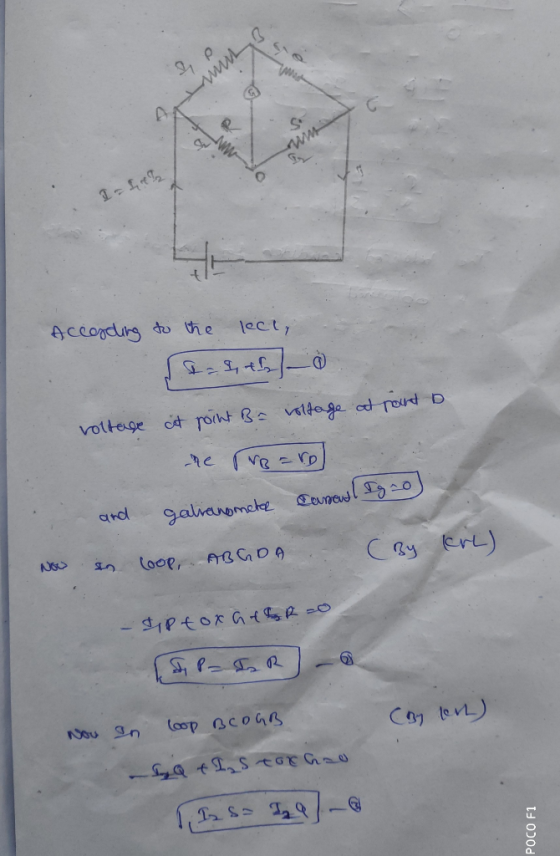
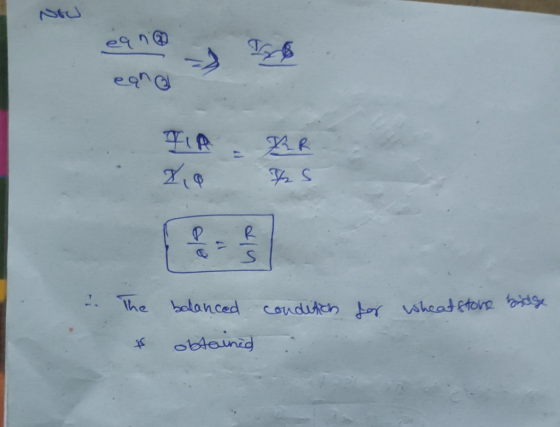
3. The figure below is Wheatstone bridge. What will be the balancing condition? Drive equation by...
7.- The Wheatstone Bridge. The circuit shown in the figure, called a Wheatstone bridge, is used...
 7.- The Wheatstone Bridge. The circuit shown in the figure, called a Wheatstone bridge, is used to determine the value of an unknown resistor \(X\) by comparison with three resistors \(M, N\), and \(P\) whose resistances can be varied. For each setting, the resistance of each resistor is precisely known. With switches \(K_{1}\) and \(K_{2}\) closed, these resistors are varied until the current in the galvanometer \(G\) is zero; the bridge is then said to be balanced. (a) Show that...
ELE 2603 Signal Conditioning Exercises 37. A Wheatstone bridge is shown in the figure below is...
 ELE 2603 Signal Conditioning Exercises 37. A Wheatstone bridge is shown in the figure below is used to find the resistance of temp sensor. In this bridge R1- 300 n, R2 350 0,R3- 450 Q and Rx 100n is the sensor wire resistance. What is the value of temperature that nulls the bridge if the sensor has a transfer function of 5 0/°C. Vcc 1V R1 R2 V2 V1 Rx R3 R4 Sensor Answer: 38. A Wheatstone bridge is shown...
7.13. Consider the Wheatstone bridge circuit in Figure 7.8 with R 1000 Ω (a) If AR is 100 Ω, what is the percent error in VoUT that arises from using the linear approximation in Equation (7.10) versu...
 7.13. Consider the Wheatstone bridge circuit in Figure 7.8 with R 1000 Ω (a) If AR is 100 Ω, what is the percent error in VoUT that arises from using the linear approximation in Equation (7.10) versus the exact expression in Equation (79)? (b) Repeat for AR-500 Ω. Ry L1 Vpc VouT VB Rf Wheatstone bridge circuit used to interface a resistive sensor. FIGURE 7.8
7.13. Consider the Wheatstone bridge circuit in Figure 7.8 with R 1000 Ω (a) If...
7.13. Consider the Wheatstone bridge circuit in Figure 7.8 with R 1000 Ω (a) If AR is 100 Ω, what is the percent error in VoUT that arises from using the linear approximation in Equation (7.10) versus the exact expression in Equation (79)? (b) Repeat for AR-500 Ω. Ry L1 Vpc VouT VB Rf Wheatstone bridge circuit used to interface a resistive sensor. FIGURE 7.8
7.13. Consider the Wheatstone bridge circuit in Figure 7.8 with R 1000 Ω (a) If...
An RTD forms one arm of a Wheatstone bridge, as shown in Figure below.
 An RTD forms one arm of a Wheatstone bridge, as shown in Figure below. The RTD in a balanced is used to measure a constant temperature, with the bridge operated mode. The RTD has a resistance of 25 V at a temperature of 0°C, and a thermal coefficient of resistance, α= 0.003925°C, The value of the variable resistance R1 must be set to 37 V to balance the bridge circuit. (1) Determine the temperature of the RTD. (2) Compare this circuit to the...
7.13. Consider the Wheatstone bridge circuit in Figure 7.8 with R,- 1000 Ω. (a) IfAR is...
 7.13. Consider the Wheatstone bridge circuit in Figure 7.8 with R,- 1000 Ω. (a) IfAR is 100 Ω, what is the percent error in VOUT that arises from using the linear approximation in Equation (7.10 we
36) The parameters for the unbalanced Wheatstone Bridge is shown below. The current value of the...
 36) The parameters for the unbalanced Wheatstone Bridge is shown below. The current value of the 1K potentiometer is at 50%. (Center Position) What direction should the potentiometer be turned to achieve a balanced Wheatstone Bridge Vsl 12 V R1 120 R2=100 R3- 220 R3 RL R2 R4 50% A)Less than 50% C) It should remain at 50% B) Greater than 50% D) It cannot be balanced with this Potentiometer 37) The parameters for the unbalanced Wheatstone Bridge is shown...
Consider the pressure measurement system shown in Figure 3.22. The Wheatstone bridge of the pressure transducer...
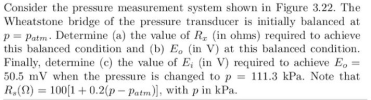 Consider the pressure measurement system shown in Figure 3.22. The Wheatstone bridge of the pressure transducer is intially balanced at p Patm. Determine (a) the value of R (in ohms) required to achieve this balanced condition and (b) E。 (in V) at this balanced condition. Finally, determine (c) the value of Ei (in V) required to achieve EO- 50.5 mV when the pressure is changed to p = 111.3 kPa. Note that Rs(Ω) 1001 + 0.2(p-patrn), with p in kPa.
Question 9 Given the Wheatstone bridge circuit in the figure below, determine VthA in Voits M...
 Question 9 Given the Wheatstone bridge circuit in the figure below, determine VthA in Voits M the Thevenin voltage source for the branch A The unit must be given with along with the nuneric answer Vs 10 V R1 100 Ohm R2 275 Ohm R3 200 Ohm R4 150 Ohm RL = 956 Ohm R, R. Δ Moving to another question wil save this response
Q.2. (a) From the data given below, the fastest and the slowest photoconductive cells are used in a Wheatstone bridge as shown in the adjoining figure. What will be the output voltage of the circuit...
 Q.2. (a) From the data given below, the fastest and the slowest photoconductive cells are used in a Wheatstone bridge as shown in the adjoining figure. What will be the output voltage of the circuit 10"sec after the same amount of light falls on both the photoconductors? Nar Photo- Time conductor Constant Resistance light CdS CdSe PbS PbSe Dark Resistance in | 30 kΩ | 30 kΩ po쓰 100ms | 100 kΩ 10ms 400us 100 k(2 | 200 kΩ |...
The setup below is designed to test the bending properties of a bome. A half Wheatstone bridge is...
 The setup below is designed to test the bending properties of
a bome. A half Wheatstone bridge is used to measure the strain
absolom induced in thr bending of the bone.
a)
b)
12. The setup below is designed to test the bending properties of a bone. A half Wheatstone bridge is used to measure the strain s induced in the bending of the bone. The resistance of the strain gages RG R when the strain is zero. (a) Derive...
The setup below is designed to test the bending properties of
a bome. A half Wheatstone bridge is used to measure the strain
absolom induced in thr bending of the bone.
a)
b)
12. The setup below is designed to test the bending properties of a bone. A half Wheatstone bridge is used to measure the strain s induced in the bending of the bone. The resistance of the strain gages RG R when the strain is zero. (a) Derive...
 7.- The Wheatstone Bridge. The circuit shown in the figure, called a Wheatstone bridge, is used to determine the value of an unknown resistor \(X\) by comparison with three resistors \(M, N\), and \(P\) whose resistances can be varied. For each setting, the resistance of each resistor is precisely known. With switches \(K_{1}\) and \(K_{2}\) closed, these resistors are varied until the current in the galvanometer \(G\) is zero; the bridge is then said to be balanced. (a) Show that...
 ELE 2603 Signal Conditioning Exercises 37. A Wheatstone bridge is shown in the figure below is used to find the resistance of temp sensor. In this bridge R1- 300 n, R2 350 0,R3- 450 Q and Rx 100n is the sensor wire resistance. What is the value of temperature that nulls the bridge if the sensor has a transfer function of 5 0/°C. Vcc 1V R1 R2 V2 V1 Rx R3 R4 Sensor Answer: 38. A Wheatstone bridge is shown...
 7.13. Consider the Wheatstone bridge circuit in Figure 7.8 with R 1000 Ω (a) If AR is 100 Ω, what is the percent error in VoUT that arises from using the linear approximation in Equation (7.10) versus the exact expression in Equation (79)? (b) Repeat for AR-500 Ω. Ry L1 Vpc VouT VB Rf Wheatstone bridge circuit used to interface a resistive sensor. FIGURE 7.8
7.13. Consider the Wheatstone bridge circuit in Figure 7.8 with R 1000 Ω (a) If...
7.13. Consider the Wheatstone bridge circuit in Figure 7.8 with R 1000 Ω (a) If AR is 100 Ω, what is the percent error in VoUT that arises from using the linear approximation in Equation (7.10) versus the exact expression in Equation (79)? (b) Repeat for AR-500 Ω. Ry L1 Vpc VouT VB Rf Wheatstone bridge circuit used to interface a resistive sensor. FIGURE 7.8
7.13. Consider the Wheatstone bridge circuit in Figure 7.8 with R 1000 Ω (a) If...
 7.13. Consider the Wheatstone bridge circuit in Figure 7.8 with R,- 1000 Ω. (a) IfAR is 100 Ω, what is the percent error in VOUT that arises from using the linear approximation in Equation (7.10 we
 36) The parameters for the unbalanced Wheatstone Bridge is shown below. The current value of the 1K potentiometer is at 50%. (Center Position) What direction should the potentiometer be turned to achieve a balanced Wheatstone Bridge Vsl 12 V R1 120 R2=100 R3- 220 R3 RL R2 R4 50% A)Less than 50% C) It should remain at 50% B) Greater than 50% D) It cannot be balanced with this Potentiometer 37) The parameters for the unbalanced Wheatstone Bridge is shown...
 Consider the pressure measurement system shown in Figure 3.22. The Wheatstone bridge of the pressure transducer is intially balanced at p Patm. Determine (a) the value of R (in ohms) required to achieve this balanced condition and (b) E。 (in V) at this balanced condition. Finally, determine (c) the value of Ei (in V) required to achieve EO- 50.5 mV when the pressure is changed to p = 111.3 kPa. Note that Rs(Ω) 1001 + 0.2(p-patrn), with p in kPa.
 Question 9 Given the Wheatstone bridge circuit in the figure below, determine VthA in Voits M the Thevenin voltage source for the branch A The unit must be given with along with the nuneric answer Vs 10 V R1 100 Ohm R2 275 Ohm R3 200 Ohm R4 150 Ohm RL = 956 Ohm R, R. Δ Moving to another question wil save this response
 Q.2. (a) From the data given below, the fastest and the slowest photoconductive cells are used in a Wheatstone bridge as shown in the adjoining figure. What will be the output voltage of the circuit 10"sec after the same amount of light falls on both the photoconductors? Nar Photo- Time conductor Constant Resistance light CdS CdSe PbS PbSe Dark Resistance in | 30 kΩ | 30 kΩ po쓰 100ms | 100 kΩ 10ms 400us 100 k(2 | 200 kΩ |...
 The setup below is designed to test the bending properties of
a bome. A half Wheatstone bridge is used to measure the strain
absolom induced in thr bending of the bone.
a)
b)
12. The setup below is designed to test the bending properties of a bone. A half Wheatstone bridge is used to measure the strain s induced in the bending of the bone. The resistance of the strain gages RG R when the strain is zero. (a) Derive...
The setup below is designed to test the bending properties of
a bome. A half Wheatstone bridge is used to measure the strain
absolom induced in thr bending of the bone.
a)
b)
12. The setup below is designed to test the bending properties of a bone. A half Wheatstone bridge is used to measure the strain s induced in the bending of the bone. The resistance of the strain gages RG R when the strain is zero. (a) Derive...
Most questions answered within 3 hours.
-
Where is the error in this code sequence?
String s1 = "Hello";
String s2 = "ello";...
asked 10 months ago -
Financial data for Joel de Paris, Inc., for last year
follow:
Joel de Paris, Inc.
Balance...
asked 10 months ago -
Consider this reaction:
Al2(SO4)3 (aq)+ BaCl3
(aq) Al2Cl6 (aq)- +
3BaSO4(s) . What is the...
asked 10 months ago -
Suppose that Savneet is considering increasing her
recent random sample from 20 car rentals to 40...
asked 10 months ago -
Trucks arrive at an unloading terminal at an average rate of 120
per hour.
Trucks arrive...
asked 10 months ago -
Why are methanol and ethanol completely soluble in water while
octanol is not very little soluble....
asked 10 months ago -
A facilities manager at a university reads in a research report
that the mean amount of...
asked 10 months ago -
When the CuSO4 is rehydrated by adding water to the anhydrous
compound, is this an endothermic...
asked 10 months ago -
A ray of sunlight is passing from diamond into crown glass; the
angle of incidence is...
asked 10 months ago -
A block of mass 0.249 kg is placed on top of a light, vertical
spring of...
asked 10 months ago -
how do the kidneys compensate in the presences of acidosis
a) trigger hyperventilate
b) reserve acid...
asked 10 months ago -
Question 501 pts
The rental rate of capital to the firm increases. Which of the
following...
asked 10 months ago