Draw the two products for the following reaction: H2O* N Show transcribed image text
 Draw the two products for the following reaction:
H2O* N
Draw the two products for the following reaction:
H2O* N
Reactions of Alkenes Draw the products formed in each reaction.
 Reactions of Alkenes Draw the products formed in each reaction.
Question 14 of 27 Save A Question 14 12 points Consider this exothermic reaction at equilibrium:...
 Question 14 of 27 Save A Question 14 12 points Consider this exothermic reaction at equilibrium: 2C(s) + O2(8) -- 200(g). Predict whether the reaction will shift left, right, or will not shift after each disturbance. Use the drop down to answer. When some CO is removed, the reaction will When some C is added, the reaction will When the...
The equilibrium constant Kc for the reaction below is 0.00491 at a certain temperature. If the initial concentrations are [Br2l-0.0860 M and [Br concentrations of these species at equilibrium. 0.0362...
 The equilibrium constant Kc for the reaction below is 0.00491 at a certain temperature. If the initial concentrations are [Br2l-0.0860 M and [Br concentrations of these species at equilibrium. 0.0362 M, calculate the [Br] =
The equilibrium constant Kc for the reaction below is 0.00491 at a certain temperature. If the initial concentrations are [Br2l-0.0860 M and [Br concentrations of...
The equilibrium constant Kc for the reaction below is 0.00491 at a certain temperature. If the initial concentrations are [Br2l-0.0860 M and [Br concentrations of these species at equilibrium. 0.0362 M, calculate the [Br] =
The equilibrium constant Kc for the reaction below is 0.00491 at a certain temperature. If the initial concentrations are [Br2l-0.0860 M and [Br concentrations of...
A. The rate constant for a certain reaction is k = 1.70×10⁻³ s−1 . If the...
A. The rate constant for a certain reaction is k = 1.70×10⁻³ s−1 . If the initial reactant concentration was 0.650 M, what will the concentration be after 18.0 minutes? B. A zero-order reaction has a constant rate of 4.20×10⁻⁴M/s. If after 70.0 seconds the concentration has dropped to 1.50×10⁻²M, what was the initial concentration?
Part A: The activation energy of a certain reaction is 33.5 kJ/mol . At 20 ∘C,...
Part A: The activation energy of a certain reaction is 33.5 kJ/mol . At 20 ∘C, the rate constant is 0.0130 s−1. At what temperature would this reaction go twice as fast? Part B: Given that the initial rate constant is 0.0130 s−1 at an initial temperature of 20 ∘C, what would the rate constant be at a temperature of...
For the following exothermic reaction 3H2(g) + N2(g) ↔ 2NH3(g) + heat. In which direction does...
For the following exothermic reaction 3H2(g) + N2(g) ↔ 2NH3(g) + heat. In which direction does equilibrium shift if the temperature of the reaction vessel is raised. Select one: a. Reaction shifts towards products. b. There is no effect. c. reaction shifts towards reactants
Empty Table: Filled Out Table: Question: Predict the stoichiometric ratio of MnO4- to HSO3- in reactions 2 and 3. Comp...
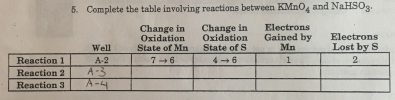 Empty Table:
Filled Out Table:
Question: Predict the stoichiometric ratio of
MnO4- to HSO3- in
reactions 2 and 3.
Complete the table involving reactions between KMno4 and NaHSOg 5. Change in Change in Electrons Oxidation Oxidation Gained by Electrons Lost by S Well State of Mn State of S Mn A-2 Reaction 1 Reaction 2 A-3 Reaction 3 | A...
Empty Table:
Filled Out Table:
Question: Predict the stoichiometric ratio of
MnO4- to HSO3- in
reactions 2 and 3.
Complete the table involving reactions between KMno4 and NaHSOg 5. Change in Change in Electrons Oxidation Oxidation Gained by Electrons Lost by S Well State of Mn State of S Mn A-2 Reaction 1 Reaction 2 A-3 Reaction 3 | A...
Question 6- Reaction Mechanisms (10 marks) The next set of questions refers to the reaction below:...
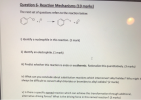 Question 6- Reaction Mechanisms (10 marks) The next set of questions refers to the reaction below: + CI co i) Identify a nucleophile in this reaction. (1 mark) ii) Identify an electrophile. (1 mark) 1 ill) Predict whether this reaction is endo or exothermic. Rationalize this quantitatively. (3 marks) iv) What can you conclude about substitution reactions which interconvert alkyl...
1. Predict the product(s) (or no reaction) and reagent(s). (17 pts DCM EtOH heat BU DCM...
 1. Predict the product(s) (or no reaction) and reagent(s). (17 pts DCM EtOH heat BU DCM Br tot & ob 8 6 6 KN, DMF Коме DMF ΚΟΕΙ HMPA LDA THF NaO Bu toluene
 Draw the two products for the following reaction:
H2O* N
Draw the two products for the following reaction:
H2O* N
 Reactions of Alkenes Draw the products formed in each reaction.
 Question 14 of 27 Save A Question 14 12 points Consider this exothermic reaction at equilibrium: 2C(s) + O2(8) -- 200(g). Predict whether the reaction will shift left, right, or will not shift after each disturbance. Use the drop down to answer. When some CO is removed, the reaction will When some C is added, the reaction will When the...
 The equilibrium constant Kc for the reaction below is 0.00491 at a certain temperature. If the initial concentrations are [Br2l-0.0860 M and [Br concentrations of these species at equilibrium. 0.0362 M, calculate the [Br] =
The equilibrium constant Kc for the reaction below is 0.00491 at a certain temperature. If the initial concentrations are [Br2l-0.0860 M and [Br concentrations of...
The equilibrium constant Kc for the reaction below is 0.00491 at a certain temperature. If the initial concentrations are [Br2l-0.0860 M and [Br concentrations of these species at equilibrium. 0.0362 M, calculate the [Br] =
The equilibrium constant Kc for the reaction below is 0.00491 at a certain temperature. If the initial concentrations are [Br2l-0.0860 M and [Br concentrations of...
 Empty Table:
Filled Out Table:
Question: Predict the stoichiometric ratio of
MnO4- to HSO3- in
reactions 2 and 3.
Complete the table involving reactions between KMno4 and NaHSOg 5. Change in Change in Electrons Oxidation Oxidation Gained by Electrons Lost by S Well State of Mn State of S Mn A-2 Reaction 1 Reaction 2 A-3 Reaction 3 | A...
Empty Table:
Filled Out Table:
Question: Predict the stoichiometric ratio of
MnO4- to HSO3- in
reactions 2 and 3.
Complete the table involving reactions between KMno4 and NaHSOg 5. Change in Change in Electrons Oxidation Oxidation Gained by Electrons Lost by S Well State of Mn State of S Mn A-2 Reaction 1 Reaction 2 A-3 Reaction 3 | A...
 Question 6- Reaction Mechanisms (10 marks) The next set of questions refers to the reaction below: + CI co i) Identify a nucleophile in this reaction. (1 mark) ii) Identify an electrophile. (1 mark) 1 ill) Predict whether this reaction is endo or exothermic. Rationalize this quantitatively. (3 marks) iv) What can you conclude about substitution reactions which interconvert alkyl...
 1. Predict the product(s) (or no reaction) and reagent(s). (17 pts DCM EtOH heat BU DCM Br tot & ob 8 6 6 KN, DMF Коме DMF ΚΟΕΙ HMPA LDA THF NaO Bu toluene
Most questions answered within 3 hours.