2. The following data were measured for the reaction BF3 (g)+NH, (g) FBNH (g): Experiment 0.250...
 2. The following data were measured for the reaction BF3 (g)+NH, (g) FBNH (g): Experiment 0.250 0.250 0.200 0.350 0.175 NH,J (M) 0.250 0.125 0.100 0.100 0.100 Initial Rate (M/s) 0.2130 0.1065 0.0682 0.1193 0.0596 4 a. b. c. What is the order of this reaction with respect to each reactant? What is the rate constant, with proper units, for...
Data for the following reaction are given in the table. 2NO(g) + Br2(g)->2NOBr(g) Experiment [NO],M [Br2],M...
Data for the following reaction are given in the table. 2NO(g) + Br2(g)->2NOBr(g) Experiment [NO],M [Br2],M Initial rate, M/s 1 1.0x10⁻² 2.0 x10⁻² 2.4x10⁻² 2 4.0x10⁻² 2.0x10⁻² 0.384 3 1.0x10⁻² 5.0x10⁻² 6.0x10⁻² What is the rate law for this reaction? b. What is the overall order of the reaction? c. What is the rate constant for this reaction?
6. The first-order decomposition of H:O2 at -30 °C occurs with a rate constant of 0.0165...
 6. The first-order decomposition of H:O2 at -30 °C occurs with a rate constant of 0.0165 s. If we start the reaction with10.0 mol/L H:0 1) What is the rate half-life, ty2 of the reaction? 2) What will be the residual concentration of H O, after 5 minutes? 3) What will be the initial reaction rate and the reaction rate...
The decomposition of dimethyl ether at 504°C is a first order reaction with a half-life of...
The decomposition of dimethyl ether at 504°C is a first order reaction with a half-life of 27.0 min. (CH₃)₂O(g) → CH₄(g) + H₂(g) + CO(g) A reaction vessel is charged with dimethyl ether at an initial pressure of 725 torr, and the reaction is initiated by rapidly heating the vessel to 504°C. Assuming a negligible time lag in beginning the...
Question 30 HNO2 at 800 C. Determine the rate law for the reaction The data in...
 Question 30 HNO2 at 800 C. Determine the rate law for the reaction The data in the below table were collected for the reaction No2+ (1/2) H2-H ExperimentNOl molsitH2lmoles/it Initial rate of reaction moles/lit sec 0.001 0.002 0.003 0.004 0.004 0.004 0.004 0.004 0.004 0.001 0.00 0.003 0.008 0.018 0.008 0.016 O Rate kN0221H21
The reaction A + 2B → C proceeds according to the rate law, rate = k[A][B]...
The reaction A + 2B → C proceeds according to the rate law, rate = k[A][B] with k = 6.05 x 10⁻³ M-1 min-1. Assume that at the start of a particular reaction, [A] = 0.275 M, [B] = 0.0950 M. What is the initial rate of reaction? What is the rate when half of B has reacted? Give units!...
Qlb. (10 points) 30 3 The gas phase reaction CO(g)+Cl(g)COC(g) is first order in each reactant....
 Qlb. (10 points) 30 3 The gas phase reaction CO(g)+Cl(g)COC(g) is first order in each reactant. If the initial pressure of each reactant is 0.100 bar, at 30°C the time required for the reaction to proceed to 50% conversion is 43 minutes, while at 1340°C only 22 minutes are required (0). What are the Arrhenius parameters for this reaction?
The reaction A + 2B → C proceeds according to the rate law, rate = k[A][B]...
The reaction A + 2B → C proceeds according to the rate law, rate = k[A][B] with k = 4.44 x 10⁻³ M-1 min-1. Assume that at the start of a particular reaction, [A] = 0.0650 M, [B] = 0.0550 M. What is the initial rate of reaction? What is the rate when half of B has reacted? Give units!...
Using an equilibrium constant to predict the direction of spontan.. A chem - gineer is studying...
 Using an equilibrium constant to predict the direction of spontan.. A chem - gineer is studying the following reaction: HCN(aq)+NH3() CN (aq)+NH(aq) At the temperature the engineer picks, the equilibrium constant K for this reaction is 1.2 The engineer charges ("fills") four reaction vessels with hydrogen cyanide and ammonia, and lets the reaction begin. She then measures the composition of...
If the equation of the regression line that relates percent blood alcohol, to reaction time in...
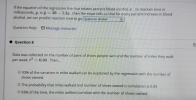 If the equation of the regression line that relates percent blood alcohol, to reaction time in milliseconds, y, isy = 36 - 1.38, then the slope tells us that for every percent increase in blood alcohol, we can predict reaction time to go Select an answer Question Help: Message instructor Question 8 Data was collected on the number of pairs...
 2. The following data were measured for the reaction BF3 (g)+NH, (g) FBNH (g): Experiment 0.250 0.250 0.200 0.350 0.175 NH,J (M) 0.250 0.125 0.100 0.100 0.100 Initial Rate (M/s) 0.2130 0.1065 0.0682 0.1193 0.0596 4 a. b. c. What is the order of this reaction with respect to each reactant? What is the rate constant, with proper units, for...
 6. The first-order decomposition of H:O2 at -30 °C occurs with a rate constant of 0.0165 s. If we start the reaction with10.0 mol/L H:0 1) What is the rate half-life, ty2 of the reaction? 2) What will be the residual concentration of H O, after 5 minutes? 3) What will be the initial reaction rate and the reaction rate...
 Question 30 HNO2 at 800 C. Determine the rate law for the reaction The data in the below table were collected for the reaction No2+ (1/2) H2-H ExperimentNOl molsitH2lmoles/it Initial rate of reaction moles/lit sec 0.001 0.002 0.003 0.004 0.004 0.004 0.004 0.004 0.004 0.001 0.00 0.003 0.008 0.018 0.008 0.016 O Rate kN0221H21
 Qlb. (10 points) 30 3 The gas phase reaction CO(g)+Cl(g)COC(g) is first order in each reactant. If the initial pressure of each reactant is 0.100 bar, at 30°C the time required for the reaction to proceed to 50% conversion is 43 minutes, while at 1340°C only 22 minutes are required (0). What are the Arrhenius parameters for this reaction?
 Using an equilibrium constant to predict the direction of spontan.. A chem - gineer is studying the following reaction: HCN(aq)+NH3() CN (aq)+NH(aq) At the temperature the engineer picks, the equilibrium constant K for this reaction is 1.2 The engineer charges ("fills") four reaction vessels with hydrogen cyanide and ammonia, and lets the reaction begin. She then measures the composition of...
 If the equation of the regression line that relates percent blood alcohol, to reaction time in milliseconds, y, isy = 36 - 1.38, then the slope tells us that for every percent increase in blood alcohol, we can predict reaction time to go Select an answer Question Help: Message instructor Question 8 Data was collected on the number of pairs...
Most questions answered within 3 hours.