02 Question (2 points) Draw a mechanism for the reaction of the ketone with hydronium ion....
 02 Question (2 points) Draw a mechanism for the reaction of the ketone with hydronium ion. In the first box, draw any necessary curved arrows. Show the products of the reaction in the second box. Include any nonzero formal charges and all lone pairs of electrons. V 1st attempt See Periodic Table See Hint ISO i Draw any necessary curved...
• Please provide the major organic product(s) of the reaction as described Account for all stereochemistry requirem...
 • Please provide the major organic product(s) of the reaction as described Account for all stereochemistry requirements for reaction and products. You need not include byproducts such as salts for this assignment, but you should be aware of their presence. "No reaction is NOT a possibility on this assignment Starting Material Conditions Major Product(s) ОН PBr3 Et20 NaCN DMF NaNH2...
what products would you expect from the following reaction? (alkene organic reaction with NBS/ CCl4) What...
 what products would you expect from the following reaction?
(alkene organic reaction with NBS/ CCl4)
What product(s) would you expect from the following reaction? You do not have to consider stereochemistry. If more than one structure fits the description, draw them all. Draw one structure per sketcher. Add additional sketchers using the dropdown Separate structures with + signs from the...
what products would you expect from the following reaction?
(alkene organic reaction with NBS/ CCl4)
What product(s) would you expect from the following reaction? You do not have to consider stereochemistry. If more than one structure fits the description, draw them all. Draw one structure per sketcher. Add additional sketchers using the dropdown Separate structures with + signs from the...
Chemistry Organic Chemistry Problems Elimination Reactions Problem 5: Which of the product in the following reaction...
 Chemistry Organic Chemistry Problems Elimination Reactions Problem 5: Which of the product in the following reaction will form and why. Use mechanism and relevant drawings to explain your answer. Br Problem 6: What is the product of the following reaction? sodium methoxide methanol sodium methoxide methanol Organic Chemistry Organic Chemistry Problems Elimination Reactions Problem 10: Use mechanism to explain all...
Draw the products of the reaction shown. Electron flow is indicated with curved arrows. :O :O...
 Draw the products of the reaction shown. Electron flow is indicated with curved arrows. :O :O Include all valence lone pairs in your answer. Include counter-ions, e.g., Na*, I, in your submission, but draw them in their own separate sketcher. . Draw one structure per sketcher. Add additional sketchers using the drop-down menu in the bottom right c additional sketchers...
1) Determine the effect of each of the following changes on the equilibrium mixture for the...
 1) Determine the effect of each of the following changes on the equilibrium mixture for the following reaction: N2(g) + O2(g) + 90.2 kJ + 2NO(g) Circle an answer for each change. a. Increasing the temperature Shift to reactants No change Shift to products b. Adding a catalyst Shift to reactants No change Shift to products c. Removing nitrogen monoxide...
25) Treatment of cyclopentene with peroxybenzoic acid A) results in oxidative cleavage of the ring to...
 25) Treatment of cyclopentene with peroxybenzoic acid A) results in oxidative cleavage of the ring to produce an acyclic compound B) yields a meso epoxide C) yields an equimolar mixture of enantiomeric epoxides D) gives the same product as treatment of cyclopentene with OsO4 E) none of the above 26) Provide a detailed, step-by-step mechanism for the reaction shown below....
Please help i need to get these right in order to get an A PLEASE PLEASE...
Please help i need to get these right in order to get an A PLEASE PLEASE PLEASE 1. What is the Kc for the following reaction at equilibrium at 1000 ∘C if [CO]= 0.50 M , [H2]= 0.32 M , [CH4]= 1.6 M , and [H2O]= 2.8 M ? CO(g)+3H2(g)⇌CH4(g)+H2O(g) 2. The equilibrium constant, Kc, for the reaction of H2...
Each of the following equilibrium constant expressions has a mistake. Identify the mistake and pick the...
Each of the following equilibrium constant expressions has a mistake. Identify the mistake and pick the correct expression for each of the following reactions at equilibrium. (a) 4 NH3(g) + 6 NO(g) equilibrium reaction arrow 7 N2(g) + 6 H2O(g) Kc = [NH3]4[NO]6 [N2]7[H2O]6 error in the equilibrium expression: (Select all that apply.) Some products or reactants are missing. Some...
Question 8 of9 Initial-rate data at a certain temperature is given in the table for the...
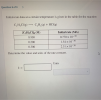 Question 8 of9 Initial-rate data at a certain temperature is given in the table for the reaction C2H, CI(g) C2H, (g) + HCIg) [C2H5Cllo (M) 0.100 0.200 0.300 Initial rate (M/s) 0.770× 10⁻³⁰ 1.54 x 10⁻³⁰ 2.31 × 10⁻³⁰ Determine the value and units of the rate constant. Units
 02 Question (2 points) Draw a mechanism for the reaction of the ketone with hydronium ion. In the first box, draw any necessary curved arrows. Show the products of the reaction in the second box. Include any nonzero formal charges and all lone pairs of electrons. V 1st attempt See Periodic Table See Hint ISO i Draw any necessary curved...
 • Please provide the major organic product(s) of the reaction as described Account for all stereochemistry requirements for reaction and products. You need not include byproducts such as salts for this assignment, but you should be aware of their presence. "No reaction is NOT a possibility on this assignment Starting Material Conditions Major Product(s) ОН PBr3 Et20 NaCN DMF NaNH2...
 what products would you expect from the following reaction?
(alkene organic reaction with NBS/ CCl4)
What product(s) would you expect from the following reaction? You do not have to consider stereochemistry. If more than one structure fits the description, draw them all. Draw one structure per sketcher. Add additional sketchers using the dropdown Separate structures with + signs from the...
what products would you expect from the following reaction?
(alkene organic reaction with NBS/ CCl4)
What product(s) would you expect from the following reaction? You do not have to consider stereochemistry. If more than one structure fits the description, draw them all. Draw one structure per sketcher. Add additional sketchers using the dropdown Separate structures with + signs from the...
 Chemistry Organic Chemistry Problems Elimination Reactions Problem 5: Which of the product in the following reaction will form and why. Use mechanism and relevant drawings to explain your answer. Br Problem 6: What is the product of the following reaction? sodium methoxide methanol sodium methoxide methanol Organic Chemistry Organic Chemistry Problems Elimination Reactions Problem 10: Use mechanism to explain all...
 Draw the products of the reaction shown. Electron flow is indicated with curved arrows. :O :O Include all valence lone pairs in your answer. Include counter-ions, e.g., Na*, I, in your submission, but draw them in their own separate sketcher. . Draw one structure per sketcher. Add additional sketchers using the drop-down menu in the bottom right c additional sketchers...
 1) Determine the effect of each of the following changes on the equilibrium mixture for the following reaction: N2(g) + O2(g) + 90.2 kJ + 2NO(g) Circle an answer for each change. a. Increasing the temperature Shift to reactants No change Shift to products b. Adding a catalyst Shift to reactants No change Shift to products c. Removing nitrogen monoxide...
 25) Treatment of cyclopentene with peroxybenzoic acid A) results in oxidative cleavage of the ring to produce an acyclic compound B) yields a meso epoxide C) yields an equimolar mixture of enantiomeric epoxides D) gives the same product as treatment of cyclopentene with OsO4 E) none of the above 26) Provide a detailed, step-by-step mechanism for the reaction shown below....
 Question 8 of9 Initial-rate data at a certain temperature is given in the table for the reaction C2H, CI(g) C2H, (g) + HCIg) [C2H5Cllo (M) 0.100 0.200 0.300 Initial rate (M/s) 0.770× 10⁻³⁰ 1.54 x 10⁻³⁰ 2.31 × 10⁻³⁰ Determine the value and units of the rate constant. Units
Most questions answered within 3 hours.