Physics
How many excess electrons must be added to an isolated spherical conductor 0.100 meters in diameter to produce an electric field of 1800 N/C just outside the surface
If you started with 0.0355 mol of copper (II) chloride and ended with 2.12g of isolated...
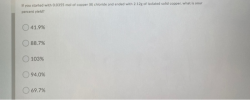 If you started with 0.0355 mol of copper (II) chloride and ended with 2.12g of isolated solid copper, what is your percent yield? 41.9% 88.7% 103% 94.0% 69.7%
Suppose that your bacterial cell contained a plasmid. When you isolated "genomic" DNA, would you expect...
Suppose that your bacterial cell contained a plasmid. When you isolated "genomic" DNA, would you expect to obtain the plasmid DNA along with the chromosomal DNA? Explain.
a microorganism that is isolated from the human skin that produces white colonies and is gram...
a microorganism that is isolated from the human skin that produces white colonies and is gram positive coccus is likely to be a. e. coli b. yeast c. s epidermis d. neisseria
if you were able to remove all neurons that have synapses with one particular neurons dendrites,...
if you were able to remove all neurons that have synapses with one particular neurons dendrites, that isolated cell would not produce any action potentials True or False?
An isolated system consists of three particles of mass m1, m2, and m3 that are initially...
An isolated system consists of three particles of mass m1, m2, and m3 that are initially at rest. They interact with pairwise forces, Fij(ri, rj). what is the net force on the system?
This was literally all I was given. Question 1 part A there was a misprint, the...
 This was literally all I was given. Question 1 part A there was
a misprint, the time interval 0.00 to 5.00 should be 0.00 to 4.00
seconds
1. Concentration versus time data is given for the reaction shown below. 2 NO (g) +2 () N, ( 2o (8) a) Calculate the average rate of disappearance of H, (g) during the...
This was literally all I was given. Question 1 part A there was
a misprint, the time interval 0.00 to 5.00 should be 0.00 to 4.00
seconds
1. Concentration versus time data is given for the reaction shown below. 2 NO (g) +2 () N, ( 2o (8) a) Calculate the average rate of disappearance of H, (g) during the...
Question 30 3 pts How would the reaction respond if some PtO is removed from the...
 Question 30 3 pts How would the reaction respond if some PtO is removed from the reaction mixture at equilibrium? CS2(g) + 2H2O(g) + Pt(s) = C(s) + 2H2S(g) + PtO(s) ΔΗχη = -55 kJ The reaction would make reactants to reach a new equilibrium. The equilibrium position of the reaction would not be affected. The reaction would make products...
Assignment 6.3-Balancing Redox Reactions 1 Balance the following reactions using the oxidation number method (fill in...
 Assignment 6.3-Balancing Redox Reactions 1 Balance the following reactions using the oxidation number method (fill in table as wel) a. NaClO+ H2S ? NaCl+ H2SO4 Element Initial Oxidation # Final Oxidation # Reduced or Oxidized? Element initial Oxidation # Final Oxidation # Reduced or Oxidized? K2Cr:07 + SnCl2 + HCl? CrCb + SnCl4 + KCl + H2O Element Initial Oxidation...
45. Calculate the rate constant k (in M's) using the information in the reaction and Table...
 45. Calculate the rate constant k (in M's) using the information in the reaction and Table 14.2 below. Page 8 NH + NO →N + 4 (aq) 2 (aq) 2 (8) 2H 0 (1) A) 2.7 x 10^m's? B) 1.0 x 10PM'sC) 5.4 x 10M's' D) 2.7 x 10-M's! TABLE 14.2 . Rate Data for the Reaction of Ammonium and...
 If you started with 0.0355 mol of copper (II) chloride and ended with 2.12g of isolated solid copper, what is your percent yield? 41.9% 88.7% 103% 94.0% 69.7%
 This was literally all I was given. Question 1 part A there was
a misprint, the time interval 0.00 to 5.00 should be 0.00 to 4.00
seconds
1. Concentration versus time data is given for the reaction shown below. 2 NO (g) +2 () N, ( 2o (8) a) Calculate the average rate of disappearance of H, (g) during the...
This was literally all I was given. Question 1 part A there was
a misprint, the time interval 0.00 to 5.00 should be 0.00 to 4.00
seconds
1. Concentration versus time data is given for the reaction shown below. 2 NO (g) +2 () N, ( 2o (8) a) Calculate the average rate of disappearance of H, (g) during the...
 Question 30 3 pts How would the reaction respond if some PtO is removed from the reaction mixture at equilibrium? CS2(g) + 2H2O(g) + Pt(s) = C(s) + 2H2S(g) + PtO(s) ΔΗχη = -55 kJ The reaction would make reactants to reach a new equilibrium. The equilibrium position of the reaction would not be affected. The reaction would make products...
 Assignment 6.3-Balancing Redox Reactions 1 Balance the following reactions using the oxidation number method (fill in table as wel) a. NaClO+ H2S ? NaCl+ H2SO4 Element Initial Oxidation # Final Oxidation # Reduced or Oxidized? Element initial Oxidation # Final Oxidation # Reduced or Oxidized? K2Cr:07 + SnCl2 + HCl? CrCb + SnCl4 + KCl + H2O Element Initial Oxidation...
 45. Calculate the rate constant k (in M's) using the information in the reaction and Table 14.2 below. Page 8 NH + NO →N + 4 (aq) 2 (aq) 2 (8) 2H 0 (1) A) 2.7 x 10^m's? B) 1.0 x 10PM'sC) 5.4 x 10M's' D) 2.7 x 10-M's! TABLE 14.2 . Rate Data for the Reaction of Ammonium and...
Most questions answered within 3 hours.