An isolated system consists of three particles of mass m1, m2, and m3 that are initially...
An isolated system consists of three particles of mass m1, m2, and m3 that are initially at rest. They interact with pairwise forces, Fij(ri, rj).
what is the net force on the system?
Homework Answers
 kindly give rating
Explanation:
Isolated System: An isolated system has no external forces acting on it. All forces are internal, arising from interactions between the particles within the system.
Newton's Third Law: The pairwise forces between particles satisfy . For example, the force exerted by particle 1 on particle 2 () is equal in magnitude and opposite in direction to the force exerted by particle 2 on particle 1 ().
Sum of Internal Forces: When you sum all the internal forces in the system, they cancel out in pairs due to Newton's Third Law.
Initial Rest Condition: Since the particles are initially at rest and the net force is zero, the system's center of mass remains at rest (consistent with Newton's First Law).
Thus, the net force on the system is always zero,
Add Answer to:
An isolated system consists of three particles of mass
m1, m2, and m3 that are initially...
Three uniform spheres of masses m1 = 2.50 kg, m2 = 4.00 kg, and m3 =...
Three uniform spheres of masses m1 = 2.50 kg, m2 = 4.00 kg, and m3 = 8.00 kg are placed at the corners of a right triangle (see figure below). Calculate the resultant gravitational force on the object of mass m2, assuming the spheres are isolated from the rest of the Universe.
Three particles of masses m1=1.2 kg, m2=2.5kg, and m3=3.4kg form an equilateral triangle of edge...
Three particles of masses m1=1.2 kg, m2=2.5kg, and m3=3.4kg form an equilateral triangle of edge length a=140 cm. Where is the center of mass of this system?
Three objects of equal mass m1 = m2 = m3 = 2.65 kg are located on...
Three objects of equal mass m1 = m2 = m3 = 2.65 kg are located on the vertices of an equilateral triangle of length d = 3.75 m. A fourth mass m4 = 15.5 kg is at the center of the triangle. What is the net gravitational force on the mass m1 that is at the origin? Express your answer in vector form.
The figure below show three masses m1=1.1 kg, m2=2.8 kg, and m3=4.3 kg which undergo two...
 The figure below show three masses m1=1.1 kg, m2=2.8 kg, and
m3=4.3 kg which undergo two successive collisions. The first
collision between m1, which has an initial velocity v=8.2 m/s, and
m2 (which is initially at rest) is completely inelastic. The second
collision between the combined mass m1+m2 and m3 (which is
initially at rest) is elastic. What is the velocity of m3 after the
second collision?
The figure below show three masses m1=1.1 kg, m2=2.8 kg, and m3=4.3 kg...
The figure below show three masses m1=1.1 kg, m2=2.8 kg, and
m3=4.3 kg which undergo two successive collisions. The first
collision between m1, which has an initial velocity v=8.2 m/s, and
m2 (which is initially at rest) is completely inelastic. The second
collision between the combined mass m1+m2 and m3 (which is
initially at rest) is elastic. What is the velocity of m3 after the
second collision?
The figure below show three masses m1=1.1 kg, m2=2.8 kg, and m3=4.3 kg...
The figure below show three masses m1=1.6 kg, m2=3.0 kg, and m3=4.6 kg which undergo two...
 The
figure below show three masses m1=1.6 kg, m2=3.0 kg, and m3=4.6 kg
which undergo two successive collisions. The first collision
between m1, which has an initial velocity v=6.9 m/s, and m2 (which
is initially at rest) is completely inelastic. The second collision
between the combined mass m1+m2 and m3 (which is initially at rest)
is elastic. What is the velocity of m3 after the second
collision?
V 1 2 co
The
figure below show three masses m1=1.6 kg, m2=3.0 kg, and m3=4.6 kg
which undergo two successive collisions. The first collision
between m1, which has an initial velocity v=6.9 m/s, and m2 (which
is initially at rest) is completely inelastic. The second collision
between the combined mass m1+m2 and m3 (which is initially at rest)
is elastic. What is the velocity of m3 after the second
collision?
V 1 2 co
The figure below show three masses m1=1.5 kg, m2=2.7 kg, and m3=4.6 kg which undergo two...
 The figure below show three masses m1=1.5 kg,
m2=2.7 kg, and m3=4.6 kg which undergo two
successive collisions. The first collision between m1,
which has an initial velocity v=8.6 m/s, and m2 (which
is initially at rest) is completely inelastic. The second collision
between the combined mass m1+m2 and
m3 (which is initially at rest) is elastic. What is the
velocity of m3 after the second collision?
V 1 2 co
The figure below show three masses m1=1.5 kg,
m2=2.7 kg, and m3=4.6 kg which undergo two
successive collisions. The first collision between m1,
which has an initial velocity v=8.6 m/s, and m2 (which
is initially at rest) is completely inelastic. The second collision
between the combined mass m1+m2 and
m3 (which is initially at rest) is elastic. What is the
velocity of m3 after the second collision?
V 1 2 co
The figure below show three masses m1=1.6 kg, m2=3.0 kg, and m3=4.6 kg which undergo two...
 The figure below show three masses m1=1.6 kg,
m2=3.0 kg, and m3=4.6 kg which undergo two
successive collisions. The first collision between m1,
which has an initial velocity v=6.9 m/s, and m2 (which
is initially at rest) is completely inelastic. The second collision
between the combined mass m1+m2 and
m3 (which is initially at rest) is elastic. What is the
velocity of m3 after the second collision?
V 1 2 3
The figure below show three masses m1=1.6 kg,
m2=3.0 kg, and m3=4.6 kg which undergo two
successive collisions. The first collision between m1,
which has an initial velocity v=6.9 m/s, and m2 (which
is initially at rest) is completely inelastic. The second collision
between the combined mass m1+m2 and
m3 (which is initially at rest) is elastic. What is the
velocity of m3 after the second collision?
V 1 2 3
The figure below show three masses m1=1.7 kg, m2=2.9 kg, and m3=4.5 kg which undergo two...
 The figure below show three masses m1=1.7 kg, m2=2.9 kg, and
m3=4.5 kg which undergo two successive collisions. The first
collision between m1, which has an initial velocity v=7.9 m/s, and
m2 (which is initially at rest) is completely inelastic. The second
collision between the combined mass m1+m2 and m3 (which is
initially at rest) is elastic. What is the velocity of m3 after the
second collision? (use figure in picture, but answer question
above)
The figure below show three...
The figure below show three masses m1=1.7 kg, m2=2.9 kg, and
m3=4.5 kg which undergo two successive collisions. The first
collision between m1, which has an initial velocity v=7.9 m/s, and
m2 (which is initially at rest) is completely inelastic. The second
collision between the combined mass m1+m2 and m3 (which is
initially at rest) is elastic. What is the velocity of m3 after the
second collision? (use figure in picture, but answer question
above)
The figure below show three...
In the figure, M2 has more mass than M1 and M1 has more mass than M3....
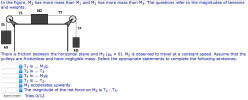 In the figure, M2 has more mass than M1 and M1 has more mass than M3. The questions refer to the magnitudes of tensions and weights. M2 T2 T3 T1 T4 MI M3 There is friction between the horizontal plane and M2 (Hk + 0). M2 is observed to travel at a constant speed. Assume that the pulleys are frictionless and have negligible mass. Select the appropriate statements to complete the following sentences. T1 is ... Mig. T2 is ......
The figure below show three masses m1=1.5 kg, m2=2.9 kg, and m3=4.6 kg which undergo two...
 The figure below show three masses m1=1.5 kg, m2=2.9 kg, and
m3=4.6 kg which undergo two successive completely inelastic
collisions. If m1 has an initial velocity v=6.2 m/s and both m2 and
m3 are initially at rest, what is the velocity of the combined mass
after the second collision.
V 1 2 co
The figure below show three masses m1=1.5 kg, m2=2.9 kg, and
m3=4.6 kg which undergo two successive completely inelastic
collisions. If m1 has an initial velocity v=6.2 m/s and both m2 and
m3 are initially at rest, what is the velocity of the combined mass
after the second collision.
V 1 2 co
 The figure below show three masses m1=1.1 kg, m2=2.8 kg, and
m3=4.3 kg which undergo two successive collisions. The first
collision between m1, which has an initial velocity v=8.2 m/s, and
m2 (which is initially at rest) is completely inelastic. The second
collision between the combined mass m1+m2 and m3 (which is
initially at rest) is elastic. What is the velocity of m3 after the
second collision?
The figure below show three masses m1=1.1 kg, m2=2.8 kg, and m3=4.3 kg...
The figure below show three masses m1=1.1 kg, m2=2.8 kg, and
m3=4.3 kg which undergo two successive collisions. The first
collision between m1, which has an initial velocity v=8.2 m/s, and
m2 (which is initially at rest) is completely inelastic. The second
collision between the combined mass m1+m2 and m3 (which is
initially at rest) is elastic. What is the velocity of m3 after the
second collision?
The figure below show three masses m1=1.1 kg, m2=2.8 kg, and m3=4.3 kg...
 The
figure below show three masses m1=1.6 kg, m2=3.0 kg, and m3=4.6 kg
which undergo two successive collisions. The first collision
between m1, which has an initial velocity v=6.9 m/s, and m2 (which
is initially at rest) is completely inelastic. The second collision
between the combined mass m1+m2 and m3 (which is initially at rest)
is elastic. What is the velocity of m3 after the second
collision?
V 1 2 co
The
figure below show three masses m1=1.6 kg, m2=3.0 kg, and m3=4.6 kg
which undergo two successive collisions. The first collision
between m1, which has an initial velocity v=6.9 m/s, and m2 (which
is initially at rest) is completely inelastic. The second collision
between the combined mass m1+m2 and m3 (which is initially at rest)
is elastic. What is the velocity of m3 after the second
collision?
V 1 2 co
 The figure below show three masses m1=1.5 kg,
m2=2.7 kg, and m3=4.6 kg which undergo two
successive collisions. The first collision between m1,
which has an initial velocity v=8.6 m/s, and m2 (which
is initially at rest) is completely inelastic. The second collision
between the combined mass m1+m2 and
m3 (which is initially at rest) is elastic. What is the
velocity of m3 after the second collision?
V 1 2 co
The figure below show three masses m1=1.5 kg,
m2=2.7 kg, and m3=4.6 kg which undergo two
successive collisions. The first collision between m1,
which has an initial velocity v=8.6 m/s, and m2 (which
is initially at rest) is completely inelastic. The second collision
between the combined mass m1+m2 and
m3 (which is initially at rest) is elastic. What is the
velocity of m3 after the second collision?
V 1 2 co
 The figure below show three masses m1=1.6 kg,
m2=3.0 kg, and m3=4.6 kg which undergo two
successive collisions. The first collision between m1,
which has an initial velocity v=6.9 m/s, and m2 (which
is initially at rest) is completely inelastic. The second collision
between the combined mass m1+m2 and
m3 (which is initially at rest) is elastic. What is the
velocity of m3 after the second collision?
V 1 2 3
The figure below show three masses m1=1.6 kg,
m2=3.0 kg, and m3=4.6 kg which undergo two
successive collisions. The first collision between m1,
which has an initial velocity v=6.9 m/s, and m2 (which
is initially at rest) is completely inelastic. The second collision
between the combined mass m1+m2 and
m3 (which is initially at rest) is elastic. What is the
velocity of m3 after the second collision?
V 1 2 3
 The figure below show three masses m1=1.7 kg, m2=2.9 kg, and
m3=4.5 kg which undergo two successive collisions. The first
collision between m1, which has an initial velocity v=7.9 m/s, and
m2 (which is initially at rest) is completely inelastic. The second
collision between the combined mass m1+m2 and m3 (which is
initially at rest) is elastic. What is the velocity of m3 after the
second collision? (use figure in picture, but answer question
above)
The figure below show three...
The figure below show three masses m1=1.7 kg, m2=2.9 kg, and
m3=4.5 kg which undergo two successive collisions. The first
collision between m1, which has an initial velocity v=7.9 m/s, and
m2 (which is initially at rest) is completely inelastic. The second
collision between the combined mass m1+m2 and m3 (which is
initially at rest) is elastic. What is the velocity of m3 after the
second collision? (use figure in picture, but answer question
above)
The figure below show three...
 In the figure, M2 has more mass than M1 and M1 has more mass than M3. The questions refer to the magnitudes of tensions and weights. M2 T2 T3 T1 T4 MI M3 There is friction between the horizontal plane and M2 (Hk + 0). M2 is observed to travel at a constant speed. Assume that the pulleys are frictionless and have negligible mass. Select the appropriate statements to complete the following sentences. T1 is ... Mig. T2 is ......
 The figure below show three masses m1=1.5 kg, m2=2.9 kg, and
m3=4.6 kg which undergo two successive completely inelastic
collisions. If m1 has an initial velocity v=6.2 m/s and both m2 and
m3 are initially at rest, what is the velocity of the combined mass
after the second collision.
V 1 2 co
The figure below show three masses m1=1.5 kg, m2=2.9 kg, and
m3=4.6 kg which undergo two successive completely inelastic
collisions. If m1 has an initial velocity v=6.2 m/s and both m2 and
m3 are initially at rest, what is the velocity of the combined mass
after the second collision.
V 1 2 co
Most questions answered within 3 hours.
-
Where is the error in this code sequence?
String s1 = "Hello";
String s2 = "ello";...
asked 10 months ago -
Financial data for Joel de Paris, Inc., for last year
follow:
Joel de Paris, Inc.
Balance...
asked 10 months ago -
Consider this reaction:
Al2(SO4)3 (aq)+ BaCl3
(aq) Al2Cl6 (aq)- +
3BaSO4(s) . What is the...
asked 10 months ago -
Suppose that Savneet is considering increasing her
recent random sample from 20 car rentals to 40...
asked 10 months ago -
Trucks arrive at an unloading terminal at an average rate of 120
per hour.
Trucks arrive...
asked 10 months ago -
Why are methanol and ethanol completely soluble in water while
octanol is not very little soluble....
asked 10 months ago -
A facilities manager at a university reads in a research report
that the mean amount of...
asked 10 months ago -
When the CuSO4 is rehydrated by adding water to the anhydrous
compound, is this an endothermic...
asked 10 months ago -
A ray of sunlight is passing from diamond into crown glass; the
angle of incidence is...
asked 10 months ago -
A block of mass 0.249 kg is placed on top of a light, vertical
spring of...
asked 10 months ago -
how do the kidneys compensate in the presences of acidosis
a) trigger hyperventilate
b) reserve acid...
asked 10 months ago -
Question 501 pts
The rental rate of capital to the firm increases. Which of the
following...
asked 10 months ago