a microorganism that is isolated from the human skin that produces white colonies and is gram...
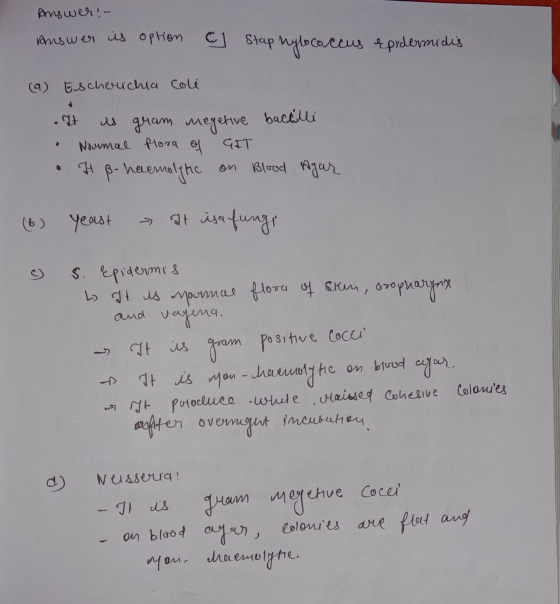
a microorganism that is isolated from the human skin that produces white colonies and is gram positive coccus is likely to be
a. e. coli
b. yeast
c. s epidermis
d. neisseria
Homework Answers
Add Answer to:
a microorganism that is isolated from the human skin that
produces white colonies and is gram...
Scenario 1: A bacterium isolated from a wound sample gave the following results: MacConkey agar =...
 Scenario 1: A bacterium isolated from a wound sample gave the following results: MacConkey agar = no growth Mannitol salt agar - good growth, color of medium unchanged Based on these results, which of the following statements is/are true? (Choose ALL true statements.) A. The organism is most likely Gram positive. B. The organism is most likely Gram negative. C. The organism is most likely a bacillus. D. The organism is most likely a coccus. Which of the following most...
What is the name of the microorganism (genius, species) in this picture? It should be one...
 What is the name of the microorganism (genius, species) in this
picture? It should be one of these microorganisms (B. cereus, E.
coli, P. aeruginosa, S. marcescens, S. aureus, S. epidermis).
Is it gram positive or negative? What is its shape and
arrangement? Please provide brief information about this organism
(what it does). Please type or write in clear handwriting.
What is the name of the microorganism (genius, species) in this
picture? It should be one of these microorganisms (B. cereus, E.
coli, P. aeruginosa, S. marcescens, S. aureus, S. epidermis).
Is it gram positive or negative? What is its shape and
arrangement? Please provide brief information about this organism
(what it does). Please type or write in clear handwriting.
When a urine culture shows greater than three different colonies on the SBA plate, no growth...
When a urine culture shows greater than three different colonies on the SBA plate, no growth on the MAC plate and some growth on the CNA plate, this may be reported as? No growth at 24 hours cc > 100,000 CFU/ml Gram negative bacilli A contaminated culture Cc < 10,000 CFU/ml Gram positive bacilli Which of the following urine cultures best indicates a possible infection? Mixed culture with > 3 organisms seen < 1,000 CFU/ml >/ 100,000 CFU/ml 10 CFU/ml...
When a urine culture shows greater than three different colonies on the SBA plate, no growth...
When a urine culture shows greater than three different colonies on the SBA plate, no growth on the MAC plate and some growth on the CNA plate, this may be reported as? No growth at 24 hours cc > 100,000 CFU/ml Gram negative bacilli A contaminated culture Cc < 10,000 CFU/ml Gram positive bacilli Which of the following urine cultures best indicates a possible infection? Mixed culture with > 3 organisms seen < 1,000 CFU/ml >/ 100,000 CFU/ml 10 CFU/ml...
Hemolytic bacteria are likely to be isolated from the a. rectum b. skin c. throat d....
Hemolytic bacteria are likely to be isolated from the a. rectum b. skin c. throat d. hair
12. If you used the PBLU plasmid as a vector to carry a desirable human gene...
 12. If you used the PBLU plasmid as a vector to carry a desirable human gene into E. coli recipient cells. The insertion site is inside the B-galactosidase gene on the p-BLU plasmid. After the transformation, you plate the cells on LBA+amp+X-Gal to screen for E. coli cells with the desirable gene. You saw both blue and white colonies on the plate. Which type of colonies carry the desirable human gene? A. White B. Blue C. both D. neither one...
You have isolated a DNA fragment containing a human gene involved in lung cancer and are...
You have isolated a DNA fragment containing a human gene involved in lung cancer and are working inserting it into a standard plasmid vector used in molecular cloning which has a multiple cloning site in the lacZ gene. After cutting the DNA fragment and the vector with the same restriction enzyme and ligating the cut DNA, you transform bacteria with hopefully the recombinant vector. How do you expect to identify bacteria with the recombinant vector? A. Bacteria with the recombinant...
D#12. Identify the microorganism(s) (Genus and/or species when applicable) associated with "EACH" of the items described...
 D#12. Identify the microorganism(s) (Genus and/or species when applicable) associated with "EACH" of the items described below 1. Gram positive spore forming bacillus which is the source of the antibiotic bacitracin; and which is also used in the identification of Group A Streptococcus. 2. Fungus that produces bacillary hyphal elements and is a source of several antibiotics as well as Vitamin B-12 3. Corrosion prod uced by this bacteria genus is one of the primary reasons for the use of...
EXPERIMENT 1: Which bacteria was gram-positive after Gram staining? Select one: O a. S. aureus O...
 EXPERIMENT 1: Which bacteria was gram-positive after Gram staining? Select one: O a. S. aureus O b. S. pneumoniae o cnone of the answer choices o d. E. coli EXPERIMENT 1: Which bacteria was pink and rod-shaped after Gram staining? Select one: O a. S. pneumoniae o b. E. coli O c. M. phlei O d. S. aureus EXPERIMENT 2: Which bacteria did not stain green after acid-fast staining? Select one: O a. E. coli O b. M. phlei O...
1.A research group is investigating the potential infectious nature of a disease. From ulcerative skin lesions...
1.A research group is investigating the potential infectious nature of a disease. From ulcerative skin lesions in mice they were able to grow as pure cultures a Gram negative microorganism. They inoculated this microorganism into the skin of healthy mice and reproduced the same ulcerative skin lesions. According to the Koch’s postulated these experimental evidences are sufficient to confirm that the Gram negative microorganism is the causative agent of the studied disease. (T/F) 2. Exotoxins can cause tissue damage during...
 Scenario 1: A bacterium isolated from a wound sample gave the following results: MacConkey agar = no growth Mannitol salt agar - good growth, color of medium unchanged Based on these results, which of the following statements is/are true? (Choose ALL true statements.) A. The organism is most likely Gram positive. B. The organism is most likely Gram negative. C. The organism is most likely a bacillus. D. The organism is most likely a coccus. Which of the following most...
 What is the name of the microorganism (genius, species) in this
picture? It should be one of these microorganisms (B. cereus, E.
coli, P. aeruginosa, S. marcescens, S. aureus, S. epidermis).
Is it gram positive or negative? What is its shape and
arrangement? Please provide brief information about this organism
(what it does). Please type or write in clear handwriting.
What is the name of the microorganism (genius, species) in this
picture? It should be one of these microorganisms (B. cereus, E.
coli, P. aeruginosa, S. marcescens, S. aureus, S. epidermis).
Is it gram positive or negative? What is its shape and
arrangement? Please provide brief information about this organism
(what it does). Please type or write in clear handwriting.
 12. If you used the PBLU plasmid as a vector to carry a desirable human gene into E. coli recipient cells. The insertion site is inside the B-galactosidase gene on the p-BLU plasmid. After the transformation, you plate the cells on LBA+amp+X-Gal to screen for E. coli cells with the desirable gene. You saw both blue and white colonies on the plate. Which type of colonies carry the desirable human gene? A. White B. Blue C. both D. neither one...
 D#12. Identify the microorganism(s) (Genus and/or species when applicable) associated with "EACH" of the items described below 1. Gram positive spore forming bacillus which is the source of the antibiotic bacitracin; and which is also used in the identification of Group A Streptococcus. 2. Fungus that produces bacillary hyphal elements and is a source of several antibiotics as well as Vitamin B-12 3. Corrosion prod uced by this bacteria genus is one of the primary reasons for the use of...
 EXPERIMENT 1: Which bacteria was gram-positive after Gram staining? Select one: O a. S. aureus O b. S. pneumoniae o cnone of the answer choices o d. E. coli EXPERIMENT 1: Which bacteria was pink and rod-shaped after Gram staining? Select one: O a. S. pneumoniae o b. E. coli O c. M. phlei O d. S. aureus EXPERIMENT 2: Which bacteria did not stain green after acid-fast staining? Select one: O a. E. coli O b. M. phlei O...
Most questions answered within 3 hours.
-
Where is the error in this code sequence?
String s1 = "Hello";
String s2 = "ello";...
asked 10 months ago -
Financial data for Joel de Paris, Inc., for last year
follow:
Joel de Paris, Inc.
Balance...
asked 10 months ago -
Consider this reaction:
Al2(SO4)3 (aq)+ BaCl3
(aq) Al2Cl6 (aq)- +
3BaSO4(s) . What is the...
asked 10 months ago -
Suppose that Savneet is considering increasing her
recent random sample from 20 car rentals to 40...
asked 10 months ago -
Trucks arrive at an unloading terminal at an average rate of 120
per hour.
Trucks arrive...
asked 10 months ago -
Why are methanol and ethanol completely soluble in water while
octanol is not very little soluble....
asked 10 months ago -
A facilities manager at a university reads in a research report
that the mean amount of...
asked 10 months ago -
When the CuSO4 is rehydrated by adding water to the anhydrous
compound, is this an endothermic...
asked 10 months ago -
A ray of sunlight is passing from diamond into crown glass; the
angle of incidence is...
asked 10 months ago -
A block of mass 0.249 kg is placed on top of a light, vertical
spring of...
asked 10 months ago -
how do the kidneys compensate in the presences of acidosis
a) trigger hyperventilate
b) reserve acid...
asked 10 months ago -
Question 501 pts
The rental rate of capital to the firm increases. Which of the
following...
asked 10 months ago