Which of the reactions performed are redox reactions (1a, 1b, 2, 3a, 3b, 4, 5a, 5b)?...
 Which of the reactions performed are redox reactions (1a, 1b, 2, 3a, 3b, 4, 5a, 5b)? (Hint: Look for changes in oxidation states of the elements.) List the reaction number of each redox reaction in the left column of the table below and complete the table, identifying each oxidized and reduced substance and its oxidation state before and after the...
2. Consider the reaction of 50.0 mL of 1.15 M HC2H302 with 50.0 mL of 1.30...
 2. Consider the reaction of 50.0 mL of 1.15 M HC2H302 with 50.0 mL of 1.30 M NH3. a. Give the net ionic reaction between these two reagents. H+(99) + NH3(aq) →NH4+(29) b. Calculate the moles of each reactant and indicate which reactant is the limiting reagent. Moles of HC2H2O2: 0.058 moles Moles of NH3: 0.065 moles c. Once the...
+ HCl (demo) Part G: Co(H20), 2(g) + 4CH pink Well 2: add AgNO3 Initial color...
 + HCl (demo) Part G: Co(H20), 2(g) + 4CH pink Well 2: add AgNO3 Initial color (well 1) purple Final Colori si pink Which reactant or product increased or a dec decreased? Reaction shifted left or right? • CoCl2 ( + 6H2O blue Test tube + Test tube + HEAT COLD Purple Purple Blue pink purple blue Heat inc Heat...
please help 7. (18 points) Consider the reaction: Nia (aq) +H.000) = OH(aq) + HNla(aq) K...
 please help
7. (18 points) Consider the reaction: Nia (aq) +H.000) = OH(aq) + HNla(aq) K = 6.25x101 @25°C SHOW ALL WORK Note: HNia weak acid Niacin (COHON, one of the B vitamins) AG = A. (6 points) What is AG"(KI) for this reaction ſhow your work. --RTink B. (12 points) What are the equilibrium concentrations (M) of each species...
please help
7. (18 points) Consider the reaction: Nia (aq) +H.000) = OH(aq) + HNla(aq) K = 6.25x101 @25°C SHOW ALL WORK Note: HNia weak acid Niacin (COHON, one of the B vitamins) AG = A. (6 points) What is AG"(KI) for this reaction ſhow your work. --RTink B. (12 points) What are the equilibrium concentrations (M) of each species...
please find all the missing blanks. Data and Calculations: Heat Effects and Calorimetry A. Specific Heat Trial 1 Ma...
 please find all the missing blanks.
Data and Calculations: Heat Effects and Calorimetry A. Specific Heat Trial 1 Mass of stoppered test tube plus metal Mass of test tube and stopper 34.564 25.7348 9.150 Trial 2 34.5648 25.7346 एयर 9. ISO 49.6928 Mass of calorimeter Mass of calorimeter and water 48.940 Mass of water Mass of metal 23.6 23.6 Initial...
please find all the missing blanks.
Data and Calculations: Heat Effects and Calorimetry A. Specific Heat Trial 1 Mass of stoppered test tube plus metal Mass of test tube and stopper 34.564 25.7348 9.150 Trial 2 34.5648 25.7346 एयर 9. ISO 49.6928 Mass of calorimeter Mass of calorimeter and water 48.940 Mass of water Mass of metal 23.6 23.6 Initial...
Question 3 35 pts Determine the value of the equilibrium constant (K) for the reaction listed...
 Question 3 35 pts Determine the value of the equilibrium constant (K) for the reaction listed below based on the concentrations provided. Alaq) + 2 B(aq) = 3(aq) + D(aq) Reagent/Product A B C D 0.17 0.69 149 0.87 Concentration (mol/L) Question 4 35 pts Determine the equilibrium molar concentration of C in the following reaction if the initial molar...
Consider the reaction at 25°C: 2A (aq) + B (aq) → C (aq) +2D (aq) An...
 Consider the reaction at 25°C: 2A (aq) + B (aq) → C (aq) +2D (aq) An experiment was performed with the following initial concentrations: [A] = 2.00 M, [B] = 3.00 M, [C] = 0.100 M, [D] = 0.800 M. The reaction was allowed to proceed until equilibrium was reached at which time [A] = 0.600 M. What is the...
Iodine atoms will combine to form I2 in liquid hexane solvent with a rate constant of...
Iodine atoms will combine to form I2 in liquid hexane solvent with a rate constant of 1.5×10¹⁰L/mol⋅s. The reaction is second order in I . Since the reaction occurs so quickly, the only way to study the reaction is to create iodine atoms almost instantaneously, usually by photochemical decomposition of I2. Suppose a flash of light creates an initial [I]...
10. Some measurements of the below. a certain reaction are given in the table 0.413 M...
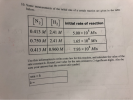 10. Some measurements of the below. a certain reaction are given in the table 0.413 M 2.41 M 0.750 M 2.41 M 0.413 M 0.960 M initial rate of reaction 5 .00 x 10mis 1.65 x 10° Mls L 7.93 104 m/s 77 Use this information to write a rate law for this reaction, and calculate the value of the...
help with this question Consider the reaction at 25°C: 2A (aq) + B (aq) → C (aq) +2D (aq) An experiment was performe...
 help with this question
Consider the reaction at 25°C: 2A (aq) + B (aq) → C (aq) +2D (aq) An experiment was performed with the following initial concentrations: [A] = 2.50 M, [B] = 2.50 M, [C] = 0.250 M, [D] = 0.500 M. The reaction was allowed to proceed until equilibrium was reached at which time [A] = 0.750...
help with this question
Consider the reaction at 25°C: 2A (aq) + B (aq) → C (aq) +2D (aq) An experiment was performed with the following initial concentrations: [A] = 2.50 M, [B] = 2.50 M, [C] = 0.250 M, [D] = 0.500 M. The reaction was allowed to proceed until equilibrium was reached at which time [A] = 0.750...
 Which of the reactions performed are redox reactions (1a, 1b, 2, 3a, 3b, 4, 5a, 5b)? (Hint: Look for changes in oxidation states of the elements.) List the reaction number of each redox reaction in the left column of the table below and complete the table, identifying each oxidized and reduced substance and its oxidation state before and after the...
 2. Consider the reaction of 50.0 mL of 1.15 M HC2H302 with 50.0 mL of 1.30 M NH3. a. Give the net ionic reaction between these two reagents. H+(99) + NH3(aq) →NH4+(29) b. Calculate the moles of each reactant and indicate which reactant is the limiting reagent. Moles of HC2H2O2: 0.058 moles Moles of NH3: 0.065 moles c. Once the...
 + HCl (demo) Part G: Co(H20), 2(g) + 4CH pink Well 2: add AgNO3 Initial color (well 1) purple Final Colori si pink Which reactant or product increased or a dec decreased? Reaction shifted left or right? • CoCl2 ( + 6H2O blue Test tube + Test tube + HEAT COLD Purple Purple Blue pink purple blue Heat inc Heat...
 please help
7. (18 points) Consider the reaction: Nia (aq) +H.000) = OH(aq) + HNla(aq) K = 6.25x101 @25°C SHOW ALL WORK Note: HNia weak acid Niacin (COHON, one of the B vitamins) AG = A. (6 points) What is AG"(KI) for this reaction ſhow your work. --RTink B. (12 points) What are the equilibrium concentrations (M) of each species...
please help
7. (18 points) Consider the reaction: Nia (aq) +H.000) = OH(aq) + HNla(aq) K = 6.25x101 @25°C SHOW ALL WORK Note: HNia weak acid Niacin (COHON, one of the B vitamins) AG = A. (6 points) What is AG"(KI) for this reaction ſhow your work. --RTink B. (12 points) What are the equilibrium concentrations (M) of each species...
 please find all the missing blanks.
Data and Calculations: Heat Effects and Calorimetry A. Specific Heat Trial 1 Mass of stoppered test tube plus metal Mass of test tube and stopper 34.564 25.7348 9.150 Trial 2 34.5648 25.7346 एयर 9. ISO 49.6928 Mass of calorimeter Mass of calorimeter and water 48.940 Mass of water Mass of metal 23.6 23.6 Initial...
please find all the missing blanks.
Data and Calculations: Heat Effects and Calorimetry A. Specific Heat Trial 1 Mass of stoppered test tube plus metal Mass of test tube and stopper 34.564 25.7348 9.150 Trial 2 34.5648 25.7346 एयर 9. ISO 49.6928 Mass of calorimeter Mass of calorimeter and water 48.940 Mass of water Mass of metal 23.6 23.6 Initial...
 Question 3 35 pts Determine the value of the equilibrium constant (K) for the reaction listed below based on the concentrations provided. Alaq) + 2 B(aq) = 3(aq) + D(aq) Reagent/Product A B C D 0.17 0.69 149 0.87 Concentration (mol/L) Question 4 35 pts Determine the equilibrium molar concentration of C in the following reaction if the initial molar...
 Consider the reaction at 25°C: 2A (aq) + B (aq) → C (aq) +2D (aq) An experiment was performed with the following initial concentrations: [A] = 2.00 M, [B] = 3.00 M, [C] = 0.100 M, [D] = 0.800 M. The reaction was allowed to proceed until equilibrium was reached at which time [A] = 0.600 M. What is the...
 10. Some measurements of the below. a certain reaction are given in the table 0.413 M 2.41 M 0.750 M 2.41 M 0.413 M 0.960 M initial rate of reaction 5 .00 x 10mis 1.65 x 10° Mls L 7.93 104 m/s 77 Use this information to write a rate law for this reaction, and calculate the value of the...
 help with this question
Consider the reaction at 25°C: 2A (aq) + B (aq) → C (aq) +2D (aq) An experiment was performed with the following initial concentrations: [A] = 2.50 M, [B] = 2.50 M, [C] = 0.250 M, [D] = 0.500 M. The reaction was allowed to proceed until equilibrium was reached at which time [A] = 0.750...
help with this question
Consider the reaction at 25°C: 2A (aq) + B (aq) → C (aq) +2D (aq) An experiment was performed with the following initial concentrations: [A] = 2.50 M, [B] = 2.50 M, [C] = 0.250 M, [D] = 0.500 M. The reaction was allowed to proceed until equilibrium was reached at which time [A] = 0.750...
Most questions answered within 3 hours.