The figure shows a solid, homogeneous ball with radius R. Before falling to the floor, its...
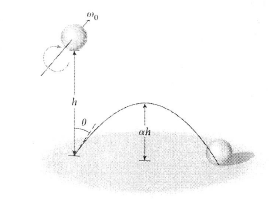
The figure shows a solid, homogeneous ball with radius R. Before falling to the floor, its center of mass is at rest, but it is spinning with angular velocity ω0 about a horizontal axis through its center. The lowest point of the ball is at a height h above ihe floor. When released, the ball falls under the influence of gravity, and rebounds to a new height such that its lowest point is ah above the floor. The deformation of the ball and the floor due to the impact can be considered negligible; the impact time, though, is finite. The mass of the ball is m, and the coefficient of kinetic friction between the ball and the floor is μk. Ignore air resistance.
For the situation where the ball is slipping throughout the impact, find each of the following:
a)tan θ, where θ is the rebound angle indicated in the diagram
b) the horizontal distance traveled in flight between thcfirst and second impacts
c) the minimum value of ω0 for this situation. For the situation where the ball stops slipping before the impact ends, find each of the following:
d) tan θ
e) the horizontal distance traveled in flight between the first and second impacts.
Taking both of the situations into account, sketch the variation of tan θ with ω0.
Step-by-Step Solution
Request Solution!
We need at least 10 more requests to produce the solution.
0 / 10 have requested this problem solution
The more requests, the faster the answer.
Most questions answered within 3 hours.
-
Calculating the space time for parallel reactions. m-Xylene is reacted over a ZSM-5 zeolit...
-
Determine Vo and ID for the networks of Fig. 2.160.FIG. 2.160
-
The truck travels along a circular road that has a radius of 50 m at a speed of 4 m/s. F...
-
A state legislature enacted a statute that required any motorcycle operator or passenger...
-
A 1024 × 1024 8-bit image with 5.3 bits/pixel entropy [computed from its histogram using E...
-
In Problem 3.3, we estimated the equationwhere we now report standard errors along with th...
-
In each of the following cases, deduce the nature of the light that is consistent with the...
-
Solve Example 20.5 such that the x, y, z axes move with curvilinear translation, Ω = 0 in...
-
In Fig. 6.43, if i = cos 4t and v = sin 4t, the element is:(a)a resistor(b) a capacitor(c)...
-
Sketch vo for each network of Fig. 2.181 for the input shown.FIG. 2.181
-
(Supplement B) Computing and Reporting Cash Flow Effectsof Sale of Plant and EquipmentDuri...
-
A 350-mL spherical flask contains 0.075 mol of an ideal gas at a temperature of 293 K. Wha...