You are the technical consultant for an action adventure film in which a stunt calls for t...
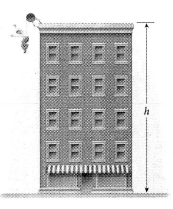
You are the technical consultant for an action adventure film in which a stunt calls for the hero to drop off a 20.0-m-tall building and land on ihe ground safely al a final vertical speed of 4.00 m/s. At the edge of the building's roof, there is a 100-kg drum that is wound with a sufficiently long rope (of negligiblemass), has a radius of 0.500 m, and is free to rotate about its cylindrical axis with a moment of inertia I0. The script calls for the 50.0-kg stuntman to tie the rope around his waist and walk off the roof.
a) Determine an expression for the stuntman's linear acceleration in terms of his mass m, the drum's radius r, and moment of inertia I0.
b) Determine the required value of the stuntman's acceleration if he is to land safely at a speed of 4.00 m/s, and use this value to calculate the moment of inertia of the drum about its axis.
c) What is the angular acceleration of the drum?
d) How many revolutions does the drum make during the fall?
Step-by-Step Solution
The torque needed to rotate a body is equal to the moment of inertia (I) times the angular acceleration
 .
.

The relation between the angular velocity and linear velocity of a rotating disc of radius R is,

The moment of inertia of a disc about its principle axis is,

Here, m is mass of the disc and R is the radius of the disc.
The figure given below shows the force diagram of given situation:

(a)
Write the net force equation for the mass m:

Rearrange the equation for T.

The torque produced by the tension in the rope is,

Here, R is the radius of the drum.
Substitute for
for and
and  for T.

Rearrange the equation for a.

Therefore, the required expression for the acceleration is . Here, m is the mass of the stuntman.
(b)
The initial speed of the stuntman is as started from rest.

The linear acceleration of the stuntman can be calculated using the following kinematic equation of motion.

Here, v is the final velocity and h is the height of the mass moved down.
Substitute 4 m/s for v and 20 m for h.

Therefore, the acceleration of the stuntman is .
.
Rearrange the equation for I.

Substitute  for m,
  for g, 0.5 m for R, and
  for a
for a

Therefore, the moment of inertia of the drum is .
.
(c)
Substitute  for a and 0.5 m for R in equation
 , and solve for the angular acceleration of the drum.

Therefore, the angular acceleration of the drum is .
.
(d)
The number of revolutions can be determined by the following kinematic equation of motion:

Here,  is the initial angular speed,
  is the final angular speed,
  is the angular acceleration and
  is the angular displacement.
Rearrange the equation for .
.

Initial angular velocity, 
Substitute  for
for in equation
 .
.

The final angular speed can be written as follows in terms of the final linear speed.

Substitute for
for in equation
 .
.

Substitute for
for ,
,  for
for  and 0.5 m for R.

Convert the unit of the angular displacement from radian to revolutions.

Therefore, the required number of revolutions is .
.
Most questions answered within 3 hours.
-
Calculating the space time for parallel reactions. m-Xylene is reacted over a ZSM-5 zeolit...
-
Determine Vo and ID for the networks of Fig. 2.160.FIG. 2.160
-
The truck travels along a circular road that has a radius of 50 m at a speed of 4 m/s. F...
-
A state legislature enacted a statute that required any motorcycle operator or passenger...
-
A 1024 × 1024 8-bit image with 5.3 bits/pixel entropy [computed from its histogram using E...
-
In Problem 3.3, we estimated the equationwhere we now report standard errors along with th...
-
In each of the following cases, deduce the nature of the light that is consistent with the...
-
Solve Example 20.5 such that the x, y, z axes move with curvilinear translation, Ω = 0 in...
-
In Fig. 6.43, if i = cos 4t and v = sin 4t, the element is:(a)a resistor(b) a capacitor(c)...
-
Sketch vo for each network of Fig. 2.181 for the input shown.FIG. 2.181
-
(Supplement B) Computing and Reporting Cash Flow Effectsof Sale of Plant and EquipmentDuri...
-
A 350-mL spherical flask contains 0.075 mol of an ideal gas at a temperature of 293 K. Wha...