Consider the initial value problem (a) Evaluate both (b) Finally, show that y...
Consider the initial value problem
 (a) Evaluate both

(b) Finally, show that y(t) is a solution of 21. Why doesn't this example contradict Theorem 7.16?
Definition 1.15:
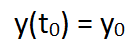
A first order differential equation together with an initial condition,

Is called an initial value problem. A solution of the initial value problem is a differentiable function y(t) such that
1.  for all t in an interval containing
  where y (t) is defined, and
2. 
THEOREM 7.16 Uniqueness of solutions
Suppose the function f (t, x) and its partial derivative ∂f/∂x are both continuous on the rectangle R in the tx-plane. Suppose  and that the solutions

Then as long as (t, x(t)) and (t, y(t)) stay in R, we have
x(t) = y(t).
Step-by-Step Solution
Request Solution!
We need at least 10 more requests to produce the solution.
0 / 10 have requested this problem solution
The more requests, the faster the answer.
Most questions answered within 3 hours.
-
Calculating the space time for parallel reactions. m-Xylene is reacted over a ZSM-5 zeolit...
-
Determine Vo and ID for the networks of Fig. 2.160.FIG. 2.160
-
The truck travels along a circular road that has a radius of 50 m at a speed of 4 m/s. F...
-
A state legislature enacted a statute that required any motorcycle operator or passenger...
-
A 1024 × 1024 8-bit image with 5.3 bits/pixel entropy [computed from its histogram using E...
-
In Problem 3.3, we estimated the equationwhere we now report standard errors along with th...
-
In each of the following cases, deduce the nature of the light that is consistent with the...
-
Solve Example 20.5 such that the x, y, z axes move with curvilinear translation, Ω = 0 in...
-
In Fig. 6.43, if i = cos 4t and v = sin 4t, the element is:(a)a resistor(b) a capacitor(c)...
-
Sketch vo for each network of Fig. 2.181 for the input shown.FIG. 2.181
-
(Supplement B) Computing and Reporting Cash Flow Effectsof Sale of Plant and EquipmentDuri...
-
A 350-mL spherical flask contains 0.075 mol of an ideal gas at a temperature of 293 K. Wha...