We say that a graph G = (V, E) is a triangulated cycle graph if it consists of the vertic...
We say that a graph G = (V, E) is a triangulated cycle graph if it consists of the vertices and edges of a triangulated convex n-gon in the plane–in other words, if it can be drawn in the plane as follows.
The vertices are all placed on the boundary of a convex set in the plane (we may assume on the boundary of a circle), with each pair of consecutive vertices on the circle joined by an edge. The remaining edges are then drawn as straight line segments through the interior of the circle, with no pair of edges crossing in the interior. We require the drawing to have the following property. If we let S denote the set of all points in the plane that lie on vertices or edges of the drawing, then each bounded component of the plane after deleting S is bordered by exactly three edges. (This is the sense in which the graph is a "triangulation.")
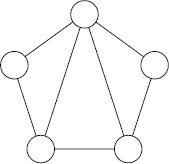
A triangulated cycle graph is pictured in Figure 1.
Prove that every triangulated cycle graph has a tree decomposition of width at most 2, and describe an efficient algorithm to construct such a decomposition.
Figure 1 A triangulated cycle graph: The edges form the boundary of a convex polygon together with a set of line segments that divide its interior into triangles.
Step-by-Step Solution
Request Solution!
We need at least 10 more requests to produce the solution.
0 / 10 have requested this problem solution
The more requests, the faster the answer.
Most questions answered within 3 hours.
-
Calculating the space time for parallel reactions. m-Xylene is reacted over a ZSM-5 zeolit...
-
Determine Vo and ID for the networks of Fig. 2.160.FIG. 2.160
-
The truck travels along a circular road that has a radius of 50 m at a speed of 4 m/s. F...
-
A state legislature enacted a statute that required any motorcycle operator or passenger...
-
A 1024 × 1024 8-bit image with 5.3 bits/pixel entropy [computed from its histogram using E...
-
In Problem 3.3, we estimated the equationwhere we now report standard errors along with th...
-
In each of the following cases, deduce the nature of the light that is consistent with the...
-
Solve Example 20.5 such that the x, y, z axes move with curvilinear translation, Ω = 0 in...
-
In Fig. 6.43, if i = cos 4t and v = sin 4t, the element is:(a)a resistor(b) a capacitor(c)...
-
Sketch vo for each network of Fig. 2.181 for the input shown.FIG. 2.181
-
(Supplement B) Computing and Reporting Cash Flow Effectsof Sale of Plant and EquipmentDuri...
-
A 350-mL spherical flask contains 0.075 mol of an ideal gas at a temperature of 293 K. Wha...