The difficulty in 3-SAT comes from the fact that there are 2n possible assignments to the...
The difficulty in 3-SAT comes from the fact that there are 2n possible assignments to the input variables x1, x2, … , xn, and there’s no apparent way to search this space in polynomial time. This intuitive picture, however, might create the misleading impression that the fastest algorithms for 3-SAT actually require time 2n. In fact, though it’s somewhat counterintuitive when you first hear it, there are algorithms for 3-SAT that run in significantly less than 2n time in the worst case; in other words, they determine whether there’s a satisfying assignment in less time than it
would take to enumerate all possible settings of the variables.
Here we'll develop one such algorithm, which solves instances of 3-SAT in  time for some polynomial p (n). Note that the main term in this running time is
  , which is bounded by 1.74n.
(a) For a truth assignment Φ for the variables x1, x2, xn, we use Φ (xi) to denote the value assigned by Φ to xi. (This can be either 0 or 1.) If Φ and Φ' are each truth assignments, we define the distance between Φ and Φ' to be the number of variables xi for which they assign different values, and we denote this distance by d (Φ, Φ).In other words, d(Φ, Φ') = |{i: Φ (xi) = Φ'(xi)}|.
A basic building block for our algorithm will be the ability to answer the following kind of question: Given a truth assignment Φ and a distance d, we'd like to know whether there exists a satisfying assignment Φ' such that the distance from Φ to Φ' is at most d. Consider the following algorithm, Explore(Φ, d), that attempts to answer this question.
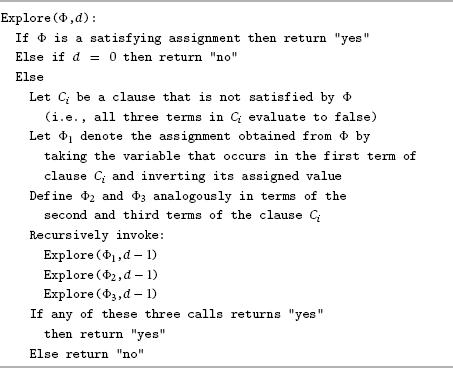
Prove that Explore(Φ, d) returns "yes" if and only if there exists a satisfying assignment Φ' such that the distance from Φ to Φ' is at most d. Also, give an analysis of the running time of Explore(Φ, d) as a function of n and d.
(b) Clearly any two assignments Φ and Φ' have distance at most n from each other, so one way to solve the given instance of 3-SAT would be to pick an arbitrary starting assignment Φ and then run Explore(Φ, n). However, this will not give us the running time we want.
Instead, we will need to make several calls to Explore, from different starting points Φ, and search each time out to more limited distances. Describe how to do this in such a way that you can solve the instance of 3-SAT in a running time of only 
Step-by-Step Solution
Request Solution!
We need at least 10 more requests to produce the solution.
0 / 10 have requested this problem solution
The more requests, the faster the answer.
Most questions answered within 3 hours.
-
Calculating the space time for parallel reactions. m-Xylene is reacted over a ZSM-5 zeolit...
-
Determine Vo and ID for the networks of Fig. 2.160.FIG. 2.160
-
The truck travels along a circular road that has a radius of 50 m at a speed of 4 m/s. F...
-
A state legislature enacted a statute that required any motorcycle operator or passenger...
-
A 1024 × 1024 8-bit image with 5.3 bits/pixel entropy [computed from its histogram using E...
-
In Problem 3.3, we estimated the equationwhere we now report standard errors along with th...
-
In each of the following cases, deduce the nature of the light that is consistent with the...
-
Solve Example 20.5 such that the x, y, z axes move with curvilinear translation, Ω = 0 in...
-
In Fig. 6.43, if i = cos 4t and v = sin 4t, the element is:(a)a resistor(b) a capacitor(c)...
-
Sketch vo for each network of Fig. 2.181 for the input shown.FIG. 2.181
-
(Supplement B) Computing and Reporting Cash Flow Effectsof Sale of Plant and EquipmentDuri...
-
A 350-mL spherical flask contains 0.075 mol of an ideal gas at a temperature of 293 K. Wha...