Most of these exercises are of an advanced nature. However, any of the exercises from Chap...
Most of these exercises are of an advanced nature. However, any of the exercises from Chapter 8 may be done using odesolve, so look there for more elementary exercises.
A driven RC-circuit is modeled with the initial value problem
 ,
,
where f is the frequency of the driving force. For purposes of this demonstration, think of the driving force V1 = cos(2π ft) as the input signal and Vc, the voltage response across the capacitor, as the output signal. This circuit is called a low-pass filter. The goal of this problem is to vary the frequency of the input signal and measure the response of the circuit by directly comparing the output and input signals. We can get odesolve to do this for us with a little subterfuge. If we differentiate the input signal we get  . We add this equation to the equation for the circuit to create the system
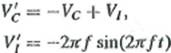
Note that we want V1(0) = cos(2π f(0)) = 1. We will have odesolve solve the system, and plot the input and output signals on the same figure, allowing easy comparison.
a) Set the frequency to f = 0.04 Hz. Recall that the period and frequency are related by T = 1/f, so the period in this case is T = 25 seconds. Enter the system in odesolve, set the initial conditions to Vc(0) = 0 and V, (0) = 1, and enter the parameter f = 0.04. We want to solve over five periods, so set the solution interval to [0, 5T] = [0,5/f]. Solve and plot both Vc and V1. How severely, if at all, is the output signal attenuated (reduced in amplitude) in comparison to the input signal?
b) Gradually increase the frequency of the input signal from f = 0.04 Hz to f = 1 Hz, adjusting the solution interval in each case to [0,5T] = [0,5/f], graphing the input and output signal over five periods of the input signal.
c) Describe what happens to the amplitude of the output signal in comparison to the input signal as you increase the frequency of the input signal V1/? Why is this circuit called a low-pass filter?
Step-by-Step Solution
Request Solution!
We need at least 10 more requests to produce the solution.
0 / 10 have requested this problem solution
The more requests, the faster the answer.
Most questions answered within 3 hours.
-
Calculating the space time for parallel reactions. m-Xylene is reacted over a ZSM-5 zeolit...
-
Determine Vo and ID for the networks of Fig. 2.160.FIG. 2.160
-
The truck travels along a circular road that has a radius of 50 m at a speed of 4 m/s. F...
-
A state legislature enacted a statute that required any motorcycle operator or passenger...
-
A 1024 × 1024 8-bit image with 5.3 bits/pixel entropy [computed from its histogram using E...
-
In Problem 3.3, we estimated the equationwhere we now report standard errors along with th...
-
In each of the following cases, deduce the nature of the light that is consistent with the...
-
Solve Example 20.5 such that the x, y, z axes move with curvilinear translation, Ω = 0 in...
-
In Fig. 6.43, if i = cos 4t and v = sin 4t, the element is:(a)a resistor(b) a capacitor(c)...
-
Sketch vo for each network of Fig. 2.181 for the input shown.FIG. 2.181
-
(Supplement B) Computing and Reporting Cash Flow Effectsof Sale of Plant and EquipmentDuri...
-
A 350-mL spherical flask contains 0.075 mol of an ideal gas at a temperature of 293 K. Wha...