proteins
a)Protein denaturation involves cleavage of its peptide bonds.
b)Denaturation of an enzyme will cause a loss of its catalytic activity.
c)A denatured protein has a different tertiary structure than its native state.
d)Denaturation and digestion refer to the same process.
e)A competetive enzyme inhibitor acts by denaturing the enzyme.
f)A denatured protein has a different primary structure than its native state.
Homework Answers
true : b, c
Denaturing destroys the secondary and tertiary structure. Primary
structure remains unaffected. Loss of tertiary structure causes
loss of function of the protein.
Test your understanding of the term denaturation by deciding which of the following statements are true....
Test your understanding of the term denaturation by deciding which of the following statements are true. 1.Denaturation of an enzyme will cause a loss of its catalytic activity 2.Denaturation and digestion refer to the same process 3.A competitive enzyme inhibitor acts by denaturing the enzyme 4.Protein denaturation involves cleavage of its peptide bonds 5.A denatured protein has a different tertiary structure than its native state 6.A denatured protein has a different primary structure than its native state
Identify which statements about denaturation are true and which are false. True statements False statements Answer...
 Identify which statements about denaturation are true and which are false. True statements False statements Answer Bank A denatured protein has a different primary structure than its native state. Cooking an egg hydrolyzes its albumin. Denaturation and digestion refer to the same process. Digestive enzymes hydrolyze proteins. Soaking fish in lime juice (PH 2.3) denatures the proteins, A denatured protein has a different tertiary structure than its native state, Egg white meringue, made by beating egg whites, contains denatured proteins
Which one or more of the four hierarchical levels of protein structure is/are always lost during...
 Which one or more of the four hierarchical levels of protein
structure is/are always lost during protein denaturation?
* I know the answer is tertiary but want to know why?
My uni gave me this table below but I don't know why the answer
is then teriary(they gave this answer). Can someone please
explain.
*
On what structural features does the catalytic activity of an enzyme depend? (1) Definition:"Enzyme denaturation" loss of enzyme structure, (almost) always with loss of biological...
Which one or more of the four hierarchical levels of protein
structure is/are always lost during protein denaturation?
* I know the answer is tertiary but want to know why?
My uni gave me this table below but I don't know why the answer
is then teriary(they gave this answer). Can someone please
explain.
*
On what structural features does the catalytic activity of an enzyme depend? (1) Definition:"Enzyme denaturation" loss of enzyme structure, (almost) always with loss of biological...
Amino Acids and Proteins 4. What are the different types of proteins and their function? 5....
Amino Acids and Proteins 4. What are the different types of proteins and their function? 5. Explain the meaning and importance of the primary, secondary, tertiary and quaternary structures of a protein and the factors that cause its denaturation.
1. Complete the following sentences Word bank: competitive, noncompetitive, allosteric site, oxaloacetate, active site, different from,...
1. Complete the following sentences Word bank: competitive, noncompetitive, allosteric site, oxaloacetate, active site, different from, similar to, succinate Oxaloacetate would be a reversible ______ inhibitor because the structure of oxaloacetate is ______ the structure of succinate, the substrate for the enzyme. As a _____ inhibitor, oxaloacetate would bind to the ______ of the enzyme. Increasing the concentration of _______, the substrate for the reaction, would reverse the effect of the _____ inhibitor. 2. Complete the following sentences The ______...
1. What are the different types of proteins and their function? 2. Explain the meaning and...
1. What are the different types of proteins and their function? 2. Explain the meaning and importance of the primary, secondary, tertiary and quaternary structures of a protein and the factors that cause its denaturation.
1. What are the different types of proteins and their function? 2. Explain the meaning and importance of the primary, secondary, tertiary and quaternary structures of a protein and the factors that...
1. What are the different types of proteins and their function? 2. Explain the meaning and importance of the primary, secondary, tertiary and quaternary structures of a protein and the factors that cause its denaturation.
pKa perturbations: A water-soluble globular protein has 2 aspartic acid residues in different parts of the...
pKa perturbations: A water-soluble globular protein has 2 aspartic acid residues in different parts of the tertiary structure. Both are almost completely buried in the interior of the native protein. (10 points) The first Asp residue has a pKa of 7.4 in the native state, but a pKa of 4.4 in the denatured state. Explain the difference in pKa between the two states (10 points) The other Asp residue, also buried in the native structure, has a pKa of 2.4...
Match the term with its definition. 1. Substances released during digestion to adjust pH in the...
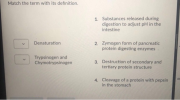 Match the term with its definition. 1. Substances released during digestion to adjust pH in the intestine Denaturation > 2. Zymogen form of pancreatic protein digesting enzymes > Trypsinogen and Chymotrypsinogen 3. Destruction of secondary and tertiary protein structure 48 4. Cleavage of a protein with pepsin in the stomach
PROTEINS Classify proteins according to their function, give examples - Aminoacids: Functional groups common to all aminoacids What is the isoelectric point Classification of aminoacids Explain t...
 PROTEINS Classify proteins according to their function, give examples - Aminoacids: Functional groups common to all aminoacids What is the isoelectric point Classification of aminoacids Explain the primary, secondary, tertiary, and cuaternary structure of proteins. Give examples of each Describe the peptide bond Identify the interaction/forces associated to the stabilization of 2°, 3°, and 4° structures. What is an enzyme and what do they do? Classes of enzymes - Explain enzyme-catalyzed reaction - Models of enzyme action - Which factors...
 Identify which statements about denaturation are true and which are false. True statements False statements Answer Bank A denatured protein has a different primary structure than its native state. Cooking an egg hydrolyzes its albumin. Denaturation and digestion refer to the same process. Digestive enzymes hydrolyze proteins. Soaking fish in lime juice (PH 2.3) denatures the proteins, A denatured protein has a different tertiary structure than its native state, Egg white meringue, made by beating egg whites, contains denatured proteins
 Which one or more of the four hierarchical levels of protein
structure is/are always lost during protein denaturation?
* I know the answer is tertiary but want to know why?
My uni gave me this table below but I don't know why the answer
is then teriary(they gave this answer). Can someone please
explain.
*
On what structural features does the catalytic activity of an enzyme depend? (1) Definition:"Enzyme denaturation" loss of enzyme structure, (almost) always with loss of biological...
Which one or more of the four hierarchical levels of protein
structure is/are always lost during protein denaturation?
* I know the answer is tertiary but want to know why?
My uni gave me this table below but I don't know why the answer
is then teriary(they gave this answer). Can someone please
explain.
*
On what structural features does the catalytic activity of an enzyme depend? (1) Definition:"Enzyme denaturation" loss of enzyme structure, (almost) always with loss of biological...
 Match the term with its definition. 1. Substances released during digestion to adjust pH in the intestine Denaturation > 2. Zymogen form of pancreatic protein digesting enzymes > Trypsinogen and Chymotrypsinogen 3. Destruction of secondary and tertiary protein structure 48 4. Cleavage of a protein with pepsin in the stomach
 PROTEINS Classify proteins according to their function, give examples - Aminoacids: Functional groups common to all aminoacids What is the isoelectric point Classification of aminoacids Explain the primary, secondary, tertiary, and cuaternary structure of proteins. Give examples of each Describe the peptide bond Identify the interaction/forces associated to the stabilization of 2°, 3°, and 4° structures. What is an enzyme and what do they do? Classes of enzymes - Explain enzyme-catalyzed reaction - Models of enzyme action - Which factors...
Most questions answered within 3 hours.
-
Where is the error in this code sequence?
String s1 = "Hello";
String s2 = "ello";...
asked 10 months ago -
Financial data for Joel de Paris, Inc., for last year
follow:
Joel de Paris, Inc.
Balance...
asked 10 months ago -
Consider this reaction:
Al2(SO4)3 (aq)+ BaCl3
(aq) Al2Cl6 (aq)- +
3BaSO4(s) . What is the...
asked 10 months ago -
Suppose that Savneet is considering increasing her
recent random sample from 20 car rentals to 40...
asked 10 months ago -
Trucks arrive at an unloading terminal at an average rate of 120
per hour.
Trucks arrive...
asked 10 months ago -
Why are methanol and ethanol completely soluble in water while
octanol is not very little soluble....
asked 10 months ago -
A facilities manager at a university reads in a research report
that the mean amount of...
asked 10 months ago -
When the CuSO4 is rehydrated by adding water to the anhydrous
compound, is this an endothermic...
asked 10 months ago -
A ray of sunlight is passing from diamond into crown glass; the
angle of incidence is...
asked 10 months ago -
A block of mass 0.249 kg is placed on top of a light, vertical
spring of...
asked 10 months ago -
how do the kidneys compensate in the presences of acidosis
a) trigger hyperventilate
b) reserve acid...
asked 10 months ago -
Question 501 pts
The rental rate of capital to the firm increases. Which of the
following...
asked 10 months ago