The figure below depicts the aggregate demand curve (AD), the short-run aggregate supply curve (SRAS), and the long-run aggregate supply curve (LRAS) for the United States. The economy is initially at long-run equilibrium, at point A.
The figure below depicts the aggregate demand curve (AD), the short-run aggregate supply curve (SRAS), and the long-run aggregate supply curve (LRAS) for the United States. The economy is initially at long-run equilibrium, at point A.
One of the most contentious issues among economists involves the economy’s adjustment to long-run equilibrium. Some economists believe that adjustment can and should occur naturally. This group, the classical economists, stress the importance of aggregate supply. Others see the return to long-run equilibrium as an adjustment that occurs unpredictably and often with much delay; this group, the Keynesian economists, stress the importance of aggregate demand and call for the government to speed the process back to full-employment GDP.
Although the classical economists dominated economics during the first part of the twentieth century, the Great Depression challenged the predominant view. In fact, the Great Depression set the stage for a new approach to macroeconomics.
Keynesian economists emphasize that wages do not adjust downward quickly enough during recessions—in other words, wages are “sticky downward”—perhaps because of the presence of long-term contracts and money illusion. As a result, high real wages prevent the labor market from reaching equilibrium and restoring full employment. This outcome leads to prolonged recessions.
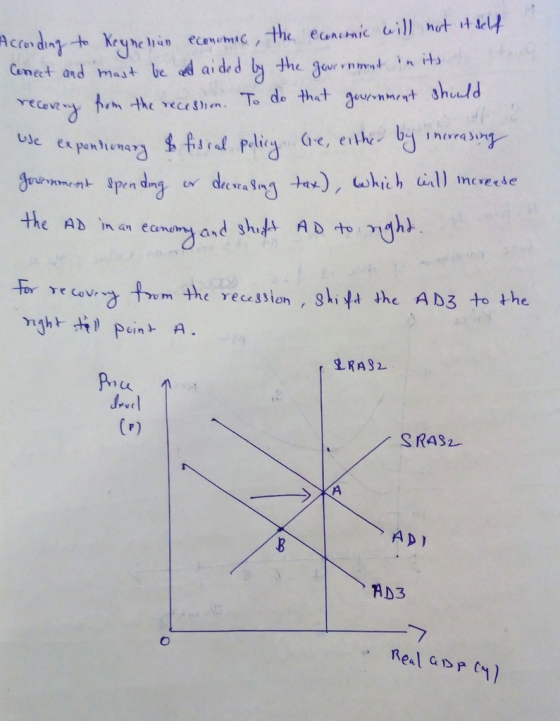
Suppose that the economy now faces a recession caused by a collapse of the stock market that is matched by a fall in expected future income. This situation would be represented by a shift of the AD curve to the left, due to a significant drop in consumption expenditure. This shift is depicted in the figure below by a movement of the economy from point A to point B.
According to Keynesian economics, the economy will not self-correct and must be aided by the government in its recovery from the recession. In the figure below, shift the appropriate curve, or use the point tool to mark the correct point, to depict the Keynesian approach to dealing with the recession.
To refer to the graphing tutorial for this question type, please click here.


Homework Answers
Answer:-
The Keynesian approach to deal to recessionary gap is expansionary fiscal policy . In case of expansionary fiscal policy government expenditure rises and taxes fall . So people have more money to spend . Money supply rises in the economy due to excess of government expenditure . So the consumption demand which had fallen would again be restored . The AD curve shifts right again from AD 2 to AD1 .
Add Answer to:
The figure below depicts the aggregate demand curve (AD), the short-run aggregate supply curve (SRAS), and the long-run aggregate supply curve (LRAS) for the United States. The economy is initially at long-run equilibrium, at point A.
The figure below depicts the aggregate demand curve (AD) and the long-run aggregate supply curve (LRAS) for the United States. The economy is initially at long-run equilibrium, at point A.
 The figure below depicts the aggregate demand curve (AD) and the long-run aggregate supply curve (LRAS) for the United States. The economy is initially at long-run equilibrium, at point A.One of the most contentious issues among economists involves the economy’s adjustment to long-run equilibrium. Some economists believe that adjustment can and should occur naturally. This group, the classical economists, stresses the importance of aggregate supply. Others see the return to long-run equilibrium as an adjustment that occurs unpredictably and often...
The following figure depicts the aggregate demand (AD), theshort-run aggregate supply (SRAS), and the long-run...
 The following figure depicts the aggregate demand (AD), the
short-run aggregate supply (SRAS), and the long-run aggregate
supply (LRAS) curves for an economy. The economy is initially at
long-run equilibrium, at point A. Suppose that there is an increase
in the amount of investment in the economy due to a reduction in
the real interest rate. This increase in investment shifts the AD
curve to the right, depicted below in the movement of the economy
from point A to point...
The following figure depicts the aggregate demand (AD), the
short-run aggregate supply (SRAS), and the long-run aggregate
supply (LRAS) curves for an economy. The economy is initially at
long-run equilibrium, at point A. Suppose that there is an increase
in the amount of investment in the economy due to a reduction in
the real interest rate. This increase in investment shifts the AD
curve to the right, depicted below in the movement of the economy
from point A to point...
14 Question (1 point) The following figure depicts the aggregate demand curve (AD), the short-run aggregate...
 14 Question (1 point) The following figure depicts the aggregate demand curve (AD), the short-run aggregate supply curve (SRAS), and the long-run aggregate supply curve (LRAS) for the United States. The economy is initially at long-run equilibrium, at point A. In addition to the crash of the stock market and a subsequent fall in expected future income, the Great Depression was also partially caused by a change in legislation regarding trade. In 1930, Congress passed the Smoot-Hawley Tariff Act. This...
Using the aggregate demand (AD), the short-run aggregate supply (SRAS), and the long-run aggregate supply (LRAS)...
Using the aggregate demand (AD), the short-run aggregate supply (SRAS), and the long-run aggregate supply (LRAS) curves, briefly explain how an open market purchase will affect the equilibrium price level (P) and real output (Y) in the short run. Assume the economy is initially in a recession?
drawing the graph of AD (Aggregate Demand), SRAS (Short- run aggregate supply curve) and LRAS (...
drawing the graph of AD (Aggregate Demand), SRAS (Short- run aggregate supply curve) and LRAS ( long run aggregate supply curve) and writing down what would happen under the two conditions "increase personal income taxes" and "decrease personal income taxes". You need to write down everything happens by following the seven steps: 1. What would happen under the condition? (Whether AD, SRAS, or LRAS would change? And in which direction the curve would shift?) 2. Where is the new short-run...
Given a downward-sloping aggregate demand (AD) curve and an upward-sloping short-run aggregate supply curve (SRAS), equilibrium...
Given a downward-sloping aggregate demand (AD) curve and an upward-sloping short-run aggregate supply curve (SRAS), equilibrium occurs where the two intersect. The value on the vertical axis is the equilibrium price level and the value on the horizontal axis is the equilibrium value of real GDP or output. What happens to the economy when AD shifts? It is useful to sketch a graph and show the shift. Suppose, for example, interest rates fall or wealth increases due to a stock...
Using aggregate demand (AD), short-run aggregate supply (SRAS) and long-run aggregate supply (LRAS) curves
Question 1: AD-SRAS-LRAS Model Using aggregate demand (AD), short-run aggregate supply (SRAS) and long-run aggregate supply (LRAS) curves, graphically illustrate the effect of an increase in the money supply on output and prices in the short and long run. Assume that the economy is initially in long run equilibrium at the potential output level and prices are fixed in the short-run. In your graph, label "A" for the initial equilibrium, "B' for the short-run equilibrium, and "C" for the long-run equilibrium.
Unit 3: Aggregate Demand, Aggregate Supply, and Fiscal Policy AD, AS, and LRAS Short Run vs....
 Unit 3: Aggregate Demand, Aggregate Supply, and Fiscal Policy AD, AS, and LRAS Short Run vs. Long Run Aggregate Supply Draw the economy at full employment 1. In the short run, wages and resource prices will as price levels increase 2. In the long run, wages and resource prices will as price levels increase Shifters of AD and AS Shifters of Aggregate Demand Shifters of Aggregate Supply imi Recessionary Gap Draw an economy in a recession Inflationary Gap Draw an...
supply curve to shift leftward to SRAS, as shown in the graph at right. The economy is currently in short-run equilibrium at point E, and the reduction in supply is expected to be permanent. LRAS...
 supply curve to shift leftward to SRAS, as shown in the graph at right. The economy is currently in short-run equilibrium at point E, and the reduction in supply is expected to be permanent. LRAS SRAS SRAS 1.) Using the line drawing and/or 3-point curved line drawing tool, show the adjustment to long-run equilibrium in this situation. Properly label your new curve(s). 2.) Using the point drawing tool, identify the new long-run equilibrium point and label the point 'E2 Carefully...
The following graph shows the short-run aggregate supply curve (AS), the aggregate demand curve (AD), and the long-run aggregate supply curve (LRAS) for a hypothetical economy
 9. Economic fluctuations II The following graph shows the short-run aggregate supply curve (AS), the aggregate demand curve (AD), and the long-run aggregate supply curve (LRAS) for a hypothetical economy. Initially, the expected price level is equal to the actual price level, and the economy is in long-run equilibrium at its natural level of output, $120 billion. Suppose a bout of severe weather drives up agricultural costs, increases the costs of transporting goods and services, and increases the costs of producing goods...
 The following figure depicts the aggregate demand (AD), the
short-run aggregate supply (SRAS), and the long-run aggregate
supply (LRAS) curves for an economy. The economy is initially at
long-run equilibrium, at point A. Suppose that there is an increase
in the amount of investment in the economy due to a reduction in
the real interest rate. This increase in investment shifts the AD
curve to the right, depicted below in the movement of the economy
from point A to point...
The following figure depicts the aggregate demand (AD), the
short-run aggregate supply (SRAS), and the long-run aggregate
supply (LRAS) curves for an economy. The economy is initially at
long-run equilibrium, at point A. Suppose that there is an increase
in the amount of investment in the economy due to a reduction in
the real interest rate. This increase in investment shifts the AD
curve to the right, depicted below in the movement of the economy
from point A to point...
 14 Question (1 point) The following figure depicts the aggregate demand curve (AD), the short-run aggregate supply curve (SRAS), and the long-run aggregate supply curve (LRAS) for the United States. The economy is initially at long-run equilibrium, at point A. In addition to the crash of the stock market and a subsequent fall in expected future income, the Great Depression was also partially caused by a change in legislation regarding trade. In 1930, Congress passed the Smoot-Hawley Tariff Act. This...
 Unit 3: Aggregate Demand, Aggregate Supply, and Fiscal Policy AD, AS, and LRAS Short Run vs. Long Run Aggregate Supply Draw the economy at full employment 1. In the short run, wages and resource prices will as price levels increase 2. In the long run, wages and resource prices will as price levels increase Shifters of AD and AS Shifters of Aggregate Demand Shifters of Aggregate Supply imi Recessionary Gap Draw an economy in a recession Inflationary Gap Draw an...
 supply curve to shift leftward to SRAS, as shown in the graph at right. The economy is currently in short-run equilibrium at point E, and the reduction in supply is expected to be permanent. LRAS SRAS SRAS 1.) Using the line drawing and/or 3-point curved line drawing tool, show the adjustment to long-run equilibrium in this situation. Properly label your new curve(s). 2.) Using the point drawing tool, identify the new long-run equilibrium point and label the point 'E2 Carefully...
Most questions answered within 3 hours.
-
Where is the error in this code sequence?
String s1 = "Hello";
String s2 = "ello";...
asked 10 months ago -
Financial data for Joel de Paris, Inc., for last year
follow:
Joel de Paris, Inc.
Balance...
asked 10 months ago -
Consider this reaction:
Al2(SO4)3 (aq)+ BaCl3
(aq) Al2Cl6 (aq)- +
3BaSO4(s) . What is the...
asked 10 months ago -
Suppose that Savneet is considering increasing her
recent random sample from 20 car rentals to 40...
asked 10 months ago -
Trucks arrive at an unloading terminal at an average rate of 120
per hour.
Trucks arrive...
asked 10 months ago -
Why are methanol and ethanol completely soluble in water while
octanol is not very little soluble....
asked 10 months ago -
A facilities manager at a university reads in a research report
that the mean amount of...
asked 10 months ago -
When the CuSO4 is rehydrated by adding water to the anhydrous
compound, is this an endothermic...
asked 10 months ago -
A ray of sunlight is passing from diamond into crown glass; the
angle of incidence is...
asked 10 months ago -
A block of mass 0.249 kg is placed on top of a light, vertical
spring of...
asked 10 months ago -
how do the kidneys compensate in the presences of acidosis
a) trigger hyperventilate
b) reserve acid...
asked 10 months ago -
Question 501 pts
The rental rate of capital to the firm increases. Which of the
following...
asked 10 months ago