Two capacitors of capacitance 3C and 5C (where C = 0.095 F) are connected in series with a resistor of resistance R = 9.5Ω.
Two capacitors of capacitance 3C and 5C (where C = 0.095 F) are connected in series with a resistor of resistance R = 9.5Ω.
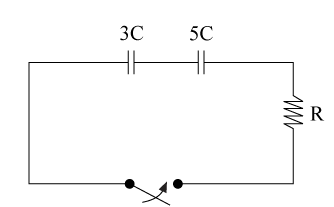
Part (a) How long will it take the amount of charge in the circuit to drop by 75% in seconds?
Part (b) If the circuit was charged by a 10.0 V source how much total charge (in C) did both capacitors have in them to begin with?
Homework Answers

Add Answer to:
Two capacitors of capacitance 3C and 5C (where C = 0.095 F) are connected in series with a resistor of resistance R = 9.5Ω.
Q6: Three capacitors are connected to a battery. Their capacitenc are C1=3C, C2-C, C3=5C. a) What...
 Q6: Three capacitors are connected to a battery. Their capacitenc are C1=3C, C2-C, C3=5C. a) What is the equivalent capacitance of this set of capacitors? b) Rank the capacitors according to the potential differences across them from largest to smallest. c) Rank the capacitors according to charge they can store from largest to smallest.
Two capacitors with capacitance C=10 μF are connected in series in a circuit with resistance R=150...
Two capacitors with capacitance C=10 μF are connected in series in a circuit with resistance R=150 Ω. What is the value for t1/2 for this circuit? Give your answer to three significant figures in milliseconds.
Consider a series circuit containing a resistor of resistance R and a capacitor of capacitance C connected to a source of EMF E with negligible internal resistance.
 Consider a series circuit containing a resistor of resistance R and a capacitor of capacitance C connected to a source of EMF E with negligible internal resistance. The wires are also assumed to have zero resistance. Initially, the switch is open and the capacitor discharged. (Figure 1)A Immediately after the switch is closed, what is the voltage across the capacitor?B Complete previous part(s) C Immediately after the switch is closed, what is the direction of the current in the circuit? E Eventually,...
An uncharged capacitor and a resistor are connected in series to a source of emf. If...
An uncharged capacitor and a resistor are connected in series to a source of emf. If emf=9.00 V, capacitance=21.5 ?F, and resistance=127Ω, find (a) the time constant of the circuit. After 1.30 ms, find (b) the charge on the capacitor, (c) the voltage drop across the capacitor, (d) the voltage drop across the resistor, and (e) the current.
Consider a series circuit containing a resistor of resistance R and a capacitor of capacitance C connected to a source of EMF ε with negligible internal resistance.
 Consider a series circuit containing a resistor of resistance R and a capacitor of capacitance C connected to a source of EMF ε with negligible internal resistance. The wires are also assumed to have zero resistance. Initially, the switch is open and the capacitor discharged. (Figure 1)Immediately after the switch is closed, what is the voltage
across the resistor?Immediately after the switch is closed, what is the direction of
the current in the circuit?
Consider a series circuit containing a resistor of resistance R and a capacitor of capacitance C connected to a source of EMF ε with negligible internal resistance. The wires are also assumed to have zero resistance. Initially, the switch is open and the capacitor discharged. (Figure 1)Immediately after the switch is closed, what is the voltage
across the resistor?Immediately after the switch is closed, what is the direction of
the current in the circuit?
1. Two 5.0 F capacitors are connected in parallel. A third 5.0 F capacitor is connected...
1. Two 5.0 F capacitors are connected in parallel. A third 5.0 F capacitor is connected in series to the first two. What is the equivalent capacitance? (a) 5.0 F (b) 15.0 F (c) 3.3 F (d) 6.7 F 2. Two capacitors, each with a capacitance of C, are connected in parallel. Those two are then connected in series to another capacitor with capacitance of C. What is the equivalent capacitance of this arrangement of capacitors? (a) C/3 (b) 2C/3 (c)...
(5. Two 0.500-F capacitors in series are connected to a 50.0-V battery through a 4.00-MS resistor....
 (5. Two 0.500-F capacitors in series are connected to a 50.0-V battery through a 4.00-MS resistor. When the switch is closed, the capacitors begin to charge up. What is the time constant for the charging process?
A capacitor of capacitance C= 2.5 μF is initially uncharged. It is connected in series with a switch of negligible resistance
 A capacitor of capacitance C= 2.5 μF is initially uncharged. It is connected in series with a switch of negligible resistance, a resistor of resistance R= 14.5 kΩ, and a battery which provides a potential difference of VB = 160 V.Part (a) Immediately after the switch is closed, what is the voltage drop Vc, in volt across the capacitor?Part (b) Immediately after the switch is closed, what is the voltage drop VR, in volt: across the resistor?Part (c) Immediately after...
A capacitor with capacitance C is initially charged with charge q0. At time t = 0 a resistor with resistance R is connected across the capacitor. (Figure 1)
 To understand the behavior of the current and voltage in a simple R-C circuit. A capacitor with capacitance C is initially charged with charge q0. At time t = 0 a resistor with resistance R is connected across the capacitor. (Figure 1) Part CNow solve the differential equation V(t) = -CR dV(t)/dt for the initial conditions given in the problem introduction to find the voltage as a function of time for any time t.
(a) A capacitor of capacitance 220 μF is connected in series with a 150 kΩ resistor, a switch and an ammeter. A d.c. power supply of negligible internal resistance is connected to the circuit as show...
 (a) A capacitor of capacitance 220 μF is connected in series with a 150 kΩ resistor, a switch and an ammeter. A d.c. power supply of negligible internal resistance is connected to the circuit as shown below 1 50 kΩ 220HF A stopclock is started and after 10 seconds the switch S is closed Ammeter readings are noted at regular intervals until a time of 80s is shown on the stopclock. The graph below shows how the current in the...
 Q6: Three capacitors are connected to a battery. Their capacitenc are C1=3C, C2-C, C3=5C. a) What is the equivalent capacitance of this set of capacitors? b) Rank the capacitors according to the potential differences across them from largest to smallest. c) Rank the capacitors according to charge they can store from largest to smallest.
 (5. Two 0.500-F capacitors in series are connected to a 50.0-V battery through a 4.00-MS resistor. When the switch is closed, the capacitors begin to charge up. What is the time constant for the charging process?
 (a) A capacitor of capacitance 220 μF is connected in series with a 150 kΩ resistor, a switch and an ammeter. A d.c. power supply of negligible internal resistance is connected to the circuit as shown below 1 50 kΩ 220HF A stopclock is started and after 10 seconds the switch S is closed Ammeter readings are noted at regular intervals until a time of 80s is shown on the stopclock. The graph below shows how the current in the...
Most questions answered within 3 hours.
-
Where is the error in this code sequence?
String s1 = "Hello";
String s2 = "ello";...
asked 10 months ago -
Financial data for Joel de Paris, Inc., for last year
follow:
Joel de Paris, Inc.
Balance...
asked 10 months ago -
Consider this reaction:
Al2(SO4)3 (aq)+ BaCl3
(aq) Al2Cl6 (aq)- +
3BaSO4(s) . What is the...
asked 10 months ago -
Suppose that Savneet is considering increasing her
recent random sample from 20 car rentals to 40...
asked 10 months ago -
Trucks arrive at an unloading terminal at an average rate of 120
per hour.
Trucks arrive...
asked 10 months ago -
Why are methanol and ethanol completely soluble in water while
octanol is not very little soluble....
asked 10 months ago -
A facilities manager at a university reads in a research report
that the mean amount of...
asked 10 months ago -
When the CuSO4 is rehydrated by adding water to the anhydrous
compound, is this an endothermic...
asked 10 months ago -
A ray of sunlight is passing from diamond into crown glass; the
angle of incidence is...
asked 10 months ago -
A block of mass 0.249 kg is placed on top of a light, vertical
spring of...
asked 10 months ago -
how do the kidneys compensate in the presences of acidosis
a) trigger hyperventilate
b) reserve acid...
asked 10 months ago -
Question 501 pts
The rental rate of capital to the firm increases. Which of the
following...
asked 10 months ago