If light reflects from all surfaces of a transparent medium, why
is the view through a glass window ()
not noticeably dimmer than the view with the window open? Using
Fresnel formulas for reflectivity and transmissivity.
Homework Answers
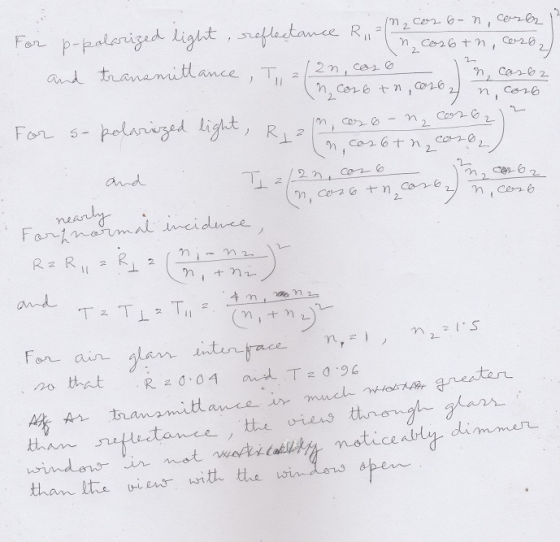
This is an answer to the question why the view through a glass
window is not much dimmer that the view with window open
Add Answer to:
If light reflects from all surfaces of a transparent medium, why
is the view through a...
Please show all work , thank you! In Bob Shaw's short story, "The Light of Other...
Please show all work , thank you! In Bob Shaw's short story, "The Light of Other Days," he describes something called slow glass. In the story, a married couple buys a 4-foot-wide window of slow glass that has been out on a beautiful hillside in Ireland, collecting light for 10 years. The idea is that the light takes 10 years to pass through the glass, so if you mount the window in your house it will give a view of...
Tiny beads of transparent material, usually less than a millimeter but still hundreds of wavelengths in...
Tiny beads of transparent material, usually less than a millimeter but still hundreds of wavelengths in diameter and made of glass for durability, are used in road and airport runway markings, and also in road signs. They perform best when the index of refraction of the material is close to 2. Why? Pick those answers that apply. The transmission optics of a sphere cannot be explained with the thin lens equation When n=2, all of the light reflects from the...
Explain, using math, why light can only undergo total internal reflection when propagating from an incident...
Explain, using math, why light can only undergo total internal reflection when propagating from an incident medium that has a higher refractive index than the medium from which the light is reflected (the potential transmitted medium), that is: ni > nt – the light must be bending away from the normal. Make sure to include the “limits” of the sine function in your discussion.
Please answer all parts of the question (a,b,c,d,e) Consider the case of oblique incidence of electromagnetic plane waves going from medium 1 to a. Draw a diagram showing the wavevectors and the direc...
 Please answer all parts of the
question (a,b,c,d,e)
Consider the case of oblique incidence of electromagnetic plane waves going from medium 1 to a. Draw a diagram showing the wavevectors and the directions of the electric and magnetic b. Using the appropriate boundary conditions, obtain the Fresnel equations for the reflected 1. medium 2 with the polarization perpendicular to the plane of incidence. fields of the incident, reflected, and transmitted waves for an angle of incidence θ| and transmitted complex...
Please answer all parts of the
question (a,b,c,d,e)
Consider the case of oblique incidence of electromagnetic plane waves going from medium 1 to a. Draw a diagram showing the wavevectors and the directions of the electric and magnetic b. Using the appropriate boundary conditions, obtain the Fresnel equations for the reflected 1. medium 2 with the polarization perpendicular to the plane of incidence. fields of the incident, reflected, and transmitted waves for an angle of incidence θ| and transmitted complex...
A ray of light travels through air until it strikes the interface between the air and...
 A ray of light travels through air until it strikes the interface between the air and another medium. The incident ray makes an angle of - 48.0° with the normal, as shown in the figure below. Upon passage into the second medium, the ray is refracted, emerging from the interface at an angle 0, with respect to the normal. e Air Second medium (a) Suppose that the second medium is Ice. What is the angle of refraction, 02 (in degrees)?...
verify 1-2-3-4-5-6 and do 7 please 1. It is hard to get the bars to be...
 verify 1-2-3-4-5-6 and do 7 please
1. It is hard to get the bars to be parallel in this experiment. Explain why the bars tend to be so wiggly That happens because there is not match friction between the glass plates and it makes it hard to move them gradually relatively to each other, plus the surfaces of the glass plates are not entirely even which makes the friction vary in different areas of the glass plates and their movement...
verify 1-2-3-4-5-6 and do 7 please
1. It is hard to get the bars to be parallel in this experiment. Explain why the bars tend to be so wiggly That happens because there is not match friction between the glass plates and it makes it hard to move them gradually relatively to each other, plus the surfaces of the glass plates are not entirely even which makes the friction vary in different areas of the glass plates and their movement...
All rays that are parallel to the principle axis in a concave mirror reflects Select one:...
 All rays that are parallel to the principle axis in a concave mirror reflects Select one: O a. Towards the focal point O b. Away from the focal point O c. Away from the center of curvature O d. Towards the center of curvature Which statements are true about a VIRTUAL image? (There may be more than one correct choice.) Select one or more: a. A concave lens always forms a virtual image. b. It cannot be photographed. c. A...
Version 1 0.) Red light propagates through window glass at a speed of 2.0 x 10 m/s. This means that bli light must...
 Version 1 0.) Red light propagates through window glass at a speed of 2.0 x 10 m/s. This means that bli light must propagate through vacuum at a speed of: A) 1.5 x 10 m/s B) 2.0 x 10 m/s C) 2.5 x 10 m/s D) 3.0 x 10 m/s E) No way to know with the information given, but it must be <3.0 x 10 m/s A screen red, yellow, blue glass 7.) Red, yellow, and blue light along...
1) Two parallel beams of light are brought together on a surface. Each beam has wave length h-500...
 1) Two parallel beams of light are brought together on a surface. Each beam has wave length h-500 nm and intensity 1 W/m at the surface. What is the resultant intensity for each of the following path lengths or phase differences between the beams? Phase or path length difference Intensity (W/m) 0 radians (phase) T/2 radians (phase) 60 degrees (phase) 3π radians (phase) 300 nm (path length) 1000 nm (path length) 5.5 λ (path length) 2) A wave of wavelength...
Partner: Date Name 11 Snell's Law Introduction When light passes from one material to another it ...
 Partner: Date Name 11 Snell's Law Introduction When light passes from one material to another it is always bent away from its original path. This process is known as refraction and the change in direction depends on the change in optical density (or refractive index) of the two materials. A larger change in refractive index results in a larger change in angle between incoming and outgoing light beams. A light beam bends closer to the normal in the material with...
 Please answer all parts of the
question (a,b,c,d,e)
Consider the case of oblique incidence of electromagnetic plane waves going from medium 1 to a. Draw a diagram showing the wavevectors and the directions of the electric and magnetic b. Using the appropriate boundary conditions, obtain the Fresnel equations for the reflected 1. medium 2 with the polarization perpendicular to the plane of incidence. fields of the incident, reflected, and transmitted waves for an angle of incidence θ| and transmitted complex...
Please answer all parts of the
question (a,b,c,d,e)
Consider the case of oblique incidence of electromagnetic plane waves going from medium 1 to a. Draw a diagram showing the wavevectors and the directions of the electric and magnetic b. Using the appropriate boundary conditions, obtain the Fresnel equations for the reflected 1. medium 2 with the polarization perpendicular to the plane of incidence. fields of the incident, reflected, and transmitted waves for an angle of incidence θ| and transmitted complex...
 A ray of light travels through air until it strikes the interface between the air and another medium. The incident ray makes an angle of - 48.0° with the normal, as shown in the figure below. Upon passage into the second medium, the ray is refracted, emerging from the interface at an angle 0, with respect to the normal. e Air Second medium (a) Suppose that the second medium is Ice. What is the angle of refraction, 02 (in degrees)?...
 verify 1-2-3-4-5-6 and do 7 please
1. It is hard to get the bars to be parallel in this experiment. Explain why the bars tend to be so wiggly That happens because there is not match friction between the glass plates and it makes it hard to move them gradually relatively to each other, plus the surfaces of the glass plates are not entirely even which makes the friction vary in different areas of the glass plates and their movement...
verify 1-2-3-4-5-6 and do 7 please
1. It is hard to get the bars to be parallel in this experiment. Explain why the bars tend to be so wiggly That happens because there is not match friction between the glass plates and it makes it hard to move them gradually relatively to each other, plus the surfaces of the glass plates are not entirely even which makes the friction vary in different areas of the glass plates and their movement...
 All rays that are parallel to the principle axis in a concave mirror reflects Select one: O a. Towards the focal point O b. Away from the focal point O c. Away from the center of curvature O d. Towards the center of curvature Which statements are true about a VIRTUAL image? (There may be more than one correct choice.) Select one or more: a. A concave lens always forms a virtual image. b. It cannot be photographed. c. A...
 Version 1 0.) Red light propagates through window glass at a speed of 2.0 x 10 m/s. This means that bli light must propagate through vacuum at a speed of: A) 1.5 x 10 m/s B) 2.0 x 10 m/s C) 2.5 x 10 m/s D) 3.0 x 10 m/s E) No way to know with the information given, but it must be <3.0 x 10 m/s A screen red, yellow, blue glass 7.) Red, yellow, and blue light along...
 1) Two parallel beams of light are brought together on a surface. Each beam has wave length h-500 nm and intensity 1 W/m at the surface. What is the resultant intensity for each of the following path lengths or phase differences between the beams? Phase or path length difference Intensity (W/m) 0 radians (phase) T/2 radians (phase) 60 degrees (phase) 3π radians (phase) 300 nm (path length) 1000 nm (path length) 5.5 λ (path length) 2) A wave of wavelength...
 Partner: Date Name 11 Snell's Law Introduction When light passes from one material to another it is always bent away from its original path. This process is known as refraction and the change in direction depends on the change in optical density (or refractive index) of the two materials. A larger change in refractive index results in a larger change in angle between incoming and outgoing light beams. A light beam bends closer to the normal in the material with...
Most questions answered within 3 hours.
-
Where is the error in this code sequence?
String s1 = "Hello";
String s2 = "ello";...
asked 10 months ago -
Financial data for Joel de Paris, Inc., for last year
follow:
Joel de Paris, Inc.
Balance...
asked 10 months ago -
Consider this reaction:
Al2(SO4)3 (aq)+ BaCl3
(aq) Al2Cl6 (aq)- +
3BaSO4(s) . What is the...
asked 10 months ago -
Suppose that Savneet is considering increasing her
recent random sample from 20 car rentals to 40...
asked 10 months ago -
Trucks arrive at an unloading terminal at an average rate of 120
per hour.
Trucks arrive...
asked 10 months ago -
Why are methanol and ethanol completely soluble in water while
octanol is not very little soluble....
asked 10 months ago -
A facilities manager at a university reads in a research report
that the mean amount of...
asked 10 months ago -
When the CuSO4 is rehydrated by adding water to the anhydrous
compound, is this an endothermic...
asked 10 months ago -
A ray of sunlight is passing from diamond into crown glass; the
angle of incidence is...
asked 10 months ago -
A block of mass 0.249 kg is placed on top of a light, vertical
spring of...
asked 10 months ago -
how do the kidneys compensate in the presences of acidosis
a) trigger hyperventilate
b) reserve acid...
asked 10 months ago -
Question 501 pts
The rental rate of capital to the firm increases. Which of the
following...
asked 10 months ago