
Homework Answers

Add Answer to:
A 2.0 kg ball hangs in an elevator as shown. The elevator has a downward acceleration...
Problem 1: A 1000.0 kg elevator is controlled with a cable. Friction and air resistance can...
Problem 1: A 1000.0 kg elevator is controlled with a cable. Friction and air resistance can be ignored. In this problem, the elevator is already moving downward at a constant speed of 1.0 m/s. During this initial stage, the elevator moves with this constant speed for 1.5 seconds. Then, in a 2nd stage, the elevator slows down to a stop with constant acceleration. During this 2nd stage, it takes 0.5 seconds of time to come to a stop. A. Draw...
Two boxes, each of mass 2.0 kg. are connected by a rope. acceleration= 5 m/s^2 A.)...
 Two boxes, each of mass 2.0 kg. are connected by a
rope. acceleration= 5 m/s^2
A.) draw a free body diagram for each box
B.) considering the ropes are lightweight...
B1.)what is the tension in the top rope?
B2.) what is the tension of the rope connecting the two boxes?
C.)considering the ropes are steel cables with a mass
of 1.0 kg...
C1.) what would be the force of the steel cable on the top
box?
C2.) what would be...
Two boxes, each of mass 2.0 kg. are connected by a
rope. acceleration= 5 m/s^2
A.) draw a free body diagram for each box
B.) considering the ropes are lightweight...
B1.)what is the tension in the top rope?
B2.) what is the tension of the rope connecting the two boxes?
C.)considering the ropes are steel cables with a mass
of 1.0 kg...
C1.) what would be the force of the steel cable on the top
box?
C2.) what would be...
A mass m1=5.0 kg hangs suspended by a rope from an elevator ceiling. A second mass...
A mass m1=5.0 kg hangs suspended by a rope from an elevator ceiling. A second mass m2=5.0 kg hangs suspended by a rope from the bottom of mass m1. Starting from rest, the elevator ascends, attaining its maximum speed of 1.8 m/s in 0.80 s. The elevator travels with this constant speed for 5.0 s, undergoes a uniform negative acceleration for 1.5 s, and then comes to rest. Draw a FBD for each mass Find the tension in each rope...
A rudimentary elevator is constructed by connected an elevator car of mass Me = 568 kg...
 A rudimentary elevator is constructed by connected an elevator car of mass Me = 568 kg to a large counterweight of mass Me = 730 kg. A man of mass m = 90 kg steps on the elevator car and then the counterweight is released. a) Draw the free body diagrams for the elevator car, the counterweight, and the man. b) What is the acceleration of the counterweight (magnitude and direction)? c) What is the tension in the string? d)...
A 40 kg box is sitting on a scale in an elevator because the box and...
A 40 kg box is sitting on a scale in an elevator because the box and scale need to get to the lab on the second floor of the Science Building. Looking at the scale you realize that it is reading 500 Newtons as the elevator is speeding up. How many forces are acting on the box as it speeds up? Use a stacked addition table to determine the acceleration of the box. Draw a force diagram for the box...
(13.1) An elevator riding in a frictionless vertical shaft has total mass of 1000 kg. (a)...
(13.1) An elevator riding in a frictionless vertical shaft has total mass of 1000 kg. (a) The elevator cable exerts a force of 9000 N in the upward direction on the elevator. Determine (i) the acceleration of the elevator, and (ii) how long it takes for the elevator, starting from rest, to attain a speed of 5 m/s. (b) The cable exerts a force of 12000 N [up] on the elevator. Determine (i) the acceleration of the elevator, and (ii)...
A large fish hangs from a spring balance supported from the roof of an elevator. If...
A large fish hangs from a spring balance supported from the roof of an elevator. If the elevator has an upward acceleration of 2.45 m/s2 and the balance reads 60.0 N , what is the true weight of the fish? SET UP Draw a sketch of the physical situation, and identify the moving object or objects to which you will apply Newton’s 2nd law. Draw a free-body diagram for each chosen object, showing all the forces acting on that object....
1 kg ball hanging of a scale ina freefalling elevator Please follow the instructions for this...
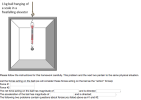 1 kg ball hanging of a scale ina freefalling elevator Please follow the instructions for this homework carefully. This problem and the next two pertain to the same physical situation List the forces acting on the ball (we will consider these forces acting on the ball as the "action" forces): Force #1 Force #2 and is directed The net force acting on the ball has magnitude of The acceleration of the ball has magnitude of The following two problems contain...
Problem#6 A system comprising blocks, a light frictionless pulley, a frictionless incline, and connecting ropes is shown in the figure. The 9.0-kg block accelerates downward when the system...
 Problem#6 A system comprising blocks, a light frictionless pulley, a frictionless incline, and connecting ropes is shown in the figure. The 9.0-kg block accelerates downward when the system is released from rest. The tension in the rope connects the 6.0-kg block and the 4.0-kg block. (a) Draw the free body diagrams (b) Find the tension in the rope (c) Find the reaction of the incline surface on each block rn +1 30° 10-9
Problem#6 A system comprising blocks, a light...
Problem#6 A system comprising blocks, a light frictionless pulley, a frictionless incline, and connecting ropes is shown in the figure. The 9.0-kg block accelerates downward when the system is released from rest. The tension in the rope connects the 6.0-kg block and the 4.0-kg block. (a) Draw the free body diagrams (b) Find the tension in the rope (c) Find the reaction of the incline surface on each block rn +1 30° 10-9
Problem#6 A system comprising blocks, a light...
a spherical ball hangs on a string on a smooth, frictionless wall.The mass of the ball...
a spherical ball hangs on a string on a smooth, frictionless wall.The mass of the ball is m,its radius is R,and the length of the string is l. Draw a “free-body”diagram with all the forces acting on the ball.Find the normal force between the ball and the wall.Show that N goes to 0 as l goes to infinity. Solve for T and check your answer in this limit as well as in the limit specified in the problem statement.
 Two boxes, each of mass 2.0 kg. are connected by a
rope. acceleration= 5 m/s^2
A.) draw a free body diagram for each box
B.) considering the ropes are lightweight...
B1.)what is the tension in the top rope?
B2.) what is the tension of the rope connecting the two boxes?
C.)considering the ropes are steel cables with a mass
of 1.0 kg...
C1.) what would be the force of the steel cable on the top
box?
C2.) what would be...
Two boxes, each of mass 2.0 kg. are connected by a
rope. acceleration= 5 m/s^2
A.) draw a free body diagram for each box
B.) considering the ropes are lightweight...
B1.)what is the tension in the top rope?
B2.) what is the tension of the rope connecting the two boxes?
C.)considering the ropes are steel cables with a mass
of 1.0 kg...
C1.) what would be the force of the steel cable on the top
box?
C2.) what would be...
 A rudimentary elevator is constructed by connected an elevator car of mass Me = 568 kg to a large counterweight of mass Me = 730 kg. A man of mass m = 90 kg steps on the elevator car and then the counterweight is released. a) Draw the free body diagrams for the elevator car, the counterweight, and the man. b) What is the acceleration of the counterweight (magnitude and direction)? c) What is the tension in the string? d)...
 1 kg ball hanging of a scale ina freefalling elevator Please follow the instructions for this homework carefully. This problem and the next two pertain to the same physical situation List the forces acting on the ball (we will consider these forces acting on the ball as the "action" forces): Force #1 Force #2 and is directed The net force acting on the ball has magnitude of The acceleration of the ball has magnitude of The following two problems contain...
 Problem#6 A system comprising blocks, a light frictionless pulley, a frictionless incline, and connecting ropes is shown in the figure. The 9.0-kg block accelerates downward when the system is released from rest. The tension in the rope connects the 6.0-kg block and the 4.0-kg block. (a) Draw the free body diagrams (b) Find the tension in the rope (c) Find the reaction of the incline surface on each block rn +1 30° 10-9
Problem#6 A system comprising blocks, a light...
Problem#6 A system comprising blocks, a light frictionless pulley, a frictionless incline, and connecting ropes is shown in the figure. The 9.0-kg block accelerates downward when the system is released from rest. The tension in the rope connects the 6.0-kg block and the 4.0-kg block. (a) Draw the free body diagrams (b) Find the tension in the rope (c) Find the reaction of the incline surface on each block rn +1 30° 10-9
Problem#6 A system comprising blocks, a light...
Most questions answered within 3 hours.
-
Where is the error in this code sequence?
String s1 = "Hello";
String s2 = "ello";...
asked 10 months ago -
Financial data for Joel de Paris, Inc., for last year
follow:
Joel de Paris, Inc.
Balance...
asked 10 months ago -
Consider this reaction:
Al2(SO4)3 (aq)+ BaCl3
(aq) Al2Cl6 (aq)- +
3BaSO4(s) . What is the...
asked 10 months ago -
Suppose that Savneet is considering increasing her
recent random sample from 20 car rentals to 40...
asked 10 months ago -
Trucks arrive at an unloading terminal at an average rate of 120
per hour.
Trucks arrive...
asked 10 months ago -
Why are methanol and ethanol completely soluble in water while
octanol is not very little soluble....
asked 10 months ago -
A facilities manager at a university reads in a research report
that the mean amount of...
asked 10 months ago -
When the CuSO4 is rehydrated by adding water to the anhydrous
compound, is this an endothermic...
asked 10 months ago -
A ray of sunlight is passing from diamond into crown glass; the
angle of incidence is...
asked 10 months ago -
A block of mass 0.249 kg is placed on top of a light, vertical
spring of...
asked 10 months ago -
how do the kidneys compensate in the presences of acidosis
a) trigger hyperventilate
b) reserve acid...
asked 10 months ago -
Question 501 pts
The rental rate of capital to the firm increases. Which of the
following...
asked 10 months ago