![a) A point charge +q is placed at the origin. By explicitly calculating the relevant line integral, determine how much exter- nal work must be done to bring another point charge +q from infinity to the point r2- ay? Consider the difference between external work and work done by the force. {2] b) Both of these charges are held fixed and a third charge +q is now brought from infinity to position F3 a+ay. Re- peat the same type of calculation as in a). What is the total stored potential energy of this three-charge system? 12 c) A fourth charge is now brought from infinity to 74-ai. Again, repeat the same type of calculation as in a). What is the total electrostatic potential energy? 12)](http://img.homeworklib.com/questions/cc152eb0-6e9c-11ea-860c-2bdce984f231.png?x-oss-process=image/resize,w_560)
Homework Answers
 please rate it up thanks
:)
please rate it up thanks
:)
Add Answer to:
a) A point charge +q is placed at the origin. By explicitly calculating the relevant line...
a) b) A point charge Q is held fixed in place and another point charge q...
 a)
b)
A point charge Q is held fixed in place and another point charge q is brought closer to it moving at constant velocity. Which of the following statement(s) is (are) true? 1. I. The electrostatic potential energy of q increases as it is brought closer to Q if q and Q are of the same sign. 2. I. The work done by the electrostatic force is positive if q and Q are of the same sign. 3. III....
a)
b)
A point charge Q is held fixed in place and another point charge q is brought closer to it moving at constant velocity. Which of the following statement(s) is (are) true? 1. I. The electrostatic potential energy of q increases as it is brought closer to Q if q and Q are of the same sign. 2. I. The work done by the electrostatic force is positive if q and Q are of the same sign. 3. III....
A) A point charge 2Q is placed at the origin and a point charge -Q is...
 A) A point charge 2Q is placed at the origin and a point charge -Q is placed at position +D on the x-axis. (a) At what point on the x-axis is the electric field due to these charges equal to zero? o? (c) If another point charge equal to -2Q is brought from infinitely far away, and placed at the point identified in part (b), what is the change of the total potential energy for the system in the process...
Question 1 (20 pts.) Two point objects are placed on the x-axis with a separations d...
 Question 1 (20 pts.) Two point objects are placed on the x-axis with a separations d between them as seen in the figure having equal and opposite charges. For q = 2C, and d = 0.1m: (a) What is the electric field E (vector) at the point P? (b) What is the electric potential V (scalar) at the point P? (c) What is the total electrostatic potential energy U of this system? (d) A third particle with charge Q =...
Consider a point charge ?1 = +1.0 C sitting by itself in empty space. a. (1...
Consider a point charge ?1 = +1.0 C sitting by itself in empty space. a. (1 point) What is the electric potential energy of the charge? b. (2 points) What is the potential at some point P that is 1.0 m away? c. (2 points) What is the electric field magnitude at P? d. (2 points) A second point charge, ?2 = +2.0 C, is brought from infinity and positioned at point P. What is the potential energy of this...
A negative point charge is fixed at the origin. A positive charge q is placed at...
A negative point charge is fixed at the origin. A positive charge q is placed at point P, initially at rest. After it is released and allowed to move freely, it passes through point R. Which of the following is true about the charge q: A. Its kinetic energy is larger at R than at P, and its potential energy is also larger at R than at P B. Its kinetic energy is larger at R than at P, but...
A 5.00-mC point charge is at the origin, and a point charge q_2 = -22.00 mC...
 A 5.00-mC point charge is at the origin, and a point charge q_2 = -22.00 mC is on the x-axis at (3.00, 0) m. If the electric potential is taken to be zero at infinity, find the electric potential due to these charges at point P with coordinates (0, 4.00) How much work is required to bring a third point charge of 4.00 mC from infinity to P?
A positive point charge +Q is located on the x-axis at x = −a. (a) How...
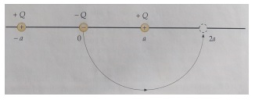 A positive point charge +Q is located on the x-axis at x = −a.
(a) How much work is needed to bring a second charge +Q from
infinity to x = a? (b) With 2 charges Q at x = ±a, how much work is
needed to bring a charge −Q from infinity to x = 0? (c) How much
work is needed to bring the −Q charges from x = 0 to x = 2a along
the semicircular path...
A positive point charge +Q is located on the x-axis at x = −a.
(a) How much work is needed to bring a second charge +Q from
infinity to x = a? (b) With 2 charges Q at x = ±a, how much work is
needed to bring a charge −Q from infinity to x = 0? (c) How much
work is needed to bring the −Q charges from x = 0 to x = 2a along
the semicircular path...
P1. (60 pts) Three point charges are placed in the corners of a right triangle of...
 P1. (60 pts) Three point charges are placed in the corners of a right triangle of side a - 2 m, which is rotated 90 deg, as shown in the figure below, where g is 1μC. In the point P, we place another charge qo of 1 μC. (a) (10 pts) Find the net electric field E vector (direction and magnitude) in P. (b) (10 pts) Find the electric force in P. (c) (10 pts) With V 0 at infinity,...
An electric point charge of Q_1 = 9.63 nC is placed at the origin of the...
 An electric point charge of Q_1 = 9.63 nC is placed at the origin of the real axis. Another point charge of Q_2 = 1.83 nC is placed at a position of p = 2.25 m on the_real axis. At which position can a third point charge of q = -7.28 nC be placed so that the net electrostatic force on it is zero? Let the sign of Q_2 be changed from positive to negative. At which position can the...
A point particle has a charge equal to +1.80 uC and is fixed at the origin...
 A point particle has a charge equal to +1.80 uC and is fixed at the origin (a) what is the electric potentialV at a point 4.50 m from the origin assuming that V = 0 at infinity? kV (b) How much work must be done to bring a second point particle that has a charge of +2.90 uC from the infinity to a distance of 4.50 m from the +1.80-HC charge? mJ eBook
 a)
b)
A point charge Q is held fixed in place and another point charge q is brought closer to it moving at constant velocity. Which of the following statement(s) is (are) true? 1. I. The electrostatic potential energy of q increases as it is brought closer to Q if q and Q are of the same sign. 2. I. The work done by the electrostatic force is positive if q and Q are of the same sign. 3. III....
a)
b)
A point charge Q is held fixed in place and another point charge q is brought closer to it moving at constant velocity. Which of the following statement(s) is (are) true? 1. I. The electrostatic potential energy of q increases as it is brought closer to Q if q and Q are of the same sign. 2. I. The work done by the electrostatic force is positive if q and Q are of the same sign. 3. III....
 A) A point charge 2Q is placed at the origin and a point charge -Q is placed at position +D on the x-axis. (a) At what point on the x-axis is the electric field due to these charges equal to zero? o? (c) If another point charge equal to -2Q is brought from infinitely far away, and placed at the point identified in part (b), what is the change of the total potential energy for the system in the process...
 Question 1 (20 pts.) Two point objects are placed on the x-axis with a separations d between them as seen in the figure having equal and opposite charges. For q = 2C, and d = 0.1m: (a) What is the electric field E (vector) at the point P? (b) What is the electric potential V (scalar) at the point P? (c) What is the total electrostatic potential energy U of this system? (d) A third particle with charge Q =...
 A 5.00-mC point charge is at the origin, and a point charge q_2 = -22.00 mC is on the x-axis at (3.00, 0) m. If the electric potential is taken to be zero at infinity, find the electric potential due to these charges at point P with coordinates (0, 4.00) How much work is required to bring a third point charge of 4.00 mC from infinity to P?
 A positive point charge +Q is located on the x-axis at x = −a.
(a) How much work is needed to bring a second charge +Q from
infinity to x = a? (b) With 2 charges Q at x = ±a, how much work is
needed to bring a charge −Q from infinity to x = 0? (c) How much
work is needed to bring the −Q charges from x = 0 to x = 2a along
the semicircular path...
A positive point charge +Q is located on the x-axis at x = −a.
(a) How much work is needed to bring a second charge +Q from
infinity to x = a? (b) With 2 charges Q at x = ±a, how much work is
needed to bring a charge −Q from infinity to x = 0? (c) How much
work is needed to bring the −Q charges from x = 0 to x = 2a along
the semicircular path...
 P1. (60 pts) Three point charges are placed in the corners of a right triangle of side a - 2 m, which is rotated 90 deg, as shown in the figure below, where g is 1μC. In the point P, we place another charge qo of 1 μC. (a) (10 pts) Find the net electric field E vector (direction and magnitude) in P. (b) (10 pts) Find the electric force in P. (c) (10 pts) With V 0 at infinity,...
 An electric point charge of Q_1 = 9.63 nC is placed at the origin of the real axis. Another point charge of Q_2 = 1.83 nC is placed at a position of p = 2.25 m on the_real axis. At which position can a third point charge of q = -7.28 nC be placed so that the net electrostatic force on it is zero? Let the sign of Q_2 be changed from positive to negative. At which position can the...
 A point particle has a charge equal to +1.80 uC and is fixed at the origin (a) what is the electric potentialV at a point 4.50 m from the origin assuming that V = 0 at infinity? kV (b) How much work must be done to bring a second point particle that has a charge of +2.90 uC from the infinity to a distance of 4.50 m from the +1.80-HC charge? mJ eBook
Most questions answered within 3 hours.
-
Where is the error in this code sequence?
String s1 = "Hello";
String s2 = "ello";...
asked 10 months ago -
Financial data for Joel de Paris, Inc., for last year
follow:
Joel de Paris, Inc.
Balance...
asked 10 months ago -
Consider this reaction:
Al2(SO4)3 (aq)+ BaCl3
(aq) Al2Cl6 (aq)- +
3BaSO4(s) . What is the...
asked 10 months ago -
Suppose that Savneet is considering increasing her
recent random sample from 20 car rentals to 40...
asked 10 months ago -
Trucks arrive at an unloading terminal at an average rate of 120
per hour.
Trucks arrive...
asked 10 months ago -
Why are methanol and ethanol completely soluble in water while
octanol is not very little soluble....
asked 10 months ago -
A facilities manager at a university reads in a research report
that the mean amount of...
asked 10 months ago -
When the CuSO4 is rehydrated by adding water to the anhydrous
compound, is this an endothermic...
asked 10 months ago -
A ray of sunlight is passing from diamond into crown glass; the
angle of incidence is...
asked 10 months ago -
A block of mass 0.249 kg is placed on top of a light, vertical
spring of...
asked 10 months ago -
how do the kidneys compensate in the presences of acidosis
a) trigger hyperventilate
b) reserve acid...
asked 10 months ago -
Question 501 pts
The rental rate of capital to the firm increases. Which of the
following...
asked 10 months ago