
Homework Answers
Add Answer to:
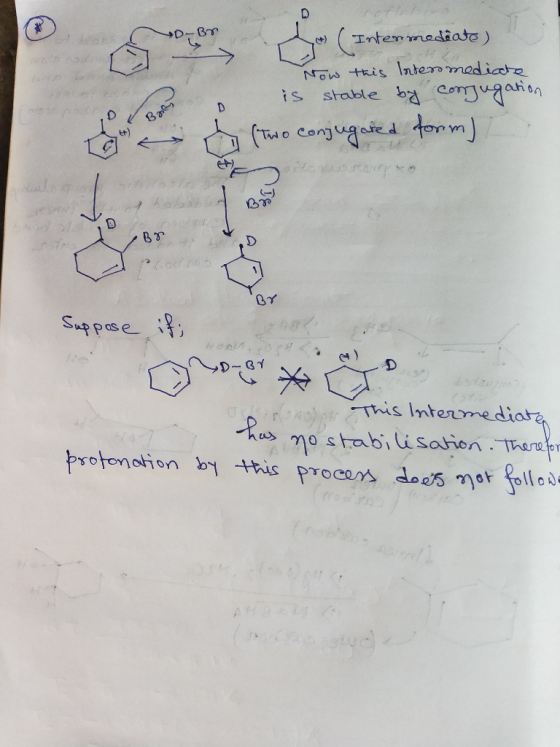
is a compound that contains two double bonds. When 1,3-cyclohexadiene reacts with DBr (analogous to HBr)...
3. 1,2-dimethyl-1,3-cyclohexadiene reacts with HCl to form up to four different products. HCI 4 possible products...
 3. 1,2-dimethyl-1,3-cyclohexadiene reacts with HCl to form up to four different products. HCI 4 possible products a. b. Give the structures for the four products. When the reaction is run at low temperature, two products are formed preferentially ldentify these two products. c. When the reaction temperature is increased, a single product is favored. Identify the major product under these reaction conditions
The addition of HBr to 1,3-butadiene in the presence of a catalytic amount of peroxides
 The addition of HBr to 1,3-butadiene in the presence of a catalytic amount of peroxides gives the expected product from anti-Markovnikov addition of HBr to one of the double bonds (BrCH2CH2CH CHa) and another product as shown below. Propose mechanism that explains how this product could be formed via a free radical mechanism. (Note: An ionic mechanism for the addition of HBr is also a possible explanation for the formation of the product. This is not what I am looking for...
a. Compound 6 reacts with hydrogen bromide as shown in reaction (4) i. Draw the structures...
 a. Compound 6 reacts with hydrogen bromide as shown in reaction (4) i. Draw the structures of the potential products which may be formed in this reaction (ignore any stereochemical isomers). (4 marks) ii. Using curly arrows, draw a mechanism for the formation of each of the potential products. ldentify the major product. Explain briefly why the major product you identified is favoured. (11 marks)
The following compound can be prepared by the addition of HBr to either of two alkenes,...
 The following compound can be prepared by the addition of HBr to either of two alkenes, give their structures Start with the same two alkenes, would the products be different if DBr(D = deuterium) were used instead of HBr? Explain using a mechanism that outlines the tree steps of all organic chemical reactions. The reaction of alpha-pinene with H_2 in the presence o Pd/c produces A and not B. Why does product B not form?
Critical Thinking Questions 1. Draw the structure for the product from the reaction of 1,3-cyclohexadiene and...
 Critical Thinking Questions 1. Draw the structure for the product from the reaction of 1,3-cyclohexadiene and maleic acid (cis-2-butenedioic acid). 2. What is the product expected from the reaction of 1,3-butadiene and 3-sulfolene? Why is this not a major concern as a by-product? Part B, the dimer dicyclopentadiene is a possible contaminant of cyclopentadi- ene. It is also a diene. Can dicyclopentadiene undergo reaction with cyclopentadi- ene? Can dicyclopentadiene act as a diene and undergo reaction with the anhydride 3....
4-chloro-2-methyl-2-pentene reacts with acetic acid (solvent), two substitution products are urmea, with the rearranged product predominating...
 4-chloro-2-methyl-2-pentene reacts with acetic acid (solvent), two substitution products are urmea, with the rearranged product predominating as shown in the diagram that follows. When small amounts of acetate ion are added to the reaction mixture, no increase in the rate is observed. Propose a mechanism that accounts for these results. Explain clearly why two products are formed (5 points) Minor Major
Orgo Lab experiment: Isomerization of Carvone 1. Carvone contains a ketone and two double bonds. However,...
Orgo Lab experiment: Isomerization of Carvone 1. Carvone contains a ketone and two double bonds. However, when treated with the concentrated acid only one reacts to create the carbocation. Which alkene reacts to form the carbocation and why only the one? 2. After the carbocation rearranges an elimination occurs, the alkene formed is a trisubstituted instead of the tetrasubstituted alternative. Why is this odd and what is the driving force for this specific alkene formation? 3. Using the H NMR...
please help with organic chemistry! mechanisms? 5) The reaction of 2-bromo-1,1-dimethylcyclohexane with methanol gives the following...
 please help with organic chemistry! mechanisms?
5) The reaction of 2-bromo-1,1-dimethylcyclohexane with methanol gives the following products. Please provide a detailed explanation to the formation of each product. You should use structures of intermediates in your answer. (8 points). осн, CH,он OCH Br + 6) There are a variety of isomeric 1,2,3,4,5,6-hexachlorocyclohexanes, but one of them does not react with CH3CH20' to give an elimination product. Provide the structure of this compound and briefly explain why it does not react...
please help with organic chemistry! mechanisms?
5) The reaction of 2-bromo-1,1-dimethylcyclohexane with methanol gives the following products. Please provide a detailed explanation to the formation of each product. You should use structures of intermediates in your answer. (8 points). осн, CH,он OCH Br + 6) There are a variety of isomeric 1,2,3,4,5,6-hexachlorocyclohexanes, but one of them does not react with CH3CH20' to give an elimination product. Provide the structure of this compound and briefly explain why it does not react...
Orgo Lab experiment: Isomerization of Carvone 1. Carvone contains a ketone and two double bonds. However,...
 Orgo Lab experiment: Isomerization of Carvone
1. Carvone contains a ketone and two double bonds. However, when
treated with the concentrated acid only one reacts to create the
carbocation. Which alkene reacts to form the carbocation and why
only the one?
2. After the carbocation rearranges an elimination occurs, the
alkene formed is a trisubstituted instead of the tetrasubstituted
alternative. Why is this odd and what is the driving force for this
specific alkene formation?
3. Using the H NMR...
Orgo Lab experiment: Isomerization of Carvone
1. Carvone contains a ketone and two double bonds. However, when
treated with the concentrated acid only one reacts to create the
carbocation. Which alkene reacts to form the carbocation and why
only the one?
2. After the carbocation rearranges an elimination occurs, the
alkene formed is a trisubstituted instead of the tetrasubstituted
alternative. Why is this odd and what is the driving force for this
specific alkene formation?
3. Using the H NMR...
help please! for 6 and 7. 6) There are a variety of isomeric 1,2,3,4,5,6-hexachlorocyclohexanes, but one...
 help please! for 6 and 7.
6) There are a variety of isomeric 1,2,3,4,5,6-hexachlorocyclohexanes, but one of them does not react with CH CH,O to give an elimination product. Provide the structure of this compound and briefly explain why it does not react (5 points). When 4-chloro-2-methyl-2-pentene reacts with acetic acid (solvent), two substitution products are formed, with the rearranged product predominating as shown in the diagram that follows. When small amounts of acetate ion are added to the reaction...
help please! for 6 and 7.
6) There are a variety of isomeric 1,2,3,4,5,6-hexachlorocyclohexanes, but one of them does not react with CH CH,O to give an elimination product. Provide the structure of this compound and briefly explain why it does not react (5 points). When 4-chloro-2-methyl-2-pentene reacts with acetic acid (solvent), two substitution products are formed, with the rearranged product predominating as shown in the diagram that follows. When small amounts of acetate ion are added to the reaction...
 3. 1,2-dimethyl-1,3-cyclohexadiene reacts with HCl to form up to four different products. HCI 4 possible products a. b. Give the structures for the four products. When the reaction is run at low temperature, two products are formed preferentially ldentify these two products. c. When the reaction temperature is increased, a single product is favored. Identify the major product under these reaction conditions
 a. Compound 6 reacts with hydrogen bromide as shown in reaction (4) i. Draw the structures of the potential products which may be formed in this reaction (ignore any stereochemical isomers). (4 marks) ii. Using curly arrows, draw a mechanism for the formation of each of the potential products. ldentify the major product. Explain briefly why the major product you identified is favoured. (11 marks)
 The following compound can be prepared by the addition of HBr to either of two alkenes, give their structures Start with the same two alkenes, would the products be different if DBr(D = deuterium) were used instead of HBr? Explain using a mechanism that outlines the tree steps of all organic chemical reactions. The reaction of alpha-pinene with H_2 in the presence o Pd/c produces A and not B. Why does product B not form?
 Critical Thinking Questions 1. Draw the structure for the product from the reaction of 1,3-cyclohexadiene and maleic acid (cis-2-butenedioic acid). 2. What is the product expected from the reaction of 1,3-butadiene and 3-sulfolene? Why is this not a major concern as a by-product? Part B, the dimer dicyclopentadiene is a possible contaminant of cyclopentadi- ene. It is also a diene. Can dicyclopentadiene undergo reaction with cyclopentadi- ene? Can dicyclopentadiene act as a diene and undergo reaction with the anhydride 3....
 4-chloro-2-methyl-2-pentene reacts with acetic acid (solvent), two substitution products are urmea, with the rearranged product predominating as shown in the diagram that follows. When small amounts of acetate ion are added to the reaction mixture, no increase in the rate is observed. Propose a mechanism that accounts for these results. Explain clearly why two products are formed (5 points) Minor Major
 please help with organic chemistry! mechanisms?
5) The reaction of 2-bromo-1,1-dimethylcyclohexane with methanol gives the following products. Please provide a detailed explanation to the formation of each product. You should use structures of intermediates in your answer. (8 points). осн, CH,он OCH Br + 6) There are a variety of isomeric 1,2,3,4,5,6-hexachlorocyclohexanes, but one of them does not react with CH3CH20' to give an elimination product. Provide the structure of this compound and briefly explain why it does not react...
please help with organic chemistry! mechanisms?
5) The reaction of 2-bromo-1,1-dimethylcyclohexane with methanol gives the following products. Please provide a detailed explanation to the formation of each product. You should use structures of intermediates in your answer. (8 points). осн, CH,он OCH Br + 6) There are a variety of isomeric 1,2,3,4,5,6-hexachlorocyclohexanes, but one of them does not react with CH3CH20' to give an elimination product. Provide the structure of this compound and briefly explain why it does not react...
 Orgo Lab experiment: Isomerization of Carvone
1. Carvone contains a ketone and two double bonds. However, when
treated with the concentrated acid only one reacts to create the
carbocation. Which alkene reacts to form the carbocation and why
only the one?
2. After the carbocation rearranges an elimination occurs, the
alkene formed is a trisubstituted instead of the tetrasubstituted
alternative. Why is this odd and what is the driving force for this
specific alkene formation?
3. Using the H NMR...
Orgo Lab experiment: Isomerization of Carvone
1. Carvone contains a ketone and two double bonds. However, when
treated with the concentrated acid only one reacts to create the
carbocation. Which alkene reacts to form the carbocation and why
only the one?
2. After the carbocation rearranges an elimination occurs, the
alkene formed is a trisubstituted instead of the tetrasubstituted
alternative. Why is this odd and what is the driving force for this
specific alkene formation?
3. Using the H NMR...
 help please! for 6 and 7.
6) There are a variety of isomeric 1,2,3,4,5,6-hexachlorocyclohexanes, but one of them does not react with CH CH,O to give an elimination product. Provide the structure of this compound and briefly explain why it does not react (5 points). When 4-chloro-2-methyl-2-pentene reacts with acetic acid (solvent), two substitution products are formed, with the rearranged product predominating as shown in the diagram that follows. When small amounts of acetate ion are added to the reaction...
help please! for 6 and 7.
6) There are a variety of isomeric 1,2,3,4,5,6-hexachlorocyclohexanes, but one of them does not react with CH CH,O to give an elimination product. Provide the structure of this compound and briefly explain why it does not react (5 points). When 4-chloro-2-methyl-2-pentene reacts with acetic acid (solvent), two substitution products are formed, with the rearranged product predominating as shown in the diagram that follows. When small amounts of acetate ion are added to the reaction...
Most questions answered within 3 hours.
-
Where is the error in this code sequence?
String s1 = "Hello";
String s2 = "ello";...
asked 10 months ago -
Financial data for Joel de Paris, Inc., for last year
follow:
Joel de Paris, Inc.
Balance...
asked 10 months ago -
Consider this reaction:
Al2(SO4)3 (aq)+ BaCl3
(aq) Al2Cl6 (aq)- +
3BaSO4(s) . What is the...
asked 10 months ago -
Suppose that Savneet is considering increasing her
recent random sample from 20 car rentals to 40...
asked 10 months ago -
Trucks arrive at an unloading terminal at an average rate of 120
per hour.
Trucks arrive...
asked 10 months ago -
Why are methanol and ethanol completely soluble in water while
octanol is not very little soluble....
asked 10 months ago -
A facilities manager at a university reads in a research report
that the mean amount of...
asked 10 months ago -
When the CuSO4 is rehydrated by adding water to the anhydrous
compound, is this an endothermic...
asked 10 months ago -
A ray of sunlight is passing from diamond into crown glass; the
angle of incidence is...
asked 10 months ago -
A block of mass 0.249 kg is placed on top of a light, vertical
spring of...
asked 10 months ago -
how do the kidneys compensate in the presences of acidosis
a) trigger hyperventilate
b) reserve acid...
asked 10 months ago -
Question 501 pts
The rental rate of capital to the firm increases. Which of the
following...
asked 10 months ago