
Homework Answers
Add Answer to:
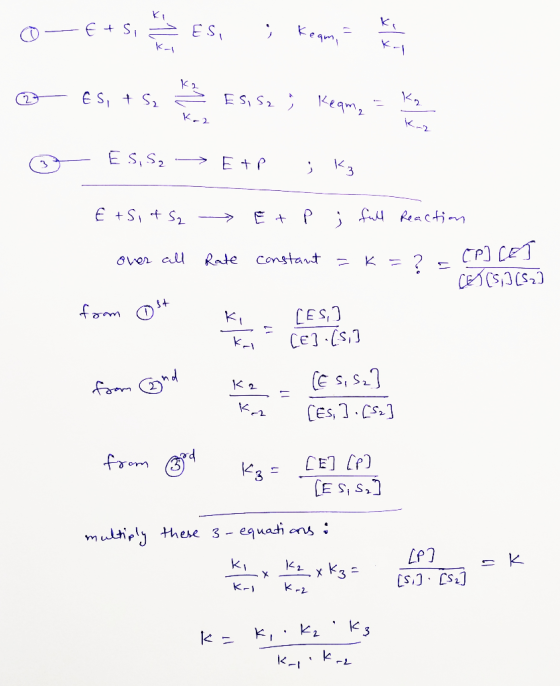
1. The sequential mechanism for an enzyme, E, with two substrates, Si and S2 is shown...
Problem 2: (Enzyme Kinetics) A competitive inhibitor I interferes with an enzyme-catalyzed reaction according to the...
 Problem 2: (Enzyme Kinetics) A competitive inhibitor I interferes with an enzyme-catalyzed reaction according to the mechanism: E+S →ES, rate constant = ki, ES → E+S, rate constant = k-1, ES → E+P, rate constant = k2, E + EI, rate constant = k3. EI → E + I, rate constant = k-3. Assuming that the concentrations of S and I are much larger than the total enzyme concentration, derive an expression for the initial rate of appearance of product,...
3) For the simplified representation of an enzyme-catalyzed reaction shown below, the statement “ES is in...
 3) For the simplified representation of an enzyme-catalyzed
reaction shown below, the statement “ES is in steady-state” means
that:
A) k2 is very slow.
B) k1= k2.
C) k1= k-1.
D) k1[E][S] = k-1[ES] + k2[ES].
E) k1[E][S] = k-1[ES].
3) For the simplified representation of an enzyme-catalyzed reaction shown below, the statement “ES is in steady-state" means that: k, k, E+S <> ES Z E +P - k1 A) k2 is very slow. B) Kı= k2. C) K1= k-1....
3) For the simplified representation of an enzyme-catalyzed
reaction shown below, the statement “ES is in steady-state” means
that:
A) k2 is very slow.
B) k1= k2.
C) k1= k-1.
D) k1[E][S] = k-1[ES] + k2[ES].
E) k1[E][S] = k-1[ES].
3) For the simplified representation of an enzyme-catalyzed reaction shown below, the statement “ES is in steady-state" means that: k, k, E+S <> ES Z E +P - k1 A) k2 is very slow. B) Kı= k2. C) K1= k-1....
Enzymes are often described as following a two-step mechanism: Where E = enzyme, S = substrate,...
Enzymes are often described as following a two-step mechanism: Where E = enzyme, S = substrate, ES = enzyme-substrate complex, and P = product. Write the balanced equation for the overall reaction. Identify and intermediates in the reaction mechanism. Derive an expression for the rate law.
The action of enzymes is often described as following a two-step mechanism, named after the biochemists...
The action of enzymes is often described as following a two-step mechanism, named after the biochemists Michaelis and Menten, where in the first step the enzyme and the substrate form an intermediate complex, and in the second step the enzyme is released and the product is formed. Schematically, E + S ⇆ ES (fast) , k1 and k-1 are the rate constants for the direct and reverse reactions respectively. ES → E + P (slow), k2 is the rate constant...
1. M. L. Bender and T. H. Marshall [J. Am. Chem. Soc., 90, 201(1968)] studied the elastase-mediated hydrolysis of p-nit...
 1. M. L. Bender and T. H. Marshall [J. Am. Chem. Soc., 90, 201(1968)] studied the elastase-mediated hydrolysis of p-nitrophenyl trimethylacetate to produce p-nitrophenol. These authors have proposed the following mechanism for this reaction: k. k2 E A ES where S, the substrate, is p-nitrophenyl trimethylacetate; P, the product, is p-nitrophenol; and A is trimethylacetiç acid. k,= 150 m3mole-ksec and k2= 2.60 ksec1. (a) Derive an equation for the rate of production of species P in terms of ki, k2,...
You set up an experiment to assess kinetic rate constants for enzyme X with substrates A...
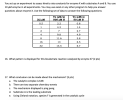 You set up an experiment to assess kinetic rate constants for enzyme X with substrates A and B. You use 10 M enzyme in all experiments. You may use excel or any other program to help you answer questions about enzyme X. Use the following set of data to answer the following questions: Vo (UM/s) 500 MB 2.2 Vo (uM/s) 50 MB [A] UM 0.8 4.3 1.4 2.7 4.9 5.8 9.8 11.6 13 13.5 6.5 6.7 16. What pattern is...
2.21 The series and parallel configurations of systems Si and S2 are shown in Fig. P2.21. The two...
 2.21 The series and parallel configurations of systems Si and S2 are shown in Fig. P2.21. The two systems are specified by the following input-output relationships: Si : y[k]- x[k] - 2x[k - 1] +x[k - 2]; (i) Show that Si and S2 are LTI systems (ii) Calculate the input-output relationship for the series configuration (iii) Calculate the input-output relationship for the parallel configuration (iv) Show that the series and parallel configurations of systems Si and of systems Si and...
Can you do b part in detail? 1. M. L. Bender and T. H. Marshall [J. Am. Chem. Soc., 90, 201(1968)] studied the elastase...
 Can you do b part in detail?
1. M. L. Bender and T. H. Marshall [J. Am. Chem. Soc., 90, 201(1968)] studied the elastase-mediated hydrolysis of p-nitrophenyl trimethylacetate to produce p-nitrophenol. These authors have proposed the following mechanism for this reaction: k. k2 E A ES where S, the substrate, is p-nitrophenyl trimethylacetate; P, the product, is p-nitrophenol; and A is trimethylacetiç acid. k,= 150 m3mole-ksec and k2= 2.60 ksec1. (a) Derive an equation for the rate of production of...
Can you do b part in detail?
1. M. L. Bender and T. H. Marshall [J. Am. Chem. Soc., 90, 201(1968)] studied the elastase-mediated hydrolysis of p-nitrophenyl trimethylacetate to produce p-nitrophenol. These authors have proposed the following mechanism for this reaction: k. k2 E A ES where S, the substrate, is p-nitrophenyl trimethylacetate; P, the product, is p-nitrophenol; and A is trimethylacetiç acid. k,= 150 m3mole-ksec and k2= 2.60 ksec1. (a) Derive an equation for the rate of production of...
Enzymes are often described as following the two-step mechanism: E+S⇌ES(fast) ES→E+P(slow) Where E = enzyme, S...
Enzymes are often described as following the two-step mechanism: E+S⇌ES(fast) ES→E+P(slow) Where E = enzyme, S = substrate, ES = enzyme-substrate complex and P = product. Question: Molecules that can bind to the active site of an enzyme but are not converted into product are called enzyme inhibitors.Write an additional elementary step to add into the preceding mechanism to account for the reaction of E with I, an inhibitor. Express your answer as a chemical equation.
8. For the simplified representation of an enzyme-catalyzed reaction shown below, the statement "ES is in...
 8. For the simplified representation of an enzyme-catalyzed reaction shown below, the statement "ES is in steady-state" means that: ki E+S ES – E+P kit2 a. kz is very slow. b. k1 = k. c. k1 = k-1. d. ki[E][S] = k-1[ES] + ka[ES]. e. ki[E][S] = k-1[ES]. 9. . You are examining the effects of a mutation in the proximal histidine of a heme-containing protein. This mutation has changed the histidine into an alanine. Based on your knowledge of...
 Problem 2: (Enzyme Kinetics) A competitive inhibitor I interferes with an enzyme-catalyzed reaction according to the mechanism: E+S →ES, rate constant = ki, ES → E+S, rate constant = k-1, ES → E+P, rate constant = k2, E + EI, rate constant = k3. EI → E + I, rate constant = k-3. Assuming that the concentrations of S and I are much larger than the total enzyme concentration, derive an expression for the initial rate of appearance of product,...
 3) For the simplified representation of an enzyme-catalyzed
reaction shown below, the statement “ES is in steady-state” means
that:
A) k2 is very slow.
B) k1= k2.
C) k1= k-1.
D) k1[E][S] = k-1[ES] + k2[ES].
E) k1[E][S] = k-1[ES].
3) For the simplified representation of an enzyme-catalyzed reaction shown below, the statement “ES is in steady-state" means that: k, k, E+S <> ES Z E +P - k1 A) k2 is very slow. B) Kı= k2. C) K1= k-1....
3) For the simplified representation of an enzyme-catalyzed
reaction shown below, the statement “ES is in steady-state” means
that:
A) k2 is very slow.
B) k1= k2.
C) k1= k-1.
D) k1[E][S] = k-1[ES] + k2[ES].
E) k1[E][S] = k-1[ES].
3) For the simplified representation of an enzyme-catalyzed reaction shown below, the statement “ES is in steady-state" means that: k, k, E+S <> ES Z E +P - k1 A) k2 is very slow. B) Kı= k2. C) K1= k-1....
 1. M. L. Bender and T. H. Marshall [J. Am. Chem. Soc., 90, 201(1968)] studied the elastase-mediated hydrolysis of p-nitrophenyl trimethylacetate to produce p-nitrophenol. These authors have proposed the following mechanism for this reaction: k. k2 E A ES where S, the substrate, is p-nitrophenyl trimethylacetate; P, the product, is p-nitrophenol; and A is trimethylacetiç acid. k,= 150 m3mole-ksec and k2= 2.60 ksec1. (a) Derive an equation for the rate of production of species P in terms of ki, k2,...
 You set up an experiment to assess kinetic rate constants for enzyme X with substrates A and B. You use 10 M enzyme in all experiments. You may use excel or any other program to help you answer questions about enzyme X. Use the following set of data to answer the following questions: Vo (UM/s) 500 MB 2.2 Vo (uM/s) 50 MB [A] UM 0.8 4.3 1.4 2.7 4.9 5.8 9.8 11.6 13 13.5 6.5 6.7 16. What pattern is...
 2.21 The series and parallel configurations of systems Si and S2 are shown in Fig. P2.21. The two systems are specified by the following input-output relationships: Si : y[k]- x[k] - 2x[k - 1] +x[k - 2]; (i) Show that Si and S2 are LTI systems (ii) Calculate the input-output relationship for the series configuration (iii) Calculate the input-output relationship for the parallel configuration (iv) Show that the series and parallel configurations of systems Si and of systems Si and...
 Can you do b part in detail?
1. M. L. Bender and T. H. Marshall [J. Am. Chem. Soc., 90, 201(1968)] studied the elastase-mediated hydrolysis of p-nitrophenyl trimethylacetate to produce p-nitrophenol. These authors have proposed the following mechanism for this reaction: k. k2 E A ES where S, the substrate, is p-nitrophenyl trimethylacetate; P, the product, is p-nitrophenol; and A is trimethylacetiç acid. k,= 150 m3mole-ksec and k2= 2.60 ksec1. (a) Derive an equation for the rate of production of...
Can you do b part in detail?
1. M. L. Bender and T. H. Marshall [J. Am. Chem. Soc., 90, 201(1968)] studied the elastase-mediated hydrolysis of p-nitrophenyl trimethylacetate to produce p-nitrophenol. These authors have proposed the following mechanism for this reaction: k. k2 E A ES where S, the substrate, is p-nitrophenyl trimethylacetate; P, the product, is p-nitrophenol; and A is trimethylacetiç acid. k,= 150 m3mole-ksec and k2= 2.60 ksec1. (a) Derive an equation for the rate of production of...
 8. For the simplified representation of an enzyme-catalyzed reaction shown below, the statement "ES is in steady-state" means that: ki E+S ES – E+P kit2 a. kz is very slow. b. k1 = k. c. k1 = k-1. d. ki[E][S] = k-1[ES] + ka[ES]. e. ki[E][S] = k-1[ES]. 9. . You are examining the effects of a mutation in the proximal histidine of a heme-containing protein. This mutation has changed the histidine into an alanine. Based on your knowledge of...
Most questions answered within 3 hours.
-
Where is the error in this code sequence?
String s1 = "Hello";
String s2 = "ello";...
asked 10 months ago -
Financial data for Joel de Paris, Inc., for last year
follow:
Joel de Paris, Inc.
Balance...
asked 10 months ago -
Consider this reaction:
Al2(SO4)3 (aq)+ BaCl3
(aq) Al2Cl6 (aq)- +
3BaSO4(s) . What is the...
asked 10 months ago -
Suppose that Savneet is considering increasing her
recent random sample from 20 car rentals to 40...
asked 10 months ago -
Trucks arrive at an unloading terminal at an average rate of 120
per hour.
Trucks arrive...
asked 10 months ago -
Why are methanol and ethanol completely soluble in water while
octanol is not very little soluble....
asked 10 months ago -
A facilities manager at a university reads in a research report
that the mean amount of...
asked 10 months ago -
When the CuSO4 is rehydrated by adding water to the anhydrous
compound, is this an endothermic...
asked 10 months ago -
A ray of sunlight is passing from diamond into crown glass; the
angle of incidence is...
asked 10 months ago -
A block of mass 0.249 kg is placed on top of a light, vertical
spring of...
asked 10 months ago -
how do the kidneys compensate in the presences of acidosis
a) trigger hyperventilate
b) reserve acid...
asked 10 months ago -
Question 501 pts
The rental rate of capital to the firm increases. Which of the
following...
asked 10 months ago