1. (5 pt.) Soon you will synthesize the analgesic acetanilide in lab. It’s m.p. is 114C....
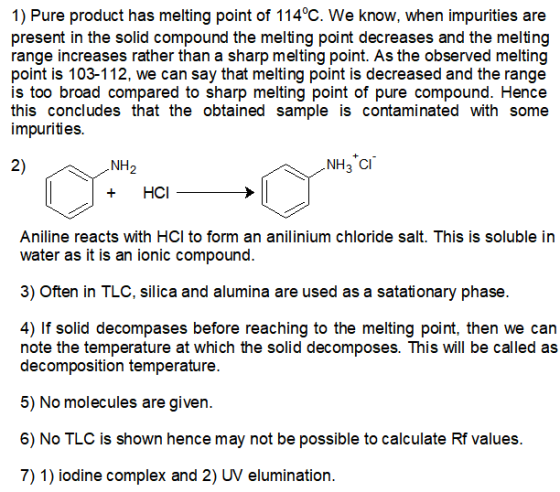
1. (5 pt.) Soon you will synthesize the analgesic acetanilide in lab. It’s m.p. is 114C. What does it indicate about your product if you obtain a m.p. of 103 - 112C. Explain.
2. (6 pt.) Neither aniline nor nitrobenzene is particularly water soluble. However, one is completely soluble in dilute aqueous HCl. Which one is soluble, and explain why? (For maximum credit, provide a chemical equation for your answer.)
3. (5 pt.) Name the two adsorbents that are most used on TLC plates or in column chromatography.
4. (4 pt.) What steps should be taken to obtain the melting point of a solid compound that decompose before reaching the melting point?
5. (8 pt.) Indicate which one of the following molecules are polar or nonpolar
6. (8 pt.) TLC of the two compounds using hexane-ethyl acetate (8:2) is given: (a) Indicate each spot belongs to which compound? (b) Calculate the Rf values for each compound. Show your work.
7. (4 pt.) What two methods were used to visualize the spots on the developed TLC plate?
8. Considering the given two component liquid mixture phase diagram, answer the following questions: a. (3 pt.) What are the boiling points of A and B, respectively? b. (2 pt.) Which line (X1, X2, or X3) represents an evaporation step in a distillation process? c. (3 pt.) When a mixture of 30% A and 70% B boils, what will be the composition of the vapor above the liquid? Show your work.
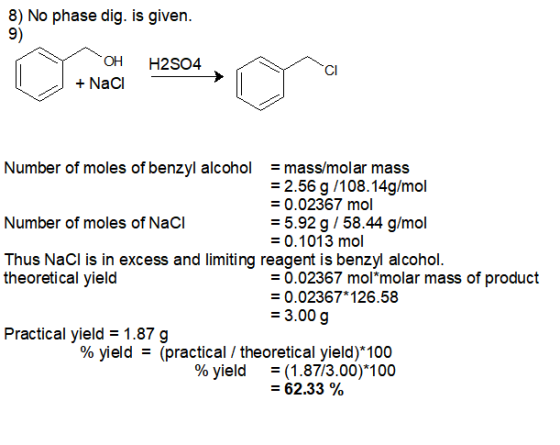
9. (6 pt.) 2.56 g of benzyl alcohol was reacted with 5.92 g of sodium chloride. Upon work up, 1.87 g of benzyl chloride was obtained. Sulfuric acid is a catalyst and should not be considered for this calculation. The stoichiometry of the reaction is 1:1 1. What is the limiting reagent? Calculate the theoretical and the percent yield. Show all calculations. (atomic weights, C = 12.011, H = 1.0079, O = 15.9994, Cl = 35.45, Na = 22.99).
Homework Answers
Add Answer to:
1. (5 pt.) Soon you will synthesize the analgesic acetanilide in
lab. It’s m.p. is 114C....
Didn't post this right the first time. Here is everything in full! Need help with Organic...
 Didn't post this right the first time. Here is everything in
full!
Need help with Organic Chemistry, understanding the labs.
1. Soon you will synthesize the analgesic acetanilide in lab. It's me is 114°C. What does it indicate about your product if you obtain a mn of 103 - 112°C. Explain. acetanilide YO 2. Neither aniline nor nitrobenzene is particularly water soluble. However, one is completely soluble in dilute aqueous HCI. Which one is soluble, and explain why? (For maximum...
Didn't post this right the first time. Here is everything in
full!
Need help with Organic Chemistry, understanding the labs.
1. Soon you will synthesize the analgesic acetanilide in lab. It's me is 114°C. What does it indicate about your product if you obtain a mn of 103 - 112°C. Explain. acetanilide YO 2. Neither aniline nor nitrobenzene is particularly water soluble. However, one is completely soluble in dilute aqueous HCI. Which one is soluble, and explain why? (For maximum...
Question # 9 (9 pt) In the lab you performed to determine the % of salt in a mixture of salt and sand. a. Which part of the procedure was performed with the aim of separating the salt from b. Whi...
 Question # 9 (9 pt) In the lab you performed to determine the % of salt in a mixture of salt and sand. a. Which part of the procedure was performed with the aim of separating the salt from b. Which part of the procedure was performed with the aim of collecting all of the salt c. Which part of the procedure was performed with the aim of finally getting a measure nothing but the salt? of salt and Choose...
Separating a Mixture, Recrystallization, pre-lab assignment could you also explain why you chose that substance for...
 Separating a Mixture, Recrystallization, pre-lab
assignment
could you also explain why you chose that substance for the empty
spaces and question marks
EXPERIMENT 4 Pre-Lab Assignment Separating a Mixture, Recrystalliration Name Date 1. Complete the following flowchart which shows how to separate a mixture of sand, sodium chloride and acetanilide. Notice that after a separation process (a down arrow) the filtered solids are shown on the left and the filtrate (the liquid) is shown on the right. The terminal step...
Separating a Mixture, Recrystallization, pre-lab
assignment
could you also explain why you chose that substance for the empty
spaces and question marks
EXPERIMENT 4 Pre-Lab Assignment Separating a Mixture, Recrystalliration Name Date 1. Complete the following flowchart which shows how to separate a mixture of sand, sodium chloride and acetanilide. Notice that after a separation process (a down arrow) the filtered solids are shown on the left and the filtrate (the liquid) is shown on the right. The terminal step...
Let's assume you have a mixture of equal parts benzoic acid, sand and toluene that are...
Let's assume you have a mixture of equal parts benzoic acid, sand and toluene that are intimately mixed together (the crude material is a mixture of solid and liquid). Propose a procedure to separate these three components using any of the chemicals commonly available (you've used all of the "common" chemicals in the lab by now) in the organic chemistry teaching laboratories and observing the typical limitations with the instruments and techniques (such as not being able to distill or...
Grignard Reaction with a Ketone: Triphenylmethanol Introduction: The purpose of this lab is to prepare phenylmagnesium...
Grignard Reaction with a Ketone: Triphenylmethanol Introduction: The purpose of this lab is to prepare phenylmagnesium bromide, a Grignard reagent, and react it with benzophenone to give triphenylmethanol. Grignard reagents are very reactive and must be synthesized in an environment free of water or any other source of potential proton donor. Once made, the Grignard reagent will do a nucleophilic attack on the carbonyl carbon of the ketone, benzophenone. The result is an alkoxide that is then protonated to give...
Construct a flow chart describing the seperation of the mixture and the isolation of each compound...
 Construct a flow chart describing the seperation of the
mixture and the isolation of each compound in this experiment. (Lab
steps/procedures includes for reference)
4. Construct a flow chart describing the separation of the mixture and the isolation of each compound in this experiment. A commonly used method of separating a mixture of organic compounds is known as liquid-liquid extraction. Most reactions of organic compounds require extraction at some stage of product purification. In this experiment you will use extraction...
Construct a flow chart describing the seperation of the
mixture and the isolation of each compound in this experiment. (Lab
steps/procedures includes for reference)
4. Construct a flow chart describing the separation of the mixture and the isolation of each compound in this experiment. A commonly used method of separating a mixture of organic compounds is known as liquid-liquid extraction. Most reactions of organic compounds require extraction at some stage of product purification. In this experiment you will use extraction...
The following questions are from an experiment titled Friedel-Crafts Alkylation for Organic Chemistry II Lab. There...
 The following questions are from an experiment titled
Friedel-Crafts Alkylation for Organic Chemistry II Lab. There are
pictures attached of the lab manual.
2) Is this method a good route for the preparation of
p-sec-butyltoulene? Give reasons for your answer.
3) Why do you use a large excess of toulene. What are its
functions?
4) What is the purpose for adding the hydrochloric acid to the
water in the separatory funnel in step 5? Hint: If no acid is
added,...
The following questions are from an experiment titled
Friedel-Crafts Alkylation for Organic Chemistry II Lab. There are
pictures attached of the lab manual.
2) Is this method a good route for the preparation of
p-sec-butyltoulene? Give reasons for your answer.
3) Why do you use a large excess of toulene. What are its
functions?
4) What is the purpose for adding the hydrochloric acid to the
water in the separatory funnel in step 5? Hint: If no acid is
added,...
1 of 2 27 Name f a liquid has a density of 2.71 what volume of...
 1 of 2 27 Name f a liquid has a density of 2.71 what volume of the lquid has a mass of 45.0 g? 0.0602 mL c) 166 mL b) 122 ml 602ml How many seconds are there in seven days? 252x 10s LO1 10s a) b) 6.05x 10s 3.02x 10s d. Which of the following is true? a liquid has a definite shape a solid can be compressed easly the particles of a gas are far aparf a gas...
CHM 1210 Final practice Name: Know electrolyte table, 5 solubility rules; 26 polyatomics (name/formula) Write 7...
 CHM 1210 Final practice Name: Know electrolyte table, 5 solubility rules; 26 polyatomics (name/formula) Write 7 naturally occurring diatomic molecules (name; formula, phase , charge) Write rite out strong acids and weak acids by name; formula, phase ,charge Write out the molecular, complete, and net-ionic equations for the following reactions The mixing of Cobalt(IlI) chloride and silver nitrate The mixing of acetic acid and sodium hydroxide The mixing of hydrochloric acid and cakcium hydroxide The mixing of barium chloride and...
Need help, numbers 3-6 please show work. and fill out table of chemicals for all chemical...
 Need help, numbers 3-6 please show work. and fill out table of
chemicals for all chemical used.
calculate mmol in the table as well show work please
and each of these must be listed in its own row. There are 10 column headings: IUPAC name OR common name, structure, CAS number (Chemical Abstract Service number) molecular mass, melting point (if applicable), boiling point (if applicable), solubility (in water, if applicable), density, amounts to be used in the experiment, and the...
Need help, numbers 3-6 please show work. and fill out table of
chemicals for all chemical used.
calculate mmol in the table as well show work please
and each of these must be listed in its own row. There are 10 column headings: IUPAC name OR common name, structure, CAS number (Chemical Abstract Service number) molecular mass, melting point (if applicable), boiling point (if applicable), solubility (in water, if applicable), density, amounts to be used in the experiment, and the...
 Didn't post this right the first time. Here is everything in
full!
Need help with Organic Chemistry, understanding the labs.
1. Soon you will synthesize the analgesic acetanilide in lab. It's me is 114°C. What does it indicate about your product if you obtain a mn of 103 - 112°C. Explain. acetanilide YO 2. Neither aniline nor nitrobenzene is particularly water soluble. However, one is completely soluble in dilute aqueous HCI. Which one is soluble, and explain why? (For maximum...
Didn't post this right the first time. Here is everything in
full!
Need help with Organic Chemistry, understanding the labs.
1. Soon you will synthesize the analgesic acetanilide in lab. It's me is 114°C. What does it indicate about your product if you obtain a mn of 103 - 112°C. Explain. acetanilide YO 2. Neither aniline nor nitrobenzene is particularly water soluble. However, one is completely soluble in dilute aqueous HCI. Which one is soluble, and explain why? (For maximum...
 Question # 9 (9 pt) In the lab you performed to determine the % of salt in a mixture of salt and sand. a. Which part of the procedure was performed with the aim of separating the salt from b. Which part of the procedure was performed with the aim of collecting all of the salt c. Which part of the procedure was performed with the aim of finally getting a measure nothing but the salt? of salt and Choose...
 Separating a Mixture, Recrystallization, pre-lab
assignment
could you also explain why you chose that substance for the empty
spaces and question marks
EXPERIMENT 4 Pre-Lab Assignment Separating a Mixture, Recrystalliration Name Date 1. Complete the following flowchart which shows how to separate a mixture of sand, sodium chloride and acetanilide. Notice that after a separation process (a down arrow) the filtered solids are shown on the left and the filtrate (the liquid) is shown on the right. The terminal step...
Separating a Mixture, Recrystallization, pre-lab
assignment
could you also explain why you chose that substance for the empty
spaces and question marks
EXPERIMENT 4 Pre-Lab Assignment Separating a Mixture, Recrystalliration Name Date 1. Complete the following flowchart which shows how to separate a mixture of sand, sodium chloride and acetanilide. Notice that after a separation process (a down arrow) the filtered solids are shown on the left and the filtrate (the liquid) is shown on the right. The terminal step...
 Construct a flow chart describing the seperation of the
mixture and the isolation of each compound in this experiment. (Lab
steps/procedures includes for reference)
4. Construct a flow chart describing the separation of the mixture and the isolation of each compound in this experiment. A commonly used method of separating a mixture of organic compounds is known as liquid-liquid extraction. Most reactions of organic compounds require extraction at some stage of product purification. In this experiment you will use extraction...
Construct a flow chart describing the seperation of the
mixture and the isolation of each compound in this experiment. (Lab
steps/procedures includes for reference)
4. Construct a flow chart describing the separation of the mixture and the isolation of each compound in this experiment. A commonly used method of separating a mixture of organic compounds is known as liquid-liquid extraction. Most reactions of organic compounds require extraction at some stage of product purification. In this experiment you will use extraction...
 The following questions are from an experiment titled
Friedel-Crafts Alkylation for Organic Chemistry II Lab. There are
pictures attached of the lab manual.
2) Is this method a good route for the preparation of
p-sec-butyltoulene? Give reasons for your answer.
3) Why do you use a large excess of toulene. What are its
functions?
4) What is the purpose for adding the hydrochloric acid to the
water in the separatory funnel in step 5? Hint: If no acid is
added,...
The following questions are from an experiment titled
Friedel-Crafts Alkylation for Organic Chemistry II Lab. There are
pictures attached of the lab manual.
2) Is this method a good route for the preparation of
p-sec-butyltoulene? Give reasons for your answer.
3) Why do you use a large excess of toulene. What are its
functions?
4) What is the purpose for adding the hydrochloric acid to the
water in the separatory funnel in step 5? Hint: If no acid is
added,...
 1 of 2 27 Name f a liquid has a density of 2.71 what volume of the lquid has a mass of 45.0 g? 0.0602 mL c) 166 mL b) 122 ml 602ml How many seconds are there in seven days? 252x 10s LO1 10s a) b) 6.05x 10s 3.02x 10s d. Which of the following is true? a liquid has a definite shape a solid can be compressed easly the particles of a gas are far aparf a gas...
 CHM 1210 Final practice Name: Know electrolyte table, 5 solubility rules; 26 polyatomics (name/formula) Write 7 naturally occurring diatomic molecules (name; formula, phase , charge) Write rite out strong acids and weak acids by name; formula, phase ,charge Write out the molecular, complete, and net-ionic equations for the following reactions The mixing of Cobalt(IlI) chloride and silver nitrate The mixing of acetic acid and sodium hydroxide The mixing of hydrochloric acid and cakcium hydroxide The mixing of barium chloride and...
 Need help, numbers 3-6 please show work. and fill out table of
chemicals for all chemical used.
calculate mmol in the table as well show work please
and each of these must be listed in its own row. There are 10 column headings: IUPAC name OR common name, structure, CAS number (Chemical Abstract Service number) molecular mass, melting point (if applicable), boiling point (if applicable), solubility (in water, if applicable), density, amounts to be used in the experiment, and the...
Need help, numbers 3-6 please show work. and fill out table of
chemicals for all chemical used.
calculate mmol in the table as well show work please
and each of these must be listed in its own row. There are 10 column headings: IUPAC name OR common name, structure, CAS number (Chemical Abstract Service number) molecular mass, melting point (if applicable), boiling point (if applicable), solubility (in water, if applicable), density, amounts to be used in the experiment, and the...
Most questions answered within 3 hours.
-
Where is the error in this code sequence?
String s1 = "Hello";
String s2 = "ello";...
asked 11 months ago -
Financial data for Joel de Paris, Inc., for last year
follow:
Joel de Paris, Inc.
Balance...
asked 11 months ago -
Consider this reaction:
Al2(SO4)3 (aq)+ BaCl3
(aq) Al2Cl6 (aq)- +
3BaSO4(s) . What is the...
asked 11 months ago -
Suppose that Savneet is considering increasing her
recent random sample from 20 car rentals to 40...
asked 11 months ago -
Trucks arrive at an unloading terminal at an average rate of 120
per hour.
Trucks arrive...
asked 11 months ago -
Why are methanol and ethanol completely soluble in water while
octanol is not very little soluble....
asked 11 months ago -
A facilities manager at a university reads in a research report
that the mean amount of...
asked 11 months ago -
When the CuSO4 is rehydrated by adding water to the anhydrous
compound, is this an endothermic...
asked 11 months ago -
A ray of sunlight is passing from diamond into crown glass; the
angle of incidence is...
asked 11 months ago -
A block of mass 0.249 kg is placed on top of a light, vertical
spring of...
asked 11 months ago -
how do the kidneys compensate in the presences of acidosis
a) trigger hyperventilate
b) reserve acid...
asked 11 months ago -
Question 501 pts
The rental rate of capital to the firm increases. Which of the
following...
asked 11 months ago