
Homework Answers
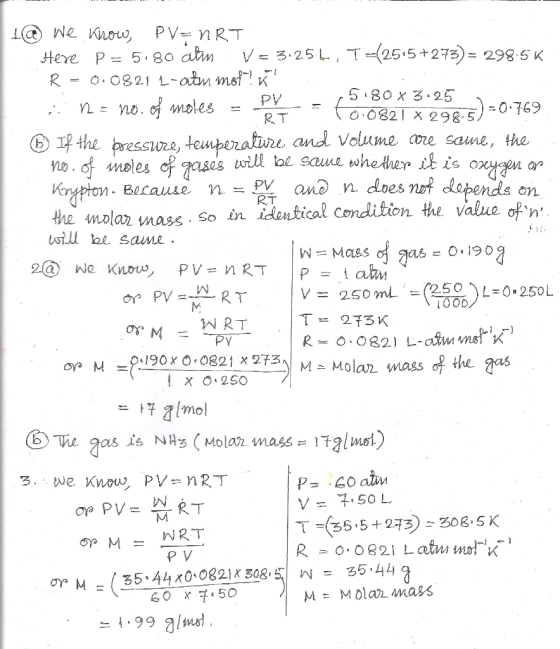
Add Answer to:
Pre-Laboratory Questions and Exercises Due before lab begins. Answer in the space provided 1. a) Determine...
ANSWER ALL QUESTIONS 7-12 or don’t bother 7. If 25.0 mL of 1.50 M CuSO4 is...
 ANSWER ALL QUESTIONS 7-12 or don’t bother
7. If 25.0 mL of 1.50 M CuSO4 is diluted to 250.0 mL with pure water, what is the molar concentration of CuSO4 after dilution? 8. A gas occupies a volume of 2.5 L at a pressure of 1.0 atm. What volume will it occupy, at the same temperature, at a pressure of 0.25 atm? 9. A 400 cm3 steel cylinder holds 1.50 g of ethanol, C2HsOH, vapor at 250 °C. What is...
ANSWER ALL QUESTIONS 7-12 or don’t bother
7. If 25.0 mL of 1.50 M CuSO4 is diluted to 250.0 mL with pure water, what is the molar concentration of CuSO4 after dilution? 8. A gas occupies a volume of 2.5 L at a pressure of 1.0 atm. What volume will it occupy, at the same temperature, at a pressure of 0.25 atm? 9. A 400 cm3 steel cylinder holds 1.50 g of ethanol, C2HsOH, vapor at 250 °C. What is...
1 Volume of Dumas Bulb (L) 0.056 L 2 Mass of Empty Dumas Bulb (g) 50.000...
1 Volume of Dumas Bulb (L) 0.056 L 2 Mass of Empty Dumas Bulb (g) 50.000 g 3 Mass of Empty Dumas Bulb + condensed acetone (g) 65.714 g 4 Mass of condensed acetone (g) (3-2) 15.714 g conclusions 1. Determine the number of acetone moles by using the ideal gas law equation. In your calculations, use the volume of the Dumas bulb and the following values: P = 1 atm, T = 373 K and R = 0.0821 L*atm/mole*K....
please do all. thanks. 1. a. A weather balloon is filled to the volume of 105...
please do all. thanks. 1. a. A weather balloon is filled to the volume of 105 L on a day when the temperature is 25°C. If no gases escaped, what would be the volume of the weather balloon after it rises to an altitude where the temperature is -9°C? Volume = L? b A 203-mL sample of a gas exerts a pressure of 2.55 atm at 19.5°C. What volume would it occupy at 1.85 atm and 190.°C? Volume = ?mL...
Physics 119 General Physics II Winter 2019 Assigament 2 Due Thursday, January 31 For the whole...
 Physics 119 General Physics II Winter 2019 Assigament 2 Due Thursday, January 31 For the whole assignment, remember, as with everything, neatness counts. Conceptual Questions: These questions are to be answered with a short para- graph. You will be graded on the physics content of your answer as well as on its structure and conciseness. Problem 1. Which statement below is true (choose only one): (a) A mol of any gas has different volume than a mol of any other...
Problems 1. According to the Ideal Gas Law, which of the following is/are correct for a...
 Problems 1. According to the Ideal Gas Law, which of the following is/are correct for a gas cylinder of fixed volume filled with one mole of oxygen gas? Please explain each one. a. When the temperature of the cylinder changes from 15 °C to 30 °C, the pressure inside the cylinder doubles. b. When a second mole of oxygen is added to the cylinder, the ratio T/P remains constant. C. An identical cylinder filled with the same pressure of hydrogen...
E elecular Geometry Name: Pre-Laboratory Review Questions and Exercises DUE BEFORE LAB BEGINS. ANSWER IN SPACE...
 E elecular Geometry Name: Pre-Laboratory Review Questions and Exercises DUE BEFORE LAB BEGINS. ANSWER IN SPACE PROVIDED. 1. Write the Lewis dot structure for the following atoms or ions. Al Cl Si What is the electronic geometry about a central atom which has the following number of regions of electron density? 2. a) Four regions of electron density: b) Six regions of electron density: Define dipole moment. Distinguish between polar and nonpolar bonds. Give an example of each. 3. 4....
pls answer all asap pls show all workings DIRECTIONS: The following questions are based on topics...
 pls answer all asap pls show all workings
DIRECTIONS: The following questions are based on topics covered in class. Read the problems carefully and CIRCLE THE LETTER that best answers the question and SHOW ALL WORK FOR CREDIT. You will not receive credit by just picking the correct answer for problems involving calculations. 1. Under constant pressure, a sample of nitrogen occupies 117 mL at 373 K. At what temperature would it occupy 234 mL? (a) 373 K (b) 746...
pls answer all asap pls show all workings
DIRECTIONS: The following questions are based on topics covered in class. Read the problems carefully and CIRCLE THE LETTER that best answers the question and SHOW ALL WORK FOR CREDIT. You will not receive credit by just picking the correct answer for problems involving calculations. 1. Under constant pressure, a sample of nitrogen occupies 117 mL at 373 K. At what temperature would it occupy 234 mL? (a) 373 K (b) 746...
answer all questions on picture Nite Gas Laws Problem Set 1. According to Dalton's Law, what...
 answer all questions on picture
Nite Gas Laws Problem Set 1. According to Dalton's Law, what is the pressure of H, gas in a mixture with a total pressure of 1.5 atm if the hydrogen gas has a mole fraction of 0.5? (Ans: 0.75 atm) 2. In Charles Law the relationship between (P&T or V&T) is determined to be (inversely/directly) proportional. 3. Why must only SI units be used when making calculations using the Ideal Gas Equation? 4. What is...
answer all questions on picture
Nite Gas Laws Problem Set 1. According to Dalton's Law, what is the pressure of H, gas in a mixture with a total pressure of 1.5 atm if the hydrogen gas has a mole fraction of 0.5? (Ans: 0.75 atm) 2. In Charles Law the relationship between (P&T or V&T) is determined to be (inversely/directly) proportional. 3. Why must only SI units be used when making calculations using the Ideal Gas Equation? 4. What is...
The International Space Station is equipped with a Vika Oxygen Generator which uses the following reaction...
 The International Space Station is equipped with a Vika Oxygen Generator which uses the following reaction to generate oxygen. LICIO4(s) LICI (s) + 2 02 (g) Determine the mass (in kg) of LICIO, required to fill the 9.8x10 L interior volume of the International Space station with oxygen at a pressure of 0.24 atm and a temperature of 25.7 °C. You may find the following molecular weights useful: LICIO4 - 106.39 g/mol LICI - 42.394 g/mol 02 - 31.9998 g/mol...
Questions 1-4 Before reaction: a. unknown number b. weight of beaker, test tube weight of beaker,...
 Questions 1-4
Before reaction: a. unknown number b. weight of beaker, test tube weight of beaker, test tube, KCIO3 KCI d. weight of beaker, test tube, KCIO3 KCI. Mno2 e. weight of KCIO3 KCl sample (c-b) After reaction: f. volume of oxygen collected at laboratory temperature and pressure -22.3% 246.3 n (determined by the amount of water expelled from the flask g. temperature of the oxygen h. water vapor pressure at the measured temperature (table: Handbook of Chemistry and Physics)...
Questions 1-4
Before reaction: a. unknown number b. weight of beaker, test tube weight of beaker, test tube, KCIO3 KCI d. weight of beaker, test tube, KCIO3 KCI. Mno2 e. weight of KCIO3 KCl sample (c-b) After reaction: f. volume of oxygen collected at laboratory temperature and pressure -22.3% 246.3 n (determined by the amount of water expelled from the flask g. temperature of the oxygen h. water vapor pressure at the measured temperature (table: Handbook of Chemistry and Physics)...
 ANSWER ALL QUESTIONS 7-12 or don’t bother
7. If 25.0 mL of 1.50 M CuSO4 is diluted to 250.0 mL with pure water, what is the molar concentration of CuSO4 after dilution? 8. A gas occupies a volume of 2.5 L at a pressure of 1.0 atm. What volume will it occupy, at the same temperature, at a pressure of 0.25 atm? 9. A 400 cm3 steel cylinder holds 1.50 g of ethanol, C2HsOH, vapor at 250 °C. What is...
ANSWER ALL QUESTIONS 7-12 or don’t bother
7. If 25.0 mL of 1.50 M CuSO4 is diluted to 250.0 mL with pure water, what is the molar concentration of CuSO4 after dilution? 8. A gas occupies a volume of 2.5 L at a pressure of 1.0 atm. What volume will it occupy, at the same temperature, at a pressure of 0.25 atm? 9. A 400 cm3 steel cylinder holds 1.50 g of ethanol, C2HsOH, vapor at 250 °C. What is...
 Physics 119 General Physics II Winter 2019 Assigament 2 Due Thursday, January 31 For the whole assignment, remember, as with everything, neatness counts. Conceptual Questions: These questions are to be answered with a short para- graph. You will be graded on the physics content of your answer as well as on its structure and conciseness. Problem 1. Which statement below is true (choose only one): (a) A mol of any gas has different volume than a mol of any other...
 Problems 1. According to the Ideal Gas Law, which of the following is/are correct for a gas cylinder of fixed volume filled with one mole of oxygen gas? Please explain each one. a. When the temperature of the cylinder changes from 15 °C to 30 °C, the pressure inside the cylinder doubles. b. When a second mole of oxygen is added to the cylinder, the ratio T/P remains constant. C. An identical cylinder filled with the same pressure of hydrogen...
 E elecular Geometry Name: Pre-Laboratory Review Questions and Exercises DUE BEFORE LAB BEGINS. ANSWER IN SPACE PROVIDED. 1. Write the Lewis dot structure for the following atoms or ions. Al Cl Si What is the electronic geometry about a central atom which has the following number of regions of electron density? 2. a) Four regions of electron density: b) Six regions of electron density: Define dipole moment. Distinguish between polar and nonpolar bonds. Give an example of each. 3. 4....
 pls answer all asap pls show all workings
DIRECTIONS: The following questions are based on topics covered in class. Read the problems carefully and CIRCLE THE LETTER that best answers the question and SHOW ALL WORK FOR CREDIT. You will not receive credit by just picking the correct answer for problems involving calculations. 1. Under constant pressure, a sample of nitrogen occupies 117 mL at 373 K. At what temperature would it occupy 234 mL? (a) 373 K (b) 746...
pls answer all asap pls show all workings
DIRECTIONS: The following questions are based on topics covered in class. Read the problems carefully and CIRCLE THE LETTER that best answers the question and SHOW ALL WORK FOR CREDIT. You will not receive credit by just picking the correct answer for problems involving calculations. 1. Under constant pressure, a sample of nitrogen occupies 117 mL at 373 K. At what temperature would it occupy 234 mL? (a) 373 K (b) 746...
 answer all questions on picture
Nite Gas Laws Problem Set 1. According to Dalton's Law, what is the pressure of H, gas in a mixture with a total pressure of 1.5 atm if the hydrogen gas has a mole fraction of 0.5? (Ans: 0.75 atm) 2. In Charles Law the relationship between (P&T or V&T) is determined to be (inversely/directly) proportional. 3. Why must only SI units be used when making calculations using the Ideal Gas Equation? 4. What is...
answer all questions on picture
Nite Gas Laws Problem Set 1. According to Dalton's Law, what is the pressure of H, gas in a mixture with a total pressure of 1.5 atm if the hydrogen gas has a mole fraction of 0.5? (Ans: 0.75 atm) 2. In Charles Law the relationship between (P&T or V&T) is determined to be (inversely/directly) proportional. 3. Why must only SI units be used when making calculations using the Ideal Gas Equation? 4. What is...
 The International Space Station is equipped with a Vika Oxygen Generator which uses the following reaction to generate oxygen. LICIO4(s) LICI (s) + 2 02 (g) Determine the mass (in kg) of LICIO, required to fill the 9.8x10 L interior volume of the International Space station with oxygen at a pressure of 0.24 atm and a temperature of 25.7 °C. You may find the following molecular weights useful: LICIO4 - 106.39 g/mol LICI - 42.394 g/mol 02 - 31.9998 g/mol...
 Questions 1-4
Before reaction: a. unknown number b. weight of beaker, test tube weight of beaker, test tube, KCIO3 KCI d. weight of beaker, test tube, KCIO3 KCI. Mno2 e. weight of KCIO3 KCl sample (c-b) After reaction: f. volume of oxygen collected at laboratory temperature and pressure -22.3% 246.3 n (determined by the amount of water expelled from the flask g. temperature of the oxygen h. water vapor pressure at the measured temperature (table: Handbook of Chemistry and Physics)...
Questions 1-4
Before reaction: a. unknown number b. weight of beaker, test tube weight of beaker, test tube, KCIO3 KCI d. weight of beaker, test tube, KCIO3 KCI. Mno2 e. weight of KCIO3 KCl sample (c-b) After reaction: f. volume of oxygen collected at laboratory temperature and pressure -22.3% 246.3 n (determined by the amount of water expelled from the flask g. temperature of the oxygen h. water vapor pressure at the measured temperature (table: Handbook of Chemistry and Physics)...
Most questions answered within 3 hours.
-
Where is the error in this code sequence?
String s1 = "Hello";
String s2 = "ello";...
asked 10 months ago -
Financial data for Joel de Paris, Inc., for last year
follow:
Joel de Paris, Inc.
Balance...
asked 10 months ago -
Consider this reaction:
Al2(SO4)3 (aq)+ BaCl3
(aq) Al2Cl6 (aq)- +
3BaSO4(s) . What is the...
asked 10 months ago -
Suppose that Savneet is considering increasing her
recent random sample from 20 car rentals to 40...
asked 10 months ago -
Trucks arrive at an unloading terminal at an average rate of 120
per hour.
Trucks arrive...
asked 10 months ago -
Why are methanol and ethanol completely soluble in water while
octanol is not very little soluble....
asked 10 months ago -
A facilities manager at a university reads in a research report
that the mean amount of...
asked 10 months ago -
When the CuSO4 is rehydrated by adding water to the anhydrous
compound, is this an endothermic...
asked 10 months ago -
A ray of sunlight is passing from diamond into crown glass; the
angle of incidence is...
asked 10 months ago -
A block of mass 0.249 kg is placed on top of a light, vertical
spring of...
asked 10 months ago -
how do the kidneys compensate in the presences of acidosis
a) trigger hyperventilate
b) reserve acid...
asked 10 months ago -
Question 501 pts
The rental rate of capital to the firm increases. Which of the
following...
asked 10 months ago