Amp nucleosidase gives a rate enhancement of 6.0 x 10¹² over the nonenzymatic reaction. What is...
Amp nucleosidase gives a rate enhancement of 6.0 x 10¹² over the nonenzymatic reaction. What is the ∆∆G≠ of this enzyme?
A.) 9.0 kJ/mol
B.)75.8 kJ/mol
C.) 60 kJ/mol
D.) 49 kJ/mol
Homework Answers
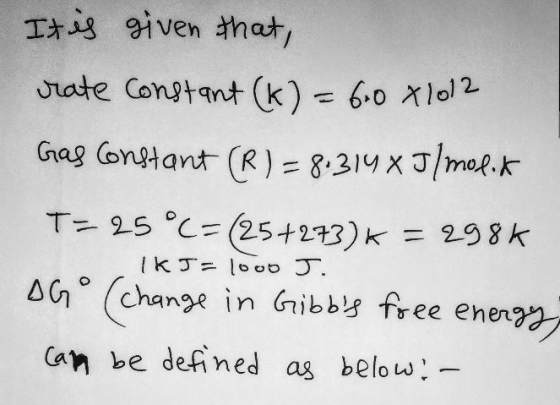
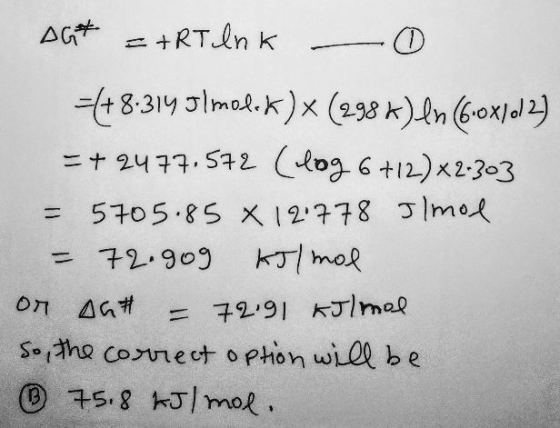
The complete step wise calculation of the change in Gibb's free energy is given as below:-
Add Answer to:
Amp nucleosidase gives a rate enhancement of 6.0 x
1012 over the nonenzymatic reaction. What is...
An uncatalyzed reaction has a rate of 4.2 x 10^-7 sec-1 at 25 degrees Celsius. When...
An uncatalyzed reaction has a rate of 4.2 x 10^-7 sec-1 at 25 degrees Celsius. When an enzyme is added the rate is 3.2 x 10^4 sec-1. Calculate the difference in activation energy between the catalyzed and uncatalyzed reactions. (Please show work so I can see what you did). A. 22 kJ/mol B. 25 kJ/mol C. 43 kJ/mol D. 62 kJ/mol
Why is the answer positive? 6. What is the AGº for the reaction at 298 K?...
 Why is the answer positive?
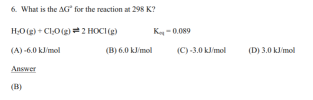
6. What is the AGº for the reaction at 298 K? H2O(g) + C1,0 (g) = 2 HOCI(g) Key = 0.089 (A) -6.0 kJ/mol (B) 6.0 kJ/mol (C)-3.0 kJ/mol (D) 3.0 kJ/mol Answer (B)
Why is the answer positive?
6. What is the AGº for the reaction at 298 K? H2O(g) + C1,0 (g) = 2 HOCI(g) Key = 0.089 (A) -6.0 kJ/mol (B) 6.0 kJ/mol (C)-3.0 kJ/mol (D) 3.0 kJ/mol Answer (B)
The reaction 2 NO2(g) → 2 NO (g) + O2(g) has rate constants of 2.70 x...
The reaction 2 NO2(g) → 2 NO (g) + O2(g) has rate constants of 2.70 x 10⁻² M-1s-1 at 227 oC and 0.240 M-1s-1 at 277oC. What is the activation energy of this reaction? (Given: Arrhenius equation, k = Ae-Ea/RT ) A) 99.6 kJ/mol B) 22.8 kJ/mol C) 49.8 kJ/mol D) -22.8 kJ/mol E) 65.3 kJ/mol I'm unsure on how to do it since you're not given the frequency factor
Question 1: Fully label - with names or descriptions, NOT values -the reaction coordinate diagram of...
 Question 1: Fully label - with names or descriptions, NOT values -the reaction coordinate diagram of an enzyme-catalyzed (continuous line) vs. uncatalyzed reaction (dashed line). THEN do the following calculations... a) What is the value of ΔGo, for the reaction? b) Is the reaction spontaneous in the direction written (left to right)? c) What is the value of AG for the catalyzed reaction? d) What is the value of ΔG# for the uncatalyzed reaction? e) Calculate the rate enhancement for...
Already posted this question but it was wrong the other times ;( Consider the following gas phase reaction. D B—A=A—B +...
 Already posted this question but it was
wrong the other times ;(
Consider the following gas phase reaction. D B—A=A—B + 2 D-D D CA + ť be B-B Consider the following bond energies. ASA: 600. kJ/mol ASA: 350. kJ/mol A-B: 150. kJ/mol A-D: 540. kJ/mol B-B: 380. kJ/mol D-D: 230. kJ/mol (a) What is the enthalpy of reaction? (Enter your answer to the nearest integer.) 49) kJ/mol (b) The entropy of reaction is ---Select--- 9. (c) The reaction is...
Already posted this question but it was
wrong the other times ;(
Consider the following gas phase reaction. D B—A=A—B + 2 D-D D CA + ť be B-B Consider the following bond energies. ASA: 600. kJ/mol ASA: 350. kJ/mol A-B: 150. kJ/mol A-D: 540. kJ/mol B-B: 380. kJ/mol D-D: 230. kJ/mol (a) What is the enthalpy of reaction? (Enter your answer to the nearest integer.) 49) kJ/mol (b) The entropy of reaction is ---Select--- 9. (c) The reaction is...
3. For the reaction 103 (aq) + 51(aq) + 6H*(aq) → 312(aq) + 3H2O(1) the rate...
 3. For the reaction 103 (aq) + 51(aq) + 6H*(aq) → 312(aq) + 3H2O(1) the rate of disappearance of I (aq) at a particular time and concentration is 2.6 x 10-' mol/(L · s). What is the rate of appearance of 12(aq)? A) 4.3 10-' mol/(L •s) B) 7.8 x 10⁻³ mol/(L • s) C) -1.6 x 10 mol/(L • s) D) 1.6 x 10' mol/(L •s) E) 6.4 x 10^'mol/(L •s) 4. For the first-order reaction 1/2 N2O4(g) →...
we - Google Given the following data, determine the rate law for the following reaction 2A+B+2C...
 we - Google Given the following data, determine the rate law for the following reaction 2A+B+2C - products Experiment 2 [A] 0.273 0.819 0.273 0.273 [B] [C] Rate (M/s) 0.763 0.400 3.0 0.763 0.400 9.0 1.526 0.400 12.0 0.763 0.800 4 6.0 Rate = k[A][B][C] Rate = k[A][B][C] Rate = K[A] [B]*C]2 Rate = K[A]2[B] [CH Rate = k[A] [B][C] Question 16 5 pts SOCl2 gas dissociates into SO2 and Cly via the following reaction: SOCI2(e) + SO2(g) + Cl2(8)...
42) Which statement is FALSE? A) An exothermic reaction gives heat off heat to the surroundings. B) Enthalpy is the...
 42) Which statement is FALSE? A) An exothermic reaction gives heat off heat to the surroundings. B) Enthalpy is the sum of a system's internal energy and the product of pressure and volume change. C) AErxn is a measure of heat. D) AHrxn is the heat of reaction. E) Endothermic has a positive AH. 43) How much energy is required to decompose 765 g of PC13, according to the reaction below? The molar mass of PCl3 is 137.32 g/mol and...
Consider this reaction: --> At the same concentrations, the rate at 942 K is 7.85 x...
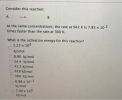 Consider this reaction: --> At the same concentrations, the rate at 942 K is 7.85 x 10² times faster than the rate at 300 K. What is the activation energy for this reaction? 5.23 x 10² kJ/mol C 8.90 kJ/mol C 24.4 kJ/mol C 45.3 kJ/mol C 418 kJ/mol C 366 kJ/mol 6.88 x 10⁻¹ kJ/mol 7.09 x 10³ kj/mol
10) Consider the hypothetical reaction: 3A2+ 2B C+ 2D If 6.0 moles with 2.0 moles of...
 10) Consider the hypothetical reaction: 3A2+ 2B C+ 2D If 6.0 moles with 2.0 moles of B, what is the maximum amount of C that can be formed? A) 6.0 mol E) 5.0 mol D) 1.0 mol C) 2.0 mol B) 8.0 mol ues 11) 11) What is the mass of 4.35 moles of aluminum? A) 9.78 x 10²² g B) 2.62 x 1024 C)0.163 g D) 117 g E) 27.8 g g 12) 12) Choose the best classification of...
 Why is the answer positive?
6. What is the AGº for the reaction at 298 K? H2O(g) + C1,0 (g) = 2 HOCI(g) Key = 0.089 (A) -6.0 kJ/mol (B) 6.0 kJ/mol (C)-3.0 kJ/mol (D) 3.0 kJ/mol Answer (B)
Why is the answer positive?
6. What is the AGº for the reaction at 298 K? H2O(g) + C1,0 (g) = 2 HOCI(g) Key = 0.089 (A) -6.0 kJ/mol (B) 6.0 kJ/mol (C)-3.0 kJ/mol (D) 3.0 kJ/mol Answer (B)
 Question 1: Fully label - with names or descriptions, NOT values -the reaction coordinate diagram of an enzyme-catalyzed (continuous line) vs. uncatalyzed reaction (dashed line). THEN do the following calculations... a) What is the value of ΔGo, for the reaction? b) Is the reaction spontaneous in the direction written (left to right)? c) What is the value of AG for the catalyzed reaction? d) What is the value of ΔG# for the uncatalyzed reaction? e) Calculate the rate enhancement for...
 Already posted this question but it was
wrong the other times ;(
Consider the following gas phase reaction. D B—A=A—B + 2 D-D D CA + ť be B-B Consider the following bond energies. ASA: 600. kJ/mol ASA: 350. kJ/mol A-B: 150. kJ/mol A-D: 540. kJ/mol B-B: 380. kJ/mol D-D: 230. kJ/mol (a) What is the enthalpy of reaction? (Enter your answer to the nearest integer.) 49) kJ/mol (b) The entropy of reaction is ---Select--- 9. (c) The reaction is...
Already posted this question but it was
wrong the other times ;(
Consider the following gas phase reaction. D B—A=A—B + 2 D-D D CA + ť be B-B Consider the following bond energies. ASA: 600. kJ/mol ASA: 350. kJ/mol A-B: 150. kJ/mol A-D: 540. kJ/mol B-B: 380. kJ/mol D-D: 230. kJ/mol (a) What is the enthalpy of reaction? (Enter your answer to the nearest integer.) 49) kJ/mol (b) The entropy of reaction is ---Select--- 9. (c) The reaction is...
 3. For the reaction 103 (aq) + 51(aq) + 6H*(aq) → 312(aq) + 3H2O(1) the rate of disappearance of I (aq) at a particular time and concentration is 2.6 x 10-' mol/(L · s). What is the rate of appearance of 12(aq)? A) 4.3 10-' mol/(L •s) B) 7.8 x 10⁻³ mol/(L • s) C) -1.6 x 10 mol/(L • s) D) 1.6 x 10' mol/(L •s) E) 6.4 x 10^'mol/(L •s) 4. For the first-order reaction 1/2 N2O4(g) →...
 we - Google Given the following data, determine the rate law for the following reaction 2A+B+2C - products Experiment 2 [A] 0.273 0.819 0.273 0.273 [B] [C] Rate (M/s) 0.763 0.400 3.0 0.763 0.400 9.0 1.526 0.400 12.0 0.763 0.800 4 6.0 Rate = k[A][B][C] Rate = k[A][B][C] Rate = K[A] [B]*C]2 Rate = K[A]2[B] [CH Rate = k[A] [B][C] Question 16 5 pts SOCl2 gas dissociates into SO2 and Cly via the following reaction: SOCI2(e) + SO2(g) + Cl2(8)...
 42) Which statement is FALSE? A) An exothermic reaction gives heat off heat to the surroundings. B) Enthalpy is the sum of a system's internal energy and the product of pressure and volume change. C) AErxn is a measure of heat. D) AHrxn is the heat of reaction. E) Endothermic has a positive AH. 43) How much energy is required to decompose 765 g of PC13, according to the reaction below? The molar mass of PCl3 is 137.32 g/mol and...
 Consider this reaction: --> At the same concentrations, the rate at 942 K is 7.85 x 10² times faster than the rate at 300 K. What is the activation energy for this reaction? 5.23 x 10² kJ/mol C 8.90 kJ/mol C 24.4 kJ/mol C 45.3 kJ/mol C 418 kJ/mol C 366 kJ/mol 6.88 x 10⁻¹ kJ/mol 7.09 x 10³ kj/mol
 10) Consider the hypothetical reaction: 3A2+ 2B C+ 2D If 6.0 moles with 2.0 moles of B, what is the maximum amount of C that can be formed? A) 6.0 mol E) 5.0 mol D) 1.0 mol C) 2.0 mol B) 8.0 mol ues 11) 11) What is the mass of 4.35 moles of aluminum? A) 9.78 x 10²² g B) 2.62 x 1024 C)0.163 g D) 117 g E) 27.8 g g 12) 12) Choose the best classification of...
Most questions answered within 3 hours.
-
Where is the error in this code sequence?
String s1 = "Hello";
String s2 = "ello";...
asked 11 months ago -
Financial data for Joel de Paris, Inc., for last year
follow:
Joel de Paris, Inc.
Balance...
asked 11 months ago -
Consider this reaction:
Al2(SO4)3 (aq)+ BaCl3
(aq) Al2Cl6 (aq)- +
3BaSO4(s) . What is the...
asked 11 months ago -
Suppose that Savneet is considering increasing her
recent random sample from 20 car rentals to 40...
asked 11 months ago -
Trucks arrive at an unloading terminal at an average rate of 120
per hour.
Trucks arrive...
asked 11 months ago -
Why are methanol and ethanol completely soluble in water while
octanol is not very little soluble....
asked 11 months ago -
A facilities manager at a university reads in a research report
that the mean amount of...
asked 11 months ago -
When the CuSO4 is rehydrated by adding water to the anhydrous
compound, is this an endothermic...
asked 11 months ago -
A ray of sunlight is passing from diamond into crown glass; the
angle of incidence is...
asked 11 months ago -
A block of mass 0.249 kg is placed on top of a light, vertical
spring of...
asked 11 months ago -
how do the kidneys compensate in the presences of acidosis
a) trigger hyperventilate
b) reserve acid...
asked 11 months ago -
Question 501 pts
The rental rate of capital to the firm increases. Which of the
following...
asked 11 months ago