
Homework Answers
T![Dissociative reaction [w Lax] win tx (dissociation in dat Lomity K2, LAMY A step) L2MX ty x+ Lojmy ph menj Racefion coas devi](http://img.homeworklib.com/questions/676e2b60-6fe6-11ea-9069-63560c3d7c12.png?x-oss-process=image/resize,w_560)
 he answer is given in the
attachment.
he answer is given in the
attachment.
Add Answer to:
* 1. Draw reaction coordinate diagrams for dissociative, associative, and interchange mechanisms. Label the intermediate and/or...
Thermodynamics and kinetics of SN1, SN2, E1, and E2 mechanisms. 2. Draw the reaction coordinate diagrams...
 Thermodynamics and kinetics of SN1, SN2, E1, and E2 mechanisms. 2. Draw the reaction coordinate diagrams of the following reactions according to the type of mechanisms given and include the following: a) Label the reactant, product, intermediates, and a drawing of the transition state of the rate determining step. If there are multiple E, label the largest E (5 pts) b) State if AG rx is <0 or >0 and make sure your diagram reflects the AGxn. (4 pts) Hint:...
Draw a labelled reaction coordinate diagram for the both SN reactions. Label the activation energy (free...
Draw a labelled reaction coordinate diagram for the both SN reactions. Label the activation energy (free energy of activation) and give the approximate structures of the intimal state, the transition states, the intermediate and product at the correct points along the reaction coordinate. Also, can you decide on the basis of the kinetic expression whether the t-butyl chloride-hydroxide ion reaction proceeds by a one-step or a two-step mechanism? Explain why observed kinetic expression is consistent with the mechanism you chose.
Let's continue on the rates of reactions diagrams & reaction coordinate 3. Here is a reaction...
 Let's continue on the rates of reactions diagrams & reaction coordinate 3. Here is a reaction energy diagram. Label the poolo transition state м2 терге TH reactants products 1345 in NLB Reaction Coordinate graph, please draw & label both the activation energy (Ea! overall energy change for the reaction CAE). . On the & the Toensuz gopstod reactants ولدانهم Reaction Coordinate
1. Draw all of the constitutional isomers that are formed in each elimination reaction and label...
 1. Draw all of the constitutional isomers that are formed in each elimination reaction and label the mechanism as E2 or E1. a. 2-bromo butane reacts with methoxide b. 1-chloro-1-ethyl 2 methyl cyclopentane reacts with water 2. For which reaction mechanism are each of the following statements true? Mechanism S1, S2, E1 or E2. A statement may be true for one or more mechanisms a. The mechanism involves carbocation intermediates b. The mechanism has two steps C. The reaction rate...
Descriptions of enzyme mechanisms often contain the terms reaction intermediate, transition state, and transition state analogue....
 Descriptions of enzyme mechanisms often contain the terms
reaction intermediate, transition state, and transition state
analogue. The terms intermediate and transition state both describe
chemical species along the reaction pathway, but there are
important distinctions between the two. Transition state analogues
are often used in enzyme mechanism studies. Match the phrases to
the term that they describe. Scroll down to see all the items.
Descriptions of enzyme mechanisms often contain the terms reaction intermediate, transition state, and transition state analogue....
Descriptions of enzyme mechanisms often contain the terms
reaction intermediate, transition state, and transition state
analogue. The terms intermediate and transition state both describe
chemical species along the reaction pathway, but there are
important distinctions between the two. Transition state analogues
are often used in enzyme mechanism studies. Match the phrases to
the term that they describe. Scroll down to see all the items.
Descriptions of enzyme mechanisms often contain the terms reaction intermediate, transition state, and transition state analogue....
5. Professor Karl von Fildenshmirtzen is studying a transition metal ligand exchange reaction as follows below...
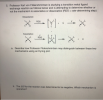 5. Professor Karl von Fildenshmirtzen is studying a transition metal ligand exchange reaction as follows below and is attempting to determine whether or not the mechanism is associative or dissociative (RDS rate-determining step): Dissociative X RDS + Associative L RDS X + a. Describe how Professor Fildenshmirtzen may distinguish between these two mechanisms using an Eyring plot. b. The AS for the reaction was determined to be negative. Which mechanism is operative?
Problem 2 (10 pts) Circle the bromocyclohexane derivative that most likely corresponds to the reaction coordinate...
 Problem 2 (10 pts) Circle the bromocyclohexane derivative that most likely corresponds to the reaction coordinate diagram for the reaction shown below. Indicate the probable reaction type: Draw the major product of the reaction. Label point A as either a transition-state (TS) or an intermediate (Int). Label point B as either a transition-state (TS) or an intermediate (Int). > Draw the structures of A and B. CH3OH reaction coordinate
2) Draw a reaction coordinate diagram for the following reaction. Be sure to label any transition...
 2) Draw a reaction coordinate diagram for the following reaction. Be sure to label any transition states or intermediates. (4 points) NaSH Br SH
2) Draw a reaction coordinate diagram for the following reaction. Be sure to label any transition states or intermed...
 2) Draw a reaction coordinate diagram for the following reaction. Be sure to label any transition states or intermediates. (4 points) NaSH SH
The reaction below proceeds through an exothermic E2 mechanism. Draw the reaction coordinate diagram for this...
 The reaction below proceeds through an exothermic E2
mechanism. Draw the reaction coordinate diagram for this reaction,
and label all activation energies, delta Gs, and transition states.
Draw the structures of the starting materials, products, and any
interediates onto your chart where they belong
NaH Br
The reaction below proceeds through an exothermic E2
mechanism. Draw the reaction coordinate diagram for this reaction,
and label all activation energies, delta Gs, and transition states.
Draw the structures of the starting materials, products, and any
interediates onto your chart where they belong
NaH Br
 Thermodynamics and kinetics of SN1, SN2, E1, and E2 mechanisms. 2. Draw the reaction coordinate diagrams of the following reactions according to the type of mechanisms given and include the following: a) Label the reactant, product, intermediates, and a drawing of the transition state of the rate determining step. If there are multiple E, label the largest E (5 pts) b) State if AG rx is <0 or >0 and make sure your diagram reflects the AGxn. (4 pts) Hint:...
 Let's continue on the rates of reactions diagrams & reaction coordinate 3. Here is a reaction energy diagram. Label the poolo transition state м2 терге TH reactants products 1345 in NLB Reaction Coordinate graph, please draw & label both the activation energy (Ea! overall energy change for the reaction CAE). . On the & the Toensuz gopstod reactants ولدانهم Reaction Coordinate
 1. Draw all of the constitutional isomers that are formed in each elimination reaction and label the mechanism as E2 or E1. a. 2-bromo butane reacts with methoxide b. 1-chloro-1-ethyl 2 methyl cyclopentane reacts with water 2. For which reaction mechanism are each of the following statements true? Mechanism S1, S2, E1 or E2. A statement may be true for one or more mechanisms a. The mechanism involves carbocation intermediates b. The mechanism has two steps C. The reaction rate...
 Descriptions of enzyme mechanisms often contain the terms
reaction intermediate, transition state, and transition state
analogue. The terms intermediate and transition state both describe
chemical species along the reaction pathway, but there are
important distinctions between the two. Transition state analogues
are often used in enzyme mechanism studies. Match the phrases to
the term that they describe. Scroll down to see all the items.
Descriptions of enzyme mechanisms often contain the terms reaction intermediate, transition state, and transition state analogue....
Descriptions of enzyme mechanisms often contain the terms
reaction intermediate, transition state, and transition state
analogue. The terms intermediate and transition state both describe
chemical species along the reaction pathway, but there are
important distinctions between the two. Transition state analogues
are often used in enzyme mechanism studies. Match the phrases to
the term that they describe. Scroll down to see all the items.
Descriptions of enzyme mechanisms often contain the terms reaction intermediate, transition state, and transition state analogue....
 5. Professor Karl von Fildenshmirtzen is studying a transition metal ligand exchange reaction as follows below and is attempting to determine whether or not the mechanism is associative or dissociative (RDS rate-determining step): Dissociative X RDS + Associative L RDS X + a. Describe how Professor Fildenshmirtzen may distinguish between these two mechanisms using an Eyring plot. b. The AS for the reaction was determined to be negative. Which mechanism is operative?
 Problem 2 (10 pts) Circle the bromocyclohexane derivative that most likely corresponds to the reaction coordinate diagram for the reaction shown below. Indicate the probable reaction type: Draw the major product of the reaction. Label point A as either a transition-state (TS) or an intermediate (Int). Label point B as either a transition-state (TS) or an intermediate (Int). > Draw the structures of A and B. CH3OH reaction coordinate
 2) Draw a reaction coordinate diagram for the following reaction. Be sure to label any transition states or intermediates. (4 points) NaSH Br SH
 2) Draw a reaction coordinate diagram for the following reaction. Be sure to label any transition states or intermediates. (4 points) NaSH SH
 The reaction below proceeds through an exothermic E2
mechanism. Draw the reaction coordinate diagram for this reaction,
and label all activation energies, delta Gs, and transition states.
Draw the structures of the starting materials, products, and any
interediates onto your chart where they belong
NaH Br
The reaction below proceeds through an exothermic E2
mechanism. Draw the reaction coordinate diagram for this reaction,
and label all activation energies, delta Gs, and transition states.
Draw the structures of the starting materials, products, and any
interediates onto your chart where they belong
NaH Br
Most questions answered within 3 hours.
-
Where is the error in this code sequence?
String s1 = "Hello";
String s2 = "ello";...
asked 10 months ago -
Financial data for Joel de Paris, Inc., for last year
follow:
Joel de Paris, Inc.
Balance...
asked 10 months ago -
Consider this reaction:
Al2(SO4)3 (aq)+ BaCl3
(aq) Al2Cl6 (aq)- +
3BaSO4(s) . What is the...
asked 10 months ago -
Suppose that Savneet is considering increasing her
recent random sample from 20 car rentals to 40...
asked 10 months ago -
Trucks arrive at an unloading terminal at an average rate of 120
per hour.
Trucks arrive...
asked 10 months ago -
Why are methanol and ethanol completely soluble in water while
octanol is not very little soluble....
asked 10 months ago -
A facilities manager at a university reads in a research report
that the mean amount of...
asked 10 months ago -
When the CuSO4 is rehydrated by adding water to the anhydrous
compound, is this an endothermic...
asked 10 months ago -
A ray of sunlight is passing from diamond into crown glass; the
angle of incidence is...
asked 10 months ago -
A block of mass 0.249 kg is placed on top of a light, vertical
spring of...
asked 10 months ago -
how do the kidneys compensate in the presences of acidosis
a) trigger hyperventilate
b) reserve acid...
asked 10 months ago -
Question 501 pts
The rental rate of capital to the firm increases. Which of the
following...
asked 10 months ago