
Homework Answers
![Let fore Rate = K[no] a [02]b trial 1 and 2 R2 [0276 5.510 10-17 - 1.10 X 10⁻¹⁶ 0.00415 0.00830 1b = 1] 1 and 3 tou tenal R1](http://img.homeworklib.com/questions/728c0130-7013-11ea-966d-0d5b3e5f0482.png?x-oss-process=image/resize,w_560)
Add Answer to:
onlocatori entale References The reaction NO(g) +0,() + NO.(k)+(s) plays a role in the formation of...
|References For the reaction N2(8) 2 H,0(8) 2 NO(g) +2 H3 (g) at 1100° C, the following data have been obtained. NO...
 |References For the reaction N2(8) 2 H,0(8) 2 NO(g) +2 H3 (g) at 1100° C, the following data have been obtained. NO 4Na1/At rate |(mal t-) (mol L) (mol-L 5.93 x 10 0.380 0.0200 1.19 x 10 0.380 0.0807 1.19 x 10 0.760 0.161 Derive a rate law for the reaction. (Rate expressions take the general form rate k H Cl rate Determine the value of the rate constant. (in L mols) le L-mols Submit Answer Try Another Version 5...
See part c below. Assume that the formation of nitrogen dioxide, 2 NO(g) + O2(g) →...
 See part c below.
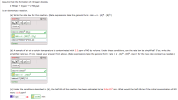
Assume that the formation of nitrogen dioxide, 2 NO(g) + O2(g) → 2 NO2(g) is an elementary reaction. (a) Write the rate law for this reaction. (Rate expressions take the general form: rate = k. [A]a[B].) chemPad Help X.X° =+ Greek rate=k-[NO]2.[02] rate = k. [NO]2.[02] rate=k*[NO]^2*[O_2] Correct. (b) A sample of air at a certain temperature is contaminated with 2.2 ppm of NO by volume. Under these conditions, can the rate law be simplified? If...
See part c below.
Assume that the formation of nitrogen dioxide, 2 NO(g) + O2(g) → 2 NO2(g) is an elementary reaction. (a) Write the rate law for this reaction. (Rate expressions take the general form: rate = k. [A]a[B].) chemPad Help X.X° =+ Greek rate=k-[NO]2.[02] rate = k. [NO]2.[02] rate=k*[NO]^2*[O_2] Correct. (b) A sample of air at a certain temperature is contaminated with 2.2 ppm of NO by volume. Under these conditions, can the rate law be simplified? If...
9,10,11 9. Consider the decomposition reaction of N2Os. 2 N203(g) → 4NO2(g) + O2(g) follows the...
 9,10,11
9. Consider the decomposition reaction of N2Os. 2 N203(g) → 4NO2(g) + O2(g) follows the first order kinetics with rate constant of 4.8 x 10's. (a) if the initial 165 x 10-2M what is the concentration at 825 s? (b) How long it will take for concentration is 1.65 x 10⁻²M what is the concentrat the concentration of N2Os to decrease to 1.00 x 10⁻²M? t 10. Nitrosyl chloride, NOCI, decomposes slowly to NO and Cl2, the reaction follows...
9,10,11
9. Consider the decomposition reaction of N2Os. 2 N203(g) → 4NO2(g) + O2(g) follows the first order kinetics with rate constant of 4.8 x 10's. (a) if the initial 165 x 10-2M what is the concentration at 825 s? (b) How long it will take for concentration is 1.65 x 10⁻²M what is the concentrat the concentration of N2Os to decrease to 1.00 x 10⁻²M? t 10. Nitrosyl chloride, NOCI, decomposes slowly to NO and Cl2, the reaction follows...
References) The reaction for the Haber process, the industrial production of ammonia, NG) + 3H2(g) +...
 References) The reaction for the Haber process, the industrial production of ammonia, NG) + 3H2(g) + 2NH,() Awsume that under certain laboratory conditions ammonia is produced at the rate of 5.63 x 10" mol L s At what rate is nitrogen consumed? At whatrate is hydrogen consumed! N, is consumed at the rate of 111111111111 mol L Hy is consed at the rate of 11 mol L- Try Another Version item attempts remaining
Please answer as many questions as you can Thanks 1. For the reaction, N2(g) 3H2(g)2NH3(g). if...
 Please answer as many questions as you can
Thanks
1. For the reaction, N2(g) 3H2(g)2NH3(g). if the rate of formation of ammonia is 0.04 mol/L min, find the rate of disappearance of H2 and N2 during that same time period. 2. For the following reaction, 5Br BrO3 6H3Br2 3H20, the rate of consumption of bromide ion at some time was found to be 0.20 mo/L s. What is the rate of formation of water over the same time period? 3....
Please answer as many questions as you can
Thanks
1. For the reaction, N2(g) 3H2(g)2NH3(g). if the rate of formation of ammonia is 0.04 mol/L min, find the rate of disappearance of H2 and N2 during that same time period. 2. For the following reaction, 5Br BrO3 6H3Br2 3H20, the rate of consumption of bromide ion at some time was found to be 0.20 mo/L s. What is the rate of formation of water over the same time period? 3....
1.) The reaction 2NOCl(g) → 2NO(g) + Cl2 (g) has an activation energy of 100.0 kJ/mol and a...
1.) The reaction 2NOCl(g) → 2NO(g) + Cl2 (g) has an activation energy of 100.0 kJ/mol and a rate constant at 350.0 K of 8.5 x 10⁻⁶ mol-1 L s-1. Determine the rate constant at 400 K. 2.) For the reaction 2 H2 (g) + O2 (g) → 2 H2O (g) it was found that at a given temperature and after a certain time the rate of formation of H2O(g) was 0.27 mol L-1 s-1. What is the rate of consumption of O2 (g)...
*Question Completion Status: a) For the reaction O2 (9) + 2NO(9) -... 2NO2 (g) Experiments were...
 *Question Completion Status: a) For the reaction O2 (9) + 2NO(9) -... 2NO2 (g) Experiments were carried out to find out how the rate of the reaction depend on the concentrations of the reactants. The results were surrirarized in the following table. Experiment Initial Rate (mol/l.) 3.21 x 10 1 2 6.40 x 10 Initial Reactant Concentrations (mol/L) [0] [NO 1.10 x 10 1.30 x 10 2.20 x 100 1.30 x 100 1.10 x 10 2.60 x 10 1.30 x...
B1. The following experimental data were obtained for the following reaction at 1000 K: 2 NO(g)...
 B1. The following experimental data were obtained for the following reaction at 1000 K: 2 NO(g) + O2(g) 2 NO2(g) NOI (mol L OJ (mol L- Inital rate of reaction (mol L-'s - 0.0100 0.0200 0.0300 0.0200 0.0500 0.0200 3.02 x 10⁻⁵ 3.02 x 10⁻⁴ 2.72 x 10⁻⁴ (a) Determine the order of the reaction for each reactant (b) Determine the overall order of the reaction. Answer: (c) Calculate the rate constant at this temperature.
NUMBER 3 AND 4 PLEASE! I JUST NEED #3 AND 4 Ozone Formation: NO2(g), is formed...
 NUMBER 3 AND 4 PLEASE! I JUST NEED #3 AND 4
Ozone Formation: NO2(g), is formed by chemical reactions involving N2(g) and O2(g) at the high temperatures Inside internal combustion engines in our cars. In the presence of sunlight, NO2(g) reacts with O2(g) to generate Os(s) as described by the following overall reaction: NO2(g) + O2(g) = NO(g) + O2(g) E = 306.5 l/mol This chemical process occurs in two steps, as illustrated in the potential energy diagram. In the...
NUMBER 3 AND 4 PLEASE! I JUST NEED #3 AND 4
Ozone Formation: NO2(g), is formed by chemical reactions involving N2(g) and O2(g) at the high temperatures Inside internal combustion engines in our cars. In the presence of sunlight, NO2(g) reacts with O2(g) to generate Os(s) as described by the following overall reaction: NO2(g) + O2(g) = NO(g) + O2(g) E = 306.5 l/mol This chemical process occurs in two steps, as illustrated in the potential energy diagram. In the...
Please explain step by step. The equilibrium constant K for the reaction 2 H2O2(g) 2 H2O(g)...
Please explain step by step. The equilibrium constant K for the reaction 2 H2O2(g) 2 H2O(g) + O2(g) is 3.9 x 10⁻³ at 300oC. A mixture contains the gases at the following concentrations: [H2O2] = 5.0 x 10⁻³ mol/L, [H2O]=2.5 x 10⁻³ mol/L, [O2]= 2.0 x 10⁻³ mol/L. (i) Is the reaction at equilibrium at 300oC? Explain your answer. If not, in what direction does the reaction proceed to come into equilibrium? Describe what happens over time to the rate...
 |References For the reaction N2(8) 2 H,0(8) 2 NO(g) +2 H3 (g) at 1100° C, the following data have been obtained. NO 4Na1/At rate |(mal t-) (mol L) (mol-L 5.93 x 10 0.380 0.0200 1.19 x 10 0.380 0.0807 1.19 x 10 0.760 0.161 Derive a rate law for the reaction. (Rate expressions take the general form rate k H Cl rate Determine the value of the rate constant. (in L mols) le L-mols Submit Answer Try Another Version 5...
 See part c below.
Assume that the formation of nitrogen dioxide, 2 NO(g) + O2(g) → 2 NO2(g) is an elementary reaction. (a) Write the rate law for this reaction. (Rate expressions take the general form: rate = k. [A]a[B].) chemPad Help X.X° =+ Greek rate=k-[NO]2.[02] rate = k. [NO]2.[02] rate=k*[NO]^2*[O_2] Correct. (b) A sample of air at a certain temperature is contaminated with 2.2 ppm of NO by volume. Under these conditions, can the rate law be simplified? If...
See part c below.
Assume that the formation of nitrogen dioxide, 2 NO(g) + O2(g) → 2 NO2(g) is an elementary reaction. (a) Write the rate law for this reaction. (Rate expressions take the general form: rate = k. [A]a[B].) chemPad Help X.X° =+ Greek rate=k-[NO]2.[02] rate = k. [NO]2.[02] rate=k*[NO]^2*[O_2] Correct. (b) A sample of air at a certain temperature is contaminated with 2.2 ppm of NO by volume. Under these conditions, can the rate law be simplified? If...
 9,10,11
9. Consider the decomposition reaction of N2Os. 2 N203(g) → 4NO2(g) + O2(g) follows the first order kinetics with rate constant of 4.8 x 10's. (a) if the initial 165 x 10-2M what is the concentration at 825 s? (b) How long it will take for concentration is 1.65 x 10⁻²M what is the concentrat the concentration of N2Os to decrease to 1.00 x 10⁻²M? t 10. Nitrosyl chloride, NOCI, decomposes slowly to NO and Cl2, the reaction follows...
9,10,11
9. Consider the decomposition reaction of N2Os. 2 N203(g) → 4NO2(g) + O2(g) follows the first order kinetics with rate constant of 4.8 x 10's. (a) if the initial 165 x 10-2M what is the concentration at 825 s? (b) How long it will take for concentration is 1.65 x 10⁻²M what is the concentrat the concentration of N2Os to decrease to 1.00 x 10⁻²M? t 10. Nitrosyl chloride, NOCI, decomposes slowly to NO and Cl2, the reaction follows...
 References) The reaction for the Haber process, the industrial production of ammonia, NG) + 3H2(g) + 2NH,() Awsume that under certain laboratory conditions ammonia is produced at the rate of 5.63 x 10" mol L s At what rate is nitrogen consumed? At whatrate is hydrogen consumed! N, is consumed at the rate of 111111111111 mol L Hy is consed at the rate of 11 mol L- Try Another Version item attempts remaining
 Please answer as many questions as you can
Thanks
1. For the reaction, N2(g) 3H2(g)2NH3(g). if the rate of formation of ammonia is 0.04 mol/L min, find the rate of disappearance of H2 and N2 during that same time period. 2. For the following reaction, 5Br BrO3 6H3Br2 3H20, the rate of consumption of bromide ion at some time was found to be 0.20 mo/L s. What is the rate of formation of water over the same time period? 3....
Please answer as many questions as you can
Thanks
1. For the reaction, N2(g) 3H2(g)2NH3(g). if the rate of formation of ammonia is 0.04 mol/L min, find the rate of disappearance of H2 and N2 during that same time period. 2. For the following reaction, 5Br BrO3 6H3Br2 3H20, the rate of consumption of bromide ion at some time was found to be 0.20 mo/L s. What is the rate of formation of water over the same time period? 3....
 *Question Completion Status: a) For the reaction O2 (9) + 2NO(9) -... 2NO2 (g) Experiments were carried out to find out how the rate of the reaction depend on the concentrations of the reactants. The results were surrirarized in the following table. Experiment Initial Rate (mol/l.) 3.21 x 10 1 2 6.40 x 10 Initial Reactant Concentrations (mol/L) [0] [NO 1.10 x 10 1.30 x 10 2.20 x 100 1.30 x 100 1.10 x 10 2.60 x 10 1.30 x...
 B1. The following experimental data were obtained for the following reaction at 1000 K: 2 NO(g) + O2(g) 2 NO2(g) NOI (mol L OJ (mol L- Inital rate of reaction (mol L-'s - 0.0100 0.0200 0.0300 0.0200 0.0500 0.0200 3.02 x 10⁻⁵ 3.02 x 10⁻⁴ 2.72 x 10⁻⁴ (a) Determine the order of the reaction for each reactant (b) Determine the overall order of the reaction. Answer: (c) Calculate the rate constant at this temperature.
 NUMBER 3 AND 4 PLEASE! I JUST NEED #3 AND 4
Ozone Formation: NO2(g), is formed by chemical reactions involving N2(g) and O2(g) at the high temperatures Inside internal combustion engines in our cars. In the presence of sunlight, NO2(g) reacts with O2(g) to generate Os(s) as described by the following overall reaction: NO2(g) + O2(g) = NO(g) + O2(g) E = 306.5 l/mol This chemical process occurs in two steps, as illustrated in the potential energy diagram. In the...
NUMBER 3 AND 4 PLEASE! I JUST NEED #3 AND 4
Ozone Formation: NO2(g), is formed by chemical reactions involving N2(g) and O2(g) at the high temperatures Inside internal combustion engines in our cars. In the presence of sunlight, NO2(g) reacts with O2(g) to generate Os(s) as described by the following overall reaction: NO2(g) + O2(g) = NO(g) + O2(g) E = 306.5 l/mol This chemical process occurs in two steps, as illustrated in the potential energy diagram. In the...
Most questions answered within 3 hours.
-
Where is the error in this code sequence?
String s1 = "Hello";
String s2 = "ello";...
asked 10 months ago -
Financial data for Joel de Paris, Inc., for last year
follow:
Joel de Paris, Inc.
Balance...
asked 10 months ago -
Consider this reaction:
Al2(SO4)3 (aq)+ BaCl3
(aq) Al2Cl6 (aq)- +
3BaSO4(s) . What is the...
asked 10 months ago -
Suppose that Savneet is considering increasing her
recent random sample from 20 car rentals to 40...
asked 10 months ago -
Trucks arrive at an unloading terminal at an average rate of 120
per hour.
Trucks arrive...
asked 10 months ago -
Why are methanol and ethanol completely soluble in water while
octanol is not very little soluble....
asked 10 months ago -
A facilities manager at a university reads in a research report
that the mean amount of...
asked 10 months ago -
When the CuSO4 is rehydrated by adding water to the anhydrous
compound, is this an endothermic...
asked 10 months ago -
A ray of sunlight is passing from diamond into crown glass; the
angle of incidence is...
asked 10 months ago -
A block of mass 0.249 kg is placed on top of a light, vertical
spring of...
asked 10 months ago -
how do the kidneys compensate in the presences of acidosis
a) trigger hyperventilate
b) reserve acid...
asked 10 months ago -
Question 501 pts
The rental rate of capital to the firm increases. Which of the
following...
asked 10 months ago