
Homework Answers

Add Answer to:
See part c below.
Assume that the formation of nitrogen dioxide, 2 NO(g) + O2(g) →...
QUESTION 1 (10) Nitric oxide reacts with oxygen to form nitrogen dioxide: 2NO(g) + O2(g) +...
 QUESTION 1 (10) Nitric oxide reacts with oxygen to form nitrogen dioxide: 2NO(g) + O2(g) + 2NO2 (g) a) What is the Kc for the reaction if the equilibrium concentration of NO is 0.300 M, O2 is 0.200 M, and NO2 is 0.530 M at 25°C? b) What is the Kp for the same reaction? c) If the equilibrium re-establishes where [NO]=0.150 M and [02]-0.225 M, what is [NO2) at this point under the same temperature? 2(12) The equilibrium constant...
The following data were obtained for the reaction given below. 2 C102(aq) + 2 OH "(aq)...
 The following data were obtained for the reaction given below. 2 C102(aq) + 2 OH "(aq) → CIO3- (aq) + ClO2" (aq) + H20(1) Rate - AC10,1 (CIO). (mol/L) (OH), (mol/L) Initial Rate (mol/L's) 0.0500 0.100 5.75 x 10⁻² 0.100 0.100 2.30 x 10⁻¹ 0.100 0.0500 1.15 x 101 (a) Determine the rate law and the value of the rate constant. (Rate equations take the general form 'rate = k. [A] [B]'.) rate law chemPad Help X.X° El Greek rate...
Nitrosyl bromide decomposes by the reaction 2 NOBO(g) + 2NO(9) + Brz(9). Show that the following...
 Nitrosyl bromide decomposes by the reaction 2 NOBO(g) + 2NO(9) + Brz(9). Show that the following data are consistent with a second-order reaction and determine the second-order rate constant for the reaction. Students may do this by plotting the data three different ways. For each plot, time goes on the x-axis. A zero-order reaction is linear when [NOBr] on the y-axis. A first-order reaction is linear when In[NOBr) is on the y-axis. A second-order reaction is linear when 1/[NOBr) is...
2N_2O_5(g) rightarrow 4NO_2(g) + O_2(g) The reaction of dinitrogen pentoxide decomposed into nitrogen dioxide and O_2...
 2N_2O_5(g) rightarrow 4NO_2(g) + O_2(g) The reaction of dinitrogen pentoxide decomposed into nitrogen dioxide and O_2 is first-order and has a rate constant of k = 9.55 times 10^-4 s^-1 under a particular set of conditions. What is the concentration of N_2O_5 in this system after 10.0 min if [N_2O_5]_0 = 0.807 M? Did you use the equation that relates initial reactant concentration, rate Number constant, time elapsed, and reaction concentration at time t for a first-order reaction? Did you...
Nitrogen and oxygen react at high temperatures. N2(g) + O2(g) equilibrium reaction arrow 2 NO(g) ΔH...
Nitrogen and oxygen react at high temperatures. N2(g) + O2(g) equilibrium reaction arrow 2 NO(g) ΔH = 182.6 kJ (a) Write the expression for the equilibrium constant (Kc) for this reversible reaction. (Concentration equilibrium expressions take the general form: Kc = [C]c / [A]a . [B]b. Subscripts and superscripts that include letters must be enclosed in braces {}.)
The decomposition of nitrogen dioxide at a high temperature NO_2(g) rightarrow NO(g) + 1/2 O_2(g) is...
 The decomposition of nitrogen dioxide at a high temperature NO_2(g) rightarrow NO(g) + 1/2 O_2(g) is second-order in this reactant. The rate constant for this reaction is 3.40 L/mol min. Determine the time needed for the concentration of NO_2 to decrease from 2.00 mol/L to 1.50 mol/L.
|References For the reaction N2(8) 2 H,0(8) 2 NO(g) +2 H3 (g) at 1100° C, the following data have been obtained. NO...
 |References For the reaction N2(8) 2 H,0(8) 2 NO(g) +2 H3 (g) at 1100° C, the following data have been obtained. NO 4Na1/At rate |(mal t-) (mol L) (mol-L 5.93 x 10 0.380 0.0200 1.19 x 10 0.380 0.0807 1.19 x 10 0.760 0.161 Derive a rate law for the reaction. (Rate expressions take the general form rate k H Cl rate Determine the value of the rate constant. (in L mols) le L-mols Submit Answer Try Another Version 5...
Butadiene reacts to form its dimer according to the equation 2 C 4H6(g) --> C8H12(g) The...
Butadiene reacts to form its dimer according to the equation 2 C 4H6(g) --> C8H12(g) The following data were collected for this reaction at a given temperature: [C4H6] Time ( 1 s) 0.01000 0 0.00625 1000 0.00476 1800 0.00370 2800 0.00313 3600 0.00270 4400 0.00241 5200 0.00208 6200 (a) Determine is the order of this reaction? Write the rate law expression. Justify your answer. Sketch a graph as part of your explanation. (b) Determine the value of the rate...
1.The reaction of hydrogen and nitric oxide, shown below, is first order with respect to hydrogen...
1.The reaction of hydrogen and nitric oxide, shown below, is first order with respect to hydrogen and second order with respect to nitric oxide. Write the rate law for this reaction. (Rate expressions take the general form: rate = k . [A]a . [B]b.) 2 H2(g) + 2 NO(g) → N2(g) + 2 H2O(l) The rate law for a general reaction involving reactant A is given by the equation rate = k[A]2, 2. Where rate is the rate of the...
onlocatori entale References The reaction NO(g) +0,() + NO.(k)+(s) plays a role in the formation of...
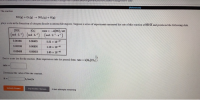 onlocatori entale References The reaction NO(g) +0,() + NO.(k)+(s) plays a role in the formation of titrogen dioxide in automobile engines Suppose a series of experiments measured the rate of this reaction at 500 K and produced the following data NO 101 rate - ANO]/A (01-L) (mol L-4) (mol-1,-1,) 0.00166 0.00415 5.51 x 10⁻¹⁷ 0.00166 0.00830 1.10 x 10- 0.00498 0.00415 1.65 x 10⁻¹⁶ Derive a rate law for the reaction (Kate expressions take the general form: rate [ C...
 QUESTION 1 (10) Nitric oxide reacts with oxygen to form nitrogen dioxide: 2NO(g) + O2(g) + 2NO2 (g) a) What is the Kc for the reaction if the equilibrium concentration of NO is 0.300 M, O2 is 0.200 M, and NO2 is 0.530 M at 25°C? b) What is the Kp for the same reaction? c) If the equilibrium re-establishes where [NO]=0.150 M and [02]-0.225 M, what is [NO2) at this point under the same temperature? 2(12) The equilibrium constant...
 The following data were obtained for the reaction given below. 2 C102(aq) + 2 OH "(aq) → CIO3- (aq) + ClO2" (aq) + H20(1) Rate - AC10,1 (CIO). (mol/L) (OH), (mol/L) Initial Rate (mol/L's) 0.0500 0.100 5.75 x 10⁻² 0.100 0.100 2.30 x 10⁻¹ 0.100 0.0500 1.15 x 101 (a) Determine the rate law and the value of the rate constant. (Rate equations take the general form 'rate = k. [A] [B]'.) rate law chemPad Help X.X° El Greek rate...
 Nitrosyl bromide decomposes by the reaction 2 NOBO(g) + 2NO(9) + Brz(9). Show that the following data are consistent with a second-order reaction and determine the second-order rate constant for the reaction. Students may do this by plotting the data three different ways. For each plot, time goes on the x-axis. A zero-order reaction is linear when [NOBr] on the y-axis. A first-order reaction is linear when In[NOBr) is on the y-axis. A second-order reaction is linear when 1/[NOBr) is...
 2N_2O_5(g) rightarrow 4NO_2(g) + O_2(g) The reaction of dinitrogen pentoxide decomposed into nitrogen dioxide and O_2 is first-order and has a rate constant of k = 9.55 times 10^-4 s^-1 under a particular set of conditions. What is the concentration of N_2O_5 in this system after 10.0 min if [N_2O_5]_0 = 0.807 M? Did you use the equation that relates initial reactant concentration, rate Number constant, time elapsed, and reaction concentration at time t for a first-order reaction? Did you...
 The decomposition of nitrogen dioxide at a high temperature NO_2(g) rightarrow NO(g) + 1/2 O_2(g) is second-order in this reactant. The rate constant for this reaction is 3.40 L/mol min. Determine the time needed for the concentration of NO_2 to decrease from 2.00 mol/L to 1.50 mol/L.
 |References For the reaction N2(8) 2 H,0(8) 2 NO(g) +2 H3 (g) at 1100° C, the following data have been obtained. NO 4Na1/At rate |(mal t-) (mol L) (mol-L 5.93 x 10 0.380 0.0200 1.19 x 10 0.380 0.0807 1.19 x 10 0.760 0.161 Derive a rate law for the reaction. (Rate expressions take the general form rate k H Cl rate Determine the value of the rate constant. (in L mols) le L-mols Submit Answer Try Another Version 5...
 onlocatori entale References The reaction NO(g) +0,() + NO.(k)+(s) plays a role in the formation of titrogen dioxide in automobile engines Suppose a series of experiments measured the rate of this reaction at 500 K and produced the following data NO 101 rate - ANO]/A (01-L) (mol L-4) (mol-1,-1,) 0.00166 0.00415 5.51 x 10⁻¹⁷ 0.00166 0.00830 1.10 x 10- 0.00498 0.00415 1.65 x 10⁻¹⁶ Derive a rate law for the reaction (Kate expressions take the general form: rate [ C...
Most questions answered within 3 hours.
-
Where is the error in this code sequence?
String s1 = "Hello";
String s2 = "ello";...
asked 10 months ago -
Financial data for Joel de Paris, Inc., for last year
follow:
Joel de Paris, Inc.
Balance...
asked 10 months ago -
Consider this reaction:
Al2(SO4)3 (aq)+ BaCl3
(aq) Al2Cl6 (aq)- +
3BaSO4(s) . What is the...
asked 10 months ago -
Suppose that Savneet is considering increasing her
recent random sample from 20 car rentals to 40...
asked 10 months ago -
Trucks arrive at an unloading terminal at an average rate of 120
per hour.
Trucks arrive...
asked 10 months ago -
Why are methanol and ethanol completely soluble in water while
octanol is not very little soluble....
asked 10 months ago -
A facilities manager at a university reads in a research report
that the mean amount of...
asked 10 months ago -
When the CuSO4 is rehydrated by adding water to the anhydrous
compound, is this an endothermic...
asked 10 months ago -
A ray of sunlight is passing from diamond into crown glass; the
angle of incidence is...
asked 10 months ago -
A block of mass 0.249 kg is placed on top of a light, vertical
spring of...
asked 10 months ago -
how do the kidneys compensate in the presences of acidosis
a) trigger hyperventilate
b) reserve acid...
asked 10 months ago -
Question 501 pts
The rental rate of capital to the firm increases. Which of the
following...
asked 10 months ago