
Homework Answers
Add Answer to:
(10 pts) The denaturation of proteins can be expressed as a two-state equilibrium 4. Native SUnfolded...
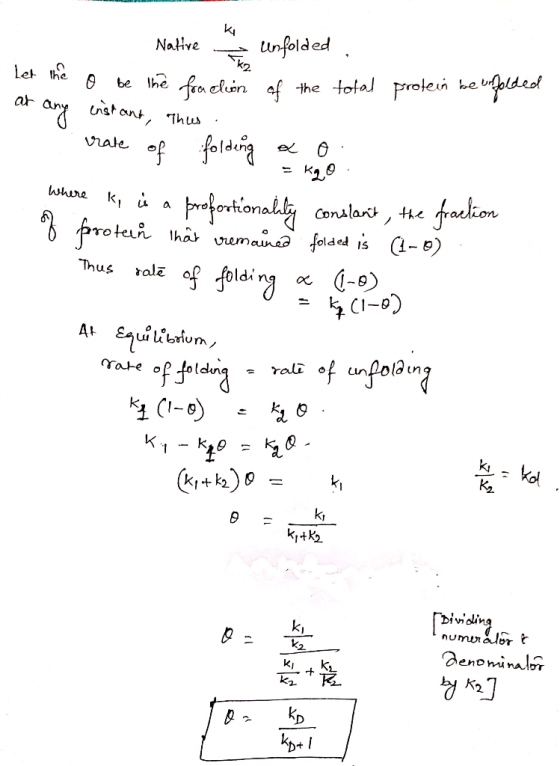
The denaturation of a biological macromolecule can be described by the equilibrium: macromolecule in native form...
The denaturation of a biological macromolecule can be described by the equilibrium: macromolecule in native form ⟷ macromolecules in denatured form a. Show that the fraction theta of denatured macromolecules is related to the equilibrium constant Kd for the denaturation process by theta= Kd / (1 + Kd)
The denaturation of proteins can be described by the equilibrium F⇌U where F and U represent...
The denaturation of proteins can be described by the equilibrium F⇌U where F and U represent the folded and unfolded proteins, respectively. For lysozyme, ΔuH0′298K= 335kJ/mol and ΔuS0′298K= 980J/K.mol. The subscript 'u' refers to 'unfolding'. A) Calculate the equilibrium constant for the equilibrium F⇌Uat 298K B) Suppose you dissolve a certain amount of lysozyme in aqueous buffer at 298K. What fraction of the lysozyme protein molecules will be unfolded once equilibrium is reached? The fraction of unfolded lysozyme is the...
2. (10 pts) Equilibrium constants of gaseous reactions can be expressed in terms of pressures (Kp),...
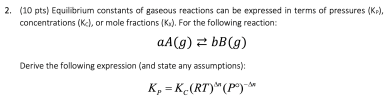 2. (10 pts) Equilibrium constants of gaseous reactions can be expressed in terms of pressures (Kp), concentrations (Kc), or mole fractions (Kx). For the following reaction: аА(g) 2 bB(g) Derive the following expression (and state any assumptions) An Кр — Ко(RT)"(Р) Ам
For the reaction A(aq) + BB(1) - C(s) + (aq) the equilibrium constant, K, can be...
 For the reaction A(aq) + BB(1) - C(s) + (aq) the equilibrium constant, K, can be written as PoD K- A When calculating the equilibrium constant, aqueous solutes must be expressed in moles per liter (M), and gases must be expressed in pressure as bars. This is because they are dimensionless ratios of the actual concentration or pressure divided by standard state concentration, which is M for solutions and 1 bar for gases. these are the only units of concentration...
Which of the following statements about equilibrium expressions and equilibrium constants are correct? Choose all that...
 Which of the following statements about equilibrium expressions and equilibrium constants are correct? Choose all that apply. Check all that apply. For chemical reactions in which all reactants and products are gases, K. can never be equal to K The equilibrium expression for a reaction involving only gases can be written in terms of either partial pressures or concentrations. A homogeneous equilibrium is one where all reactants and products are in the same physical state, When a chemical reaction is...
The equilibrium constant for the following reaction can be expressed by the empirical formula in the...
 The equilibrium constant for the following reaction
can be expressed by the empirical formula
in the interval 445 K < T < 460 K. Use this expression to
calculate ∆rH◦ and ∆rS ◦ at 450 K and derive
an equation for ∆fH◦ of Ag2O (s) in this
temperature range. Now use the following heat capacity data:
to calculate ∆rH◦ , ∆rS◦ , and
∆rG◦ at 298 K. Would Ag2O be automatically
decomposed when exposed to the atmosphere (the partial pressure...
The equilibrium constant for the following reaction
can be expressed by the empirical formula
in the interval 445 K < T < 460 K. Use this expression to
calculate ∆rH◦ and ∆rS ◦ at 450 K and derive
an equation for ∆fH◦ of Ag2O (s) in this
temperature range. Now use the following heat capacity data:
to calculate ∆rH◦ , ∆rS◦ , and
∆rG◦ at 298 K. Would Ag2O be automatically
decomposed when exposed to the atmosphere (the partial pressure...
PLEASE COMPLETE ALL WITH DETAILED WORK, NO EXPLANATIONS REQUIRED JUST STEP BY STEP WORK. Chemical Equilibrium.Submit...
 PLEASE COMPLETE ALL WITH DETAILED WORK, NO EXPLANATIONS REQUIRED
JUST STEP BY STEP WORK.
Chemical Equilibrium.Submit your answers and work as a PDF file into Canvas. Check that your responses are clear and legible. (1) (6 pts total) Consider the following two gas-phase equilibria in a sealed container at 1200 K (a) (2 pes) What is the mass-action expression and value of the equilibrium constant K for the following equilibrium at 1200 K? (b) (2 pts) What is the mass-action...
PLEASE COMPLETE ALL WITH DETAILED WORK, NO EXPLANATIONS REQUIRED
JUST STEP BY STEP WORK.
Chemical Equilibrium.Submit your answers and work as a PDF file into Canvas. Check that your responses are clear and legible. (1) (6 pts total) Consider the following two gas-phase equilibria in a sealed container at 1200 K (a) (2 pes) What is the mass-action expression and value of the equilibrium constant K for the following equilibrium at 1200 K? (b) (2 pts) What is the mass-action...
5. Consider the following concentration table 4 NH3(g) 0.30 mol 702(g) 0.80 mol 〈=> 2N,04(g) + 6...
 Please answer ALL parts OF LETTER F and show
work/explain
LETTER F
5. Consider the following concentration table 4 NH3(g) 0.30 mol 702(g) 0.80 mol 〈=> 2N,04(g) + 6H20(g) I (initial moles) C (change) E (equilibrium moles) a) What are the values for each of the v;? b) Show that Σ v, Xi-0. c) Fill in the concentration table in terms of 5, the extent of reaction. d) According to your concentration table what are the minimum and maximum values...
Please answer ALL parts OF LETTER F and show
work/explain
LETTER F
5. Consider the following concentration table 4 NH3(g) 0.30 mol 702(g) 0.80 mol 〈=> 2N,04(g) + 6H20(g) I (initial moles) C (change) E (equilibrium moles) a) What are the values for each of the v;? b) Show that Σ v, Xi-0. c) Fill in the concentration table in terms of 5, the extent of reaction. d) According to your concentration table what are the minimum and maximum values...
5. Consider the following concentration table 4 NH3(g) 0.30 mol 702(g) 0.80 mol 〈=> 2N,04(g) + 6...
 Please answer ALL parts OF LETTER E and show
work/explain
LETTER E
5. Consider the following concentration table 4 NH3(g) 0.30 mol 702(g) 0.80 mol 〈=> 2N,04(g) + 6H20(g) I (initial moles) C (change) E (equilibrium moles) a) What are the values for each of the v;? b) Show that Σ v, Xi-0. c) Fill in the concentration table in terms of 5, the extent of reaction. d) According to your concentration table what are the minimum and maximum values...
Please answer ALL parts OF LETTER E and show
work/explain
LETTER E
5. Consider the following concentration table 4 NH3(g) 0.30 mol 702(g) 0.80 mol 〈=> 2N,04(g) + 6H20(g) I (initial moles) C (change) E (equilibrium moles) a) What are the values for each of the v;? b) Show that Σ v, Xi-0. c) Fill in the concentration table in terms of 5, the extent of reaction. d) According to your concentration table what are the minimum and maximum values...
4. The energy of binding a transition state complex (X) can be determined by writing an...
 4. The energy of binding a transition state complex (X) can be determined by writing an equilibrium expression for the formation of the complex. (a) Fof the reaction AS X, what is the equilibrium expression? (b) What is the expression for the free energy of binding to the transition state (AG")? (c) What factors are needed to equate the rate constant k to the free energy of activation? Chapter 12 Enzyme Kinetics, Inhibition, and Control 119
 2. (10 pts) Equilibrium constants of gaseous reactions can be expressed in terms of pressures (Kp), concentrations (Kc), or mole fractions (Kx). For the following reaction: аА(g) 2 bB(g) Derive the following expression (and state any assumptions) An Кр — Ко(RT)"(Р) Ам
 For the reaction A(aq) + BB(1) - C(s) + (aq) the equilibrium constant, K, can be written as PoD K- A When calculating the equilibrium constant, aqueous solutes must be expressed in moles per liter (M), and gases must be expressed in pressure as bars. This is because they are dimensionless ratios of the actual concentration or pressure divided by standard state concentration, which is M for solutions and 1 bar for gases. these are the only units of concentration...
 Which of the following statements about equilibrium expressions and equilibrium constants are correct? Choose all that apply. Check all that apply. For chemical reactions in which all reactants and products are gases, K. can never be equal to K The equilibrium expression for a reaction involving only gases can be written in terms of either partial pressures or concentrations. A homogeneous equilibrium is one where all reactants and products are in the same physical state, When a chemical reaction is...
 The equilibrium constant for the following reaction
can be expressed by the empirical formula
in the interval 445 K < T < 460 K. Use this expression to
calculate ∆rH◦ and ∆rS ◦ at 450 K and derive
an equation for ∆fH◦ of Ag2O (s) in this
temperature range. Now use the following heat capacity data:
to calculate ∆rH◦ , ∆rS◦ , and
∆rG◦ at 298 K. Would Ag2O be automatically
decomposed when exposed to the atmosphere (the partial pressure...
The equilibrium constant for the following reaction
can be expressed by the empirical formula
in the interval 445 K < T < 460 K. Use this expression to
calculate ∆rH◦ and ∆rS ◦ at 450 K and derive
an equation for ∆fH◦ of Ag2O (s) in this
temperature range. Now use the following heat capacity data:
to calculate ∆rH◦ , ∆rS◦ , and
∆rG◦ at 298 K. Would Ag2O be automatically
decomposed when exposed to the atmosphere (the partial pressure...
 PLEASE COMPLETE ALL WITH DETAILED WORK, NO EXPLANATIONS REQUIRED
JUST STEP BY STEP WORK.
Chemical Equilibrium.Submit your answers and work as a PDF file into Canvas. Check that your responses are clear and legible. (1) (6 pts total) Consider the following two gas-phase equilibria in a sealed container at 1200 K (a) (2 pes) What is the mass-action expression and value of the equilibrium constant K for the following equilibrium at 1200 K? (b) (2 pts) What is the mass-action...
PLEASE COMPLETE ALL WITH DETAILED WORK, NO EXPLANATIONS REQUIRED
JUST STEP BY STEP WORK.
Chemical Equilibrium.Submit your answers and work as a PDF file into Canvas. Check that your responses are clear and legible. (1) (6 pts total) Consider the following two gas-phase equilibria in a sealed container at 1200 K (a) (2 pes) What is the mass-action expression and value of the equilibrium constant K for the following equilibrium at 1200 K? (b) (2 pts) What is the mass-action...
 Please answer ALL parts OF LETTER F and show
work/explain
LETTER F
5. Consider the following concentration table 4 NH3(g) 0.30 mol 702(g) 0.80 mol 〈=> 2N,04(g) + 6H20(g) I (initial moles) C (change) E (equilibrium moles) a) What are the values for each of the v;? b) Show that Σ v, Xi-0. c) Fill in the concentration table in terms of 5, the extent of reaction. d) According to your concentration table what are the minimum and maximum values...
Please answer ALL parts OF LETTER F and show
work/explain
LETTER F
5. Consider the following concentration table 4 NH3(g) 0.30 mol 702(g) 0.80 mol 〈=> 2N,04(g) + 6H20(g) I (initial moles) C (change) E (equilibrium moles) a) What are the values for each of the v;? b) Show that Σ v, Xi-0. c) Fill in the concentration table in terms of 5, the extent of reaction. d) According to your concentration table what are the minimum and maximum values...
 Please answer ALL parts OF LETTER E and show
work/explain
LETTER E
5. Consider the following concentration table 4 NH3(g) 0.30 mol 702(g) 0.80 mol 〈=> 2N,04(g) + 6H20(g) I (initial moles) C (change) E (equilibrium moles) a) What are the values for each of the v;? b) Show that Σ v, Xi-0. c) Fill in the concentration table in terms of 5, the extent of reaction. d) According to your concentration table what are the minimum and maximum values...
Please answer ALL parts OF LETTER E and show
work/explain
LETTER E
5. Consider the following concentration table 4 NH3(g) 0.30 mol 702(g) 0.80 mol 〈=> 2N,04(g) + 6H20(g) I (initial moles) C (change) E (equilibrium moles) a) What are the values for each of the v;? b) Show that Σ v, Xi-0. c) Fill in the concentration table in terms of 5, the extent of reaction. d) According to your concentration table what are the minimum and maximum values...
 4. The energy of binding a transition state complex (X) can be determined by writing an equilibrium expression for the formation of the complex. (a) Fof the reaction AS X, what is the equilibrium expression? (b) What is the expression for the free energy of binding to the transition state (AG")? (c) What factors are needed to equate the rate constant k to the free energy of activation? Chapter 12 Enzyme Kinetics, Inhibition, and Control 119
Most questions answered within 3 hours.
-
Where is the error in this code sequence?
String s1 = "Hello";
String s2 = "ello";...
asked 11 months ago -
Financial data for Joel de Paris, Inc., for last year
follow:
Joel de Paris, Inc.
Balance...
asked 11 months ago -
Consider this reaction:
Al2(SO4)3 (aq)+ BaCl3
(aq) Al2Cl6 (aq)- +
3BaSO4(s) . What is the...
asked 11 months ago -
Suppose that Savneet is considering increasing her
recent random sample from 20 car rentals to 40...
asked 11 months ago -
Trucks arrive at an unloading terminal at an average rate of 120
per hour.
Trucks arrive...
asked 11 months ago -
Why are methanol and ethanol completely soluble in water while
octanol is not very little soluble....
asked 11 months ago -
A facilities manager at a university reads in a research report
that the mean amount of...
asked 11 months ago -
When the CuSO4 is rehydrated by adding water to the anhydrous
compound, is this an endothermic...
asked 11 months ago -
A ray of sunlight is passing from diamond into crown glass; the
angle of incidence is...
asked 11 months ago -
A block of mass 0.249 kg is placed on top of a light, vertical
spring of...
asked 11 months ago -
how do the kidneys compensate in the presences of acidosis
a) trigger hyperventilate
b) reserve acid...
asked 11 months ago -
Question 501 pts
The rental rate of capital to the firm increases. Which of the
following...
asked 11 months ago