
Homework Answers
A) when they are connected end to end, they are connected in series
R(equi) = R + R = 2r
b) When they are welded together , they are in parallel
R(equi) =R*R / (R + R)
= R/2
Add Answer to:
CChapter 19-Homework Problem 19.42 v Part A The end of one bar is wolded to the...
CChapter 19-Homework Problem 19.38 PartA For the circuit in (Figure 1) assume that Rs -11and Rs...
 CChapter 19-Homework Problem 19.38 PartA For the circuit in (Figure 1) assume that Rs -11and Rs #58 Find the rate of conversion of internal (chemical) energy to electrical energy within the battery Express your answer in watts using two significant figures. Figure 1 of R, 12.0 v Part B Find the rate of dissipation ofelcrical y in the batery Express your answer in watts using two sigificant gures F9 Fro F11 F6
CChapter 18-Homework Problem 18.46 Part C Constants In (Figure 1), each capacitor has C 4.00 F...
 CChapter 18-Homework Problem 18.46 Part C Constants In (Figure 1), each capacitor has C 4.00 F and V-24.5V Calculate the charge on Ca Express your answer in microcoulombs to three significant figures. uC Figure 1of1 Submit Part D Calculate the charge on Ca Express your answer in microcoulombs to three significant figures Submit
CChapter 18-Homework Problem 18.46 Part E Calculate the potental difference across C Express your answer in...
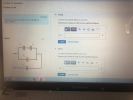 CChapter 18-Homework Problem 18.46 Part E Calculate the potental difference across C Express your answer in volts to three significant figures. nFrure 1),each capacitor has C2400 μΡ and Figure 1 of 1 C. Y Part F Calculate tho potential difference across Ca Express your answer in volts to three significant figures Submit
Exercise 29.28 Constants Part A A 1.15-m-long metal bar is pulled to the right at a...
 Exercise 29.28 Constants Part A A 1.15-m-long metal bar is pulled to the right at a steady 6.0 m/s perpendicular to a uniform, 0.765-T magnetic field. The bar rides on parallel metal rails connected through R-24.5-2, as shown in the figure (Figure 1), so the apparatus makes a complete circuit. You can ignore the resistance of the bar and the rails. Calculate the magnitude of the emf induced in the circuit Express your answer using two significant figures. Request Answer...
This is all the information given. <Chapter 19 - Homework Problem 19.20 8 of 26 Review...
 This
is all the information given.
<Chapter 19 - Homework Problem 19.20 8 of 26 Review 1 Constants A copper transmission cable 180 km long and 120 cm in diameter carries a current of 140 A. Part A What is the potential drop across the cable? VO ΑΣΦ I ? V- 3.8. 10-4 V Submit Previous Answers Request Answer * Incorrect; Try Again; 2 attempts remaining Next > Provide Feedback Course Home <Chapter 19 - Homework 2 of 26 Problem...
This
is all the information given.
<Chapter 19 - Homework Problem 19.20 8 of 26 Review 1 Constants A copper transmission cable 180 km long and 120 cm in diameter carries a current of 140 A. Part A What is the potential drop across the cable? VO ΑΣΦ I ? V- 3.8. 10-4 V Submit Previous Answers Request Answer * Incorrect; Try Again; 2 attempts remaining Next > Provide Feedback Course Home <Chapter 19 - Homework 2 of 26 Problem...
Constants Part A A metal bar is in the xy-plane with one end of the bar...
 Constants Part A A metal bar is in the xy-plane with one end of the bar at the origin. A force F (6.54 N)i ( 3.06 N )j is applied to the bar at the point x- 3.81 m, y 3.60 m What is the position vector r for the point where the force is applied? Enter the x and y components of the radius vector separated by a comma Submit Request Answer Part B What are the magnitude of...
Two parallel conducting rails a distance l apart are connected at one end by a resistance...
 Two parallel conducting rails a distance l apart are connected
at one end by a resistance R in series with battery of emf E. A
conducting bar completes the circuit, joining the two rails
electrically but free to slide along them. The whole circuit is
perpendicular to a uniform magnetic field B, as shown in (Figure
1). The bar is initially at rest, and nothing is pulling it.
Find an expression for the initial value of the current in the...
Two parallel conducting rails a distance l apart are connected
at one end by a resistance R in series with battery of emf E. A
conducting bar completes the circuit, joining the two rails
electrically but free to slide along them. The whole circuit is
perpendicular to a uniform magnetic field B, as shown in (Figure
1). The bar is initially at rest, and nothing is pulling it.
Find an expression for the initial value of the current in the...
A conducting bar of length D rotates with angular frequency w about a pivot P at...
 A conducting bar of length D rotates with angular frequency w about a pivot P at one end of the bar (see the figure). The other end of the bar is in slipping contact with a stationary conducting wire in the shape of a circle (we only show a small part of that circle to keep the drawing simple). Between point P and the circular wire there is a resistor R as shown. Thus the bar, the resistor and the...
《 ch.29 Exercise 29.57 Part A Caloulate he em induced in the bar. Express your answer...
 《 ch.29 Exercise 29.57 Part A Caloulate he em induced in the bar. Express your answer in terms of the glven quantities and appropriate constants. Constants The long, stright wire shown in the igure (Figure 1) a carries constant curent I A metal bar with length L is moving at conetant velocity t, as shown in the figure. Point a is a distance d from the wire Submit Bequest Answer Part B Which point, a or b, is at higher...
A 1.10-m-long metal bar is pulled to the right at a steady 4.0 m/s perpendicular to...
A 1.10-m-long metal bar is pulled to the right at a steady 4.0 m/s perpendicular to a uniform, 0.790-T magnetic field. The bar rides on parallel metal rails connected through R = 25.5-Ω, as shown in the figure (Figure 1), so the apparatus makes a complete circuit. You can ignore the resistance of the bar and the rails. A) Calculate the magnitude of the emf induced in the circuit. Express your answer using two significant figures. B)Find the direction of...
 CChapter 19-Homework Problem 19.38 PartA For the circuit in (Figure 1) assume that Rs -11and Rs #58 Find the rate of conversion of internal (chemical) energy to electrical energy within the battery Express your answer in watts using two significant figures. Figure 1 of R, 12.0 v Part B Find the rate of dissipation ofelcrical y in the batery Express your answer in watts using two sigificant gures F9 Fro F11 F6
 CChapter 18-Homework Problem 18.46 Part C Constants In (Figure 1), each capacitor has C 4.00 F and V-24.5V Calculate the charge on Ca Express your answer in microcoulombs to three significant figures. uC Figure 1of1 Submit Part D Calculate the charge on Ca Express your answer in microcoulombs to three significant figures Submit
 CChapter 18-Homework Problem 18.46 Part E Calculate the potental difference across C Express your answer in volts to three significant figures. nFrure 1),each capacitor has C2400 μΡ and Figure 1 of 1 C. Y Part F Calculate tho potential difference across Ca Express your answer in volts to three significant figures Submit
 Exercise 29.28 Constants Part A A 1.15-m-long metal bar is pulled to the right at a steady 6.0 m/s perpendicular to a uniform, 0.765-T magnetic field. The bar rides on parallel metal rails connected through R-24.5-2, as shown in the figure (Figure 1), so the apparatus makes a complete circuit. You can ignore the resistance of the bar and the rails. Calculate the magnitude of the emf induced in the circuit Express your answer using two significant figures. Request Answer...
 This
is all the information given.
<Chapter 19 - Homework Problem 19.20 8 of 26 Review 1 Constants A copper transmission cable 180 km long and 120 cm in diameter carries a current of 140 A. Part A What is the potential drop across the cable? VO ΑΣΦ I ? V- 3.8. 10-4 V Submit Previous Answers Request Answer * Incorrect; Try Again; 2 attempts remaining Next > Provide Feedback Course Home <Chapter 19 - Homework 2 of 26 Problem...
This
is all the information given.
<Chapter 19 - Homework Problem 19.20 8 of 26 Review 1 Constants A copper transmission cable 180 km long and 120 cm in diameter carries a current of 140 A. Part A What is the potential drop across the cable? VO ΑΣΦ I ? V- 3.8. 10-4 V Submit Previous Answers Request Answer * Incorrect; Try Again; 2 attempts remaining Next > Provide Feedback Course Home <Chapter 19 - Homework 2 of 26 Problem...
 Constants Part A A metal bar is in the xy-plane with one end of the bar at the origin. A force F (6.54 N)i ( 3.06 N )j is applied to the bar at the point x- 3.81 m, y 3.60 m What is the position vector r for the point where the force is applied? Enter the x and y components of the radius vector separated by a comma Submit Request Answer Part B What are the magnitude of...
 Two parallel conducting rails a distance l apart are connected
at one end by a resistance R in series with battery of emf E. A
conducting bar completes the circuit, joining the two rails
electrically but free to slide along them. The whole circuit is
perpendicular to a uniform magnetic field B, as shown in (Figure
1). The bar is initially at rest, and nothing is pulling it.
Find an expression for the initial value of the current in the...
Two parallel conducting rails a distance l apart are connected
at one end by a resistance R in series with battery of emf E. A
conducting bar completes the circuit, joining the two rails
electrically but free to slide along them. The whole circuit is
perpendicular to a uniform magnetic field B, as shown in (Figure
1). The bar is initially at rest, and nothing is pulling it.
Find an expression for the initial value of the current in the...
 A conducting bar of length D rotates with angular frequency w about a pivot P at one end of the bar (see the figure). The other end of the bar is in slipping contact with a stationary conducting wire in the shape of a circle (we only show a small part of that circle to keep the drawing simple). Between point P and the circular wire there is a resistor R as shown. Thus the bar, the resistor and the...
 《 ch.29 Exercise 29.57 Part A Caloulate he em induced in the bar. Express your answer in terms of the glven quantities and appropriate constants. Constants The long, stright wire shown in the igure (Figure 1) a carries constant curent I A metal bar with length L is moving at conetant velocity t, as shown in the figure. Point a is a distance d from the wire Submit Bequest Answer Part B Which point, a or b, is at higher...
Most questions answered within 3 hours.
-
Where is the error in this code sequence?
String s1 = "Hello";
String s2 = "ello";...
asked 10 months ago -
Financial data for Joel de Paris, Inc., for last year
follow:
Joel de Paris, Inc.
Balance...
asked 10 months ago -
Consider this reaction:
Al2(SO4)3 (aq)+ BaCl3
(aq) Al2Cl6 (aq)- +
3BaSO4(s) . What is the...
asked 10 months ago -
Suppose that Savneet is considering increasing her
recent random sample from 20 car rentals to 40...
asked 10 months ago -
Trucks arrive at an unloading terminal at an average rate of 120
per hour.
Trucks arrive...
asked 10 months ago -
Why are methanol and ethanol completely soluble in water while
octanol is not very little soluble....
asked 10 months ago -
A facilities manager at a university reads in a research report
that the mean amount of...
asked 10 months ago -
When the CuSO4 is rehydrated by adding water to the anhydrous
compound, is this an endothermic...
asked 10 months ago -
A ray of sunlight is passing from diamond into crown glass; the
angle of incidence is...
asked 10 months ago -
A block of mass 0.249 kg is placed on top of a light, vertical
spring of...
asked 10 months ago -
how do the kidneys compensate in the presences of acidosis
a) trigger hyperventilate
b) reserve acid...
asked 10 months ago -
Question 501 pts
The rental rate of capital to the firm increases. Which of the
following...
asked 10 months ago