
Homework Answers

Add Answer to:
Suppose we lived in a different universe, in which the force law governing electrical interactions between...
2. Suppose we lived in a different universe, in which the force law governing electrical interactions...
 2. Suppose we lived in a different universe, in which the force law governing electrical interactions between charged particles was 12T12 r12 Would Gauss's Law be valid in this hypothetical universe? Explain.
Coulomb's Law describes the force between two charged objects. Suppose Object 1 has a charge of...
Coulomb's Law describes the force between two charged objects. Suppose Object 1 has a charge of +1.50 microcoulombs and Object 2 has a charge of +14.2 coulombs. Object 2 is located a distance of 0.05810 m to the right of object 1. What is the magnitude and direction of the electrical force on object 2 due to Object 1?
Coulomb’s Law describes the force between two (and only two!) charged objects. Suppose Object 1 has...
Coulomb’s Law describes the force between two (and only two!) charged objects. Suppose Object 1 has a charge of +2.71 μC and Object 2 has a charge of +18.5 μC. Object 2 is located a distance of 0.04480 m to the right of Object 1 (Yes — please break down and draw a quick sketch!). What is the magnitude and direction of the electrical force on Object 2 due to Object 1? What is the magnitude and direction of the...
Sorry there are so many parts to the question--thank you in advance for your effort. INVESTIGATION...
 Sorry there are so many parts
to the question--thank you in advance for your effort.
INVESTIGATION 1: ELECTRICAL AND GRAVITATIONAL FORCES Let's begin our discussion with the familiar expression for the Coulomb force exerted on charge 2 by charge 1, F1-2 f12 Unit vector q1 r2 ,-8.99 × 10⁹ Ncme C2 92 where k, is a constant that equals 9.0 x 10 N m2/C2. The force F2-1 of charge 2 on charge 1 is equal in magnitude and opposite in...
Sorry there are so many parts
to the question--thank you in advance for your effort.
INVESTIGATION 1: ELECTRICAL AND GRAVITATIONAL FORCES Let's begin our discussion with the familiar expression for the Coulomb force exerted on charge 2 by charge 1, F1-2 f12 Unit vector q1 r2 ,-8.99 × 10⁹ Ncme C2 92 where k, is a constant that equals 9.0 x 10 N m2/C2. The force F2-1 of charge 2 on charge 1 is equal in magnitude and opposite in...
Suppose we had a large, positively charged plate in an upright (vertical) position and a point...
 Suppose we had a large, positively charged plate in an upright (vertical) position and a point charge with positive charge +Q. In lecture, you saw that a large charged plate gives rise to an electric field which is constant in space: we will call this electric field Eplate. Let us suppose also that we had a s bl with positive charge +q and mass m. The situation is depicted in Figure 1. +q,m +Q Figure 1 The objective of this...
HW.37. Redo Hw. 27 using the sump condition (0) and Gauss's law for Ē. As we...
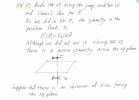 HW.37. Redo Hw. 27 using the sump condition (0) and Gauss's law for Ē. As we did in HW.29, the symmetry in the problem leads to È (F) = Ez(z)? Although we did not use in solving HW. 27, there is a mirror symmetry across the XJ-plane. zo ok zo Suppose that there is an observer at z=2o facing the xy-plane. so that If someone moves you from Z=2 to 2-2, while you are asleep still face the xy-plane, you...
ADVANCE STUDY ASSIGNMENT: COULOMB'S LAW PURPOSE of tl of this exercise is to become familiar with...
 ADVANCE STUDY ASSIGNMENT: COULOMB'S LAW PURPOSE of tl of this exercise is to become familiar with the force between electric point charges which is descrbed by Coulomb's law. In particular, we will investigate the force's inverse-square dependence on separation distance between charges. DISCUSSION A basic characteristic of electric charge is that charges exert forces on each other, like charges positive-positive and negative-negative) repel each other while opposite charges (positive- and constitute a Newton's third-law pair; that is, they are equal...
Learning Objectives As part of this activity, you want to be able to: Experimentally verify that...
 Learning Objectives As part of this activity, you want to be able to: Experimentally verify that the strength of the Coulomb force between two charged bodies varies inversely with the square of the separation distance between them. Experimentally verify that the strength of the Coulomb force between two charged bodies varies with the product of the charges. 1.1 Pre-lab Gravitational force Last semester you may have encountered Newton's universal law of gravitation. This law, which describes the force between two...
1. In class, we calculated the electrostatic force between sodium and chlorine ions in NaCl, whic...
 1. In class, we calculated the electrostatic force between sodium and chlorine ions in NaCl, which is an example of an ionic bond Another type of chemical bond is a covalent bond, where electrons are shared between atoms, like in a hydrogen molecule, H2. We can try to model this as a collection of three charges, with the two nuclei treated like two +e charges, and the two electrons treated as one -2e charge. (20 points) If the electrons are...
(a) Which part of an atom is positively charged, and which part is negatively charged? (b)...
(a) Which part of an atom is positively charged, and which part is negatively charged? (b) How does the charge of an electron compare with the charge of another electron? (c) How does the charge of an electron compare with the charge of a proton? Can charge be created or destroyed? How does that answer relate to the conservation of charge? How is electric charge similar to mass? How are they different? What are two ways electric charge can be...
 2. Suppose we lived in a different universe, in which the force law governing electrical interactions between charged particles was 12T12 r12 Would Gauss's Law be valid in this hypothetical universe? Explain.
 Sorry there are so many parts
to the question--thank you in advance for your effort.
INVESTIGATION 1: ELECTRICAL AND GRAVITATIONAL FORCES Let's begin our discussion with the familiar expression for the Coulomb force exerted on charge 2 by charge 1, F1-2 f12 Unit vector q1 r2 ,-8.99 × 10⁹ Ncme C2 92 where k, is a constant that equals 9.0 x 10 N m2/C2. The force F2-1 of charge 2 on charge 1 is equal in magnitude and opposite in...
Sorry there are so many parts
to the question--thank you in advance for your effort.
INVESTIGATION 1: ELECTRICAL AND GRAVITATIONAL FORCES Let's begin our discussion with the familiar expression for the Coulomb force exerted on charge 2 by charge 1, F1-2 f12 Unit vector q1 r2 ,-8.99 × 10⁹ Ncme C2 92 where k, is a constant that equals 9.0 x 10 N m2/C2. The force F2-1 of charge 2 on charge 1 is equal in magnitude and opposite in...
 Suppose we had a large, positively charged plate in an upright (vertical) position and a point charge with positive charge +Q. In lecture, you saw that a large charged plate gives rise to an electric field which is constant in space: we will call this electric field Eplate. Let us suppose also that we had a s bl with positive charge +q and mass m. The situation is depicted in Figure 1. +q,m +Q Figure 1 The objective of this...
 HW.37. Redo Hw. 27 using the sump condition (0) and Gauss's law for Ē. As we did in HW.29, the symmetry in the problem leads to È (F) = Ez(z)? Although we did not use in solving HW. 27, there is a mirror symmetry across the XJ-plane. zo ok zo Suppose that there is an observer at z=2o facing the xy-plane. so that If someone moves you from Z=2 to 2-2, while you are asleep still face the xy-plane, you...
 ADVANCE STUDY ASSIGNMENT: COULOMB'S LAW PURPOSE of tl of this exercise is to become familiar with the force between electric point charges which is descrbed by Coulomb's law. In particular, we will investigate the force's inverse-square dependence on separation distance between charges. DISCUSSION A basic characteristic of electric charge is that charges exert forces on each other, like charges positive-positive and negative-negative) repel each other while opposite charges (positive- and constitute a Newton's third-law pair; that is, they are equal...
 Learning Objectives As part of this activity, you want to be able to: Experimentally verify that the strength of the Coulomb force between two charged bodies varies inversely with the square of the separation distance between them. Experimentally verify that the strength of the Coulomb force between two charged bodies varies with the product of the charges. 1.1 Pre-lab Gravitational force Last semester you may have encountered Newton's universal law of gravitation. This law, which describes the force between two...
 1. In class, we calculated the electrostatic force between sodium and chlorine ions in NaCl, which is an example of an ionic bond Another type of chemical bond is a covalent bond, where electrons are shared between atoms, like in a hydrogen molecule, H2. We can try to model this as a collection of three charges, with the two nuclei treated like two +e charges, and the two electrons treated as one -2e charge. (20 points) If the electrons are...
Most questions answered within 3 hours.
-
Where is the error in this code sequence?
String s1 = "Hello";
String s2 = "ello";...
asked 10 months ago -
Financial data for Joel de Paris, Inc., for last year
follow:
Joel de Paris, Inc.
Balance...
asked 10 months ago -
Consider this reaction:
Al2(SO4)3 (aq)+ BaCl3
(aq) Al2Cl6 (aq)- +
3BaSO4(s) . What is the...
asked 10 months ago -
Suppose that Savneet is considering increasing her
recent random sample from 20 car rentals to 40...
asked 10 months ago -
Trucks arrive at an unloading terminal at an average rate of 120
per hour.
Trucks arrive...
asked 10 months ago -
Why are methanol and ethanol completely soluble in water while
octanol is not very little soluble....
asked 10 months ago -
A facilities manager at a university reads in a research report
that the mean amount of...
asked 10 months ago -
When the CuSO4 is rehydrated by adding water to the anhydrous
compound, is this an endothermic...
asked 10 months ago -
A ray of sunlight is passing from diamond into crown glass; the
angle of incidence is...
asked 10 months ago -
A block of mass 0.249 kg is placed on top of a light, vertical
spring of...
asked 10 months ago -
how do the kidneys compensate in the presences of acidosis
a) trigger hyperventilate
b) reserve acid...
asked 10 months ago -
Question 501 pts
The rental rate of capital to the firm increases. Which of the
following...
asked 10 months ago