When Fe³⁺ and F⁻ are combined, the reaction Fe³⁺ +6F⁻ ⇄FeF₆³⁻ occurs. How does this reaction affect the reaction Fe³⁺ + SCN⁻ ⇄FeSCN²⁺ ? Justify your answer in terms of observations(picture below). Think about LeChatelier's principle

Homework Answers

Add Answer to:
When Fe³⁺ and F⁻ are combined, the reaction Fe³⁺ +6F⁻
⇄FeF₆³⁻ occurs. How does this reaction...
FesCN (aq), and LeChâtelier's Explain in terms of the equation, Fe" (aq) + SCN (aq) Principle...
 FesCN (aq), and LeChâtelier's Explain in terms of the equation, Fe" (aq) + SCN (aq) Principle (4 ) Observation after adding KSCN: turned darker more red like original solution brown Explain in terms of the equation, Fe (aq) + SCN (aq) + FeSCN- (aq), and LeChâtelier's Principle. (ps.) Observation after adding AgNO3: Turned milky white + thieverf less transparent Using the ions present in the solution, write a net ionic equation that would explain the precipitate observed Use the above...
In this step, you add xSCN to oneof the our escoi y a. If your solution has Fe", s te portions fr...
 second photo is for your reference. thanks!
In this step, you add xSCN to oneof the our escoi y a. If your solution has Fe", s te portions from Step 12A. ,what change should you expect to observe? b. Write a balanced chemical equation for the reaction between Fe" and KSCH. equation Step 13 In this step, you first add Naf to one of the four decantate portions NH&SCN in ethanol. from Step 12A; then, you add a. If your...
second photo is for your reference. thanks!
In this step, you add xSCN to oneof the our escoi y a. If your solution has Fe", s te portions from Step 12A. ,what change should you expect to observe? b. Write a balanced chemical equation for the reaction between Fe" and KSCH. equation Step 13 In this step, you first add Naf to one of the four decantate portions NH&SCN in ethanol. from Step 12A; then, you add a. If your...
what us question 7 and 8 ? i do not understand it. Reaction Rates and Chemical...
 what us question 7 and 8 ? i do not understand it.
Reaction Rates and Chemical Equilibrium 211 Q6 When water was added to the anhydrate of Cuso (s), did the reaction proceed in the direction of the reactants or products? recctants B.2 Reaction of Copper(ll) Ion and Hydroxide Test tube 1 Test tube 2 Initial color of CuCl, solution (1) Que bwi ove Initial appearance Cu(OH),(s) (2) Green I light blue Change in appearance (3) турупnrbek Change in appearance...
what us question 7 and 8 ? i do not understand it.
Reaction Rates and Chemical Equilibrium 211 Q6 When water was added to the anhydrate of Cuso (s), did the reaction proceed in the direction of the reactants or products? recctants B.2 Reaction of Copper(ll) Ion and Hydroxide Test tube 1 Test tube 2 Initial color of CuCl, solution (1) Que bwi ove Initial appearance Cu(OH),(s) (2) Green I light blue Change in appearance (3) турупnrbek Change in appearance...
My question is #2 for the reaction Fe3+ (aq) + SCN- (aq) FeSCN2+ (aq). The goal...
 My question is #2 for the reaction Fe3+ (aq) + SCN- (aq)
FeSCN2+ (aq). The goal is to predict the color change (darker or
lighter) for test tubes 2-8. I have attached the supplemental
sheets given to help with the problem. The test tubes 2-8 are being
manipulated either by temperature or things being added which can
be seen by one of the pictures.
2. For reaction "UCTIONS are increased by the same amount. Fe3+ (aq) + SCN (aq) $...
My question is #2 for the reaction Fe3+ (aq) + SCN- (aq)
FeSCN2+ (aq). The goal is to predict the color change (darker or
lighter) for test tubes 2-8. I have attached the supplemental
sheets given to help with the problem. The test tubes 2-8 are being
manipulated either by temperature or things being added which can
be seen by one of the pictures.
2. For reaction "UCTIONS are increased by the same amount. Fe3+ (aq) + SCN (aq) $...
Name Part B. Iron un Chloride (FeCl) plus Potassium Thiocyanate (KSCN Prepare a stock solution to...
 Name Part B. Iron un Chloride (FeCl) plus Potassium Thiocyanate (KSCN Prepare a stock solution to be tested by adding 12 drops each of 0.1 M FeCl, and 0.1 MKSON well. Fill each of four medium sized test tubes (all the same size) half full of the stock solution FeSCN'(a) pale yellow colorless 1. The first tube is a control. Always compare to this color. 2. Add 20 drops of 0.1 Miron () chloride solution to the second tube. Observe...
1. Fe^3+(aq) + 4Cl^-(aq) ⇌ [FeCl4]^-(aq) 2. NaF(s) + H2O(l) → Na^+(aq) + F^-(aq) 3. Fe^+(aq)...
1. Fe^3+(aq) + 4Cl^-(aq) ⇌ [FeCl4]^-(aq) 2. NaF(s) + H2O(l) → Na^+(aq) + F^-(aq) 3. Fe^+(aq) + 6F^-(aq) ⇌ [FeF6]^3-(aq) Describe on the how the concentrations of Fe3+, Cl-, and [FeCl4]- changed when NaF is added (Refer to equations provided above). How did [Fe3+] change upon addition of NaF? _________________________________ How did [Cl-] change upon addition of NaF? _________________________________ How did [FeCl4-] change upon the addition of NaF? _____________________________
Fe (aq)SCN-(aq) FeSCN (aq) thiocyanate iron(II) thiocyanoiron(il) Introduction When the reactants shown above, are combined, chemical...
 Fe (aq)SCN-(aq) FeSCN (aq) thiocyanate iron(II) thiocyanoiron(il) Introduction When the reactants shown above, are combined, chemical equilibrium is reached rapidly. Once equilibrium is established, the equilibrium constant can be calculated if the concentration of all the ions are known: [FeSCNP.he [SCN-... and (Feng Your task is to prepare three different equilibrium systems that contain different concentrations of these ions. Keep in mind that although the concentrations will be different, the value of the equilibrium constant Ke will be indeed constant...
The Common Ion Effect Reaction: Fe3+ + SCN <> Fe(SCN)2+ 1. After the addition of 0.1...
The Common Ion Effect Reaction: Fe3+ + SCN <> Fe(SCN)2+ 1. After the addition of 0.1 M KSCN to test tube 2, what is the color of the solution? How does the addition of KSCN affect the equilibrium of the reaction above? How does this relate to the change, if any, in the color of the solution? Include equations for reactions in your explanation. Color: dark red After the addition of 0.1 M Fe(NO3)3 to test tube 2, what is...
2. The reaction Fe3+ (aq) + SCN (aq) → FeSCN2+ (aq) produces a dark red color...
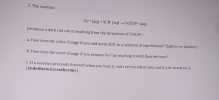 2. The reaction Fe3+ (aq) + SCN (aq) → FeSCN2+ (aq) produces a dark red color resulting from the formation of FeSCN2+. a. How does the color change if you add more SCN to a solution at equilibrium? (lighter or darker) b. How does the color change if you remove Fe3+ by reacting it with fluoride ions? c. If a reaction proceeds forward when you heat it, and reverse when you cool it, the reaction is [endothermic exothermic).
For each experiment described below 1) provide the relevant equilibrium reaction or reactions, 2) use LeChatelier's...
For each experiment described below 1) provide the relevant equilibrium reaction or reactions, 2) use LeChatelier's Principle to explain why the reaction has shifted left (L) or right (R), and 3) answer any other questions. a) To a solution containing 1M Pb(NO3)2, 1 M HCl is slowly added until a white precipitate forms. The mixture is then heated and the precipitate disappears. Is the dissociation of the precipitate endothermic or exothermic? Does the equilibrium constant (Ksp) change when the solution...
 FesCN (aq), and LeChâtelier's Explain in terms of the equation, Fe" (aq) + SCN (aq) Principle (4 ) Observation after adding KSCN: turned darker more red like original solution brown Explain in terms of the equation, Fe (aq) + SCN (aq) + FeSCN- (aq), and LeChâtelier's Principle. (ps.) Observation after adding AgNO3: Turned milky white + thieverf less transparent Using the ions present in the solution, write a net ionic equation that would explain the precipitate observed Use the above...
 second photo is for your reference. thanks!
In this step, you add xSCN to oneof the our escoi y a. If your solution has Fe", s te portions from Step 12A. ,what change should you expect to observe? b. Write a balanced chemical equation for the reaction between Fe" and KSCH. equation Step 13 In this step, you first add Naf to one of the four decantate portions NH&SCN in ethanol. from Step 12A; then, you add a. If your...
second photo is for your reference. thanks!
In this step, you add xSCN to oneof the our escoi y a. If your solution has Fe", s te portions from Step 12A. ,what change should you expect to observe? b. Write a balanced chemical equation for the reaction between Fe" and KSCH. equation Step 13 In this step, you first add Naf to one of the four decantate portions NH&SCN in ethanol. from Step 12A; then, you add a. If your...
 what us question 7 and 8 ? i do not understand it.
Reaction Rates and Chemical Equilibrium 211 Q6 When water was added to the anhydrate of Cuso (s), did the reaction proceed in the direction of the reactants or products? recctants B.2 Reaction of Copper(ll) Ion and Hydroxide Test tube 1 Test tube 2 Initial color of CuCl, solution (1) Que bwi ove Initial appearance Cu(OH),(s) (2) Green I light blue Change in appearance (3) турупnrbek Change in appearance...
what us question 7 and 8 ? i do not understand it.
Reaction Rates and Chemical Equilibrium 211 Q6 When water was added to the anhydrate of Cuso (s), did the reaction proceed in the direction of the reactants or products? recctants B.2 Reaction of Copper(ll) Ion and Hydroxide Test tube 1 Test tube 2 Initial color of CuCl, solution (1) Que bwi ove Initial appearance Cu(OH),(s) (2) Green I light blue Change in appearance (3) турупnrbek Change in appearance...
 My question is #2 for the reaction Fe3+ (aq) + SCN- (aq)
FeSCN2+ (aq). The goal is to predict the color change (darker or
lighter) for test tubes 2-8. I have attached the supplemental
sheets given to help with the problem. The test tubes 2-8 are being
manipulated either by temperature or things being added which can
be seen by one of the pictures.
2. For reaction "UCTIONS are increased by the same amount. Fe3+ (aq) + SCN (aq) $...
My question is #2 for the reaction Fe3+ (aq) + SCN- (aq)
FeSCN2+ (aq). The goal is to predict the color change (darker or
lighter) for test tubes 2-8. I have attached the supplemental
sheets given to help with the problem. The test tubes 2-8 are being
manipulated either by temperature or things being added which can
be seen by one of the pictures.
2. For reaction "UCTIONS are increased by the same amount. Fe3+ (aq) + SCN (aq) $...
 Name Part B. Iron un Chloride (FeCl) plus Potassium Thiocyanate (KSCN Prepare a stock solution to be tested by adding 12 drops each of 0.1 M FeCl, and 0.1 MKSON well. Fill each of four medium sized test tubes (all the same size) half full of the stock solution FeSCN'(a) pale yellow colorless 1. The first tube is a control. Always compare to this color. 2. Add 20 drops of 0.1 Miron () chloride solution to the second tube. Observe...
 Fe (aq)SCN-(aq) FeSCN (aq) thiocyanate iron(II) thiocyanoiron(il) Introduction When the reactants shown above, are combined, chemical equilibrium is reached rapidly. Once equilibrium is established, the equilibrium constant can be calculated if the concentration of all the ions are known: [FeSCNP.he [SCN-... and (Feng Your task is to prepare three different equilibrium systems that contain different concentrations of these ions. Keep in mind that although the concentrations will be different, the value of the equilibrium constant Ke will be indeed constant...
 2. The reaction Fe3+ (aq) + SCN (aq) → FeSCN2+ (aq) produces a dark red color resulting from the formation of FeSCN2+. a. How does the color change if you add more SCN to a solution at equilibrium? (lighter or darker) b. How does the color change if you remove Fe3+ by reacting it with fluoride ions? c. If a reaction proceeds forward when you heat it, and reverse when you cool it, the reaction is [endothermic exothermic).
Most questions answered within 3 hours.
-
Where is the error in this code sequence?
String s1 = "Hello";
String s2 = "ello";...
asked 11 months ago -
Financial data for Joel de Paris, Inc., for last year
follow:
Joel de Paris, Inc.
Balance...
asked 11 months ago -
Consider this reaction:
Al2(SO4)3 (aq)+ BaCl3
(aq) Al2Cl6 (aq)- +
3BaSO4(s) . What is the...
asked 11 months ago -
Suppose that Savneet is considering increasing her
recent random sample from 20 car rentals to 40...
asked 11 months ago -
Trucks arrive at an unloading terminal at an average rate of 120
per hour.
Trucks arrive...
asked 11 months ago -
Why are methanol and ethanol completely soluble in water while
octanol is not very little soluble....
asked 11 months ago -
A facilities manager at a university reads in a research report
that the mean amount of...
asked 11 months ago -
When the CuSO4 is rehydrated by adding water to the anhydrous
compound, is this an endothermic...
asked 11 months ago -
A ray of sunlight is passing from diamond into crown glass; the
angle of incidence is...
asked 11 months ago -
A block of mass 0.249 kg is placed on top of a light, vertical
spring of...
asked 11 months ago -
how do the kidneys compensate in the presences of acidosis
a) trigger hyperventilate
b) reserve acid...
asked 11 months ago -
Question 501 pts
The rental rate of capital to the firm increases. Which of the
following...
asked 11 months ago