A rock is moving around a circle as in the picture below. The rock is shown...
A rock is moving around a circle as in the picture below. The rock is shown at an arbitrary time. Locations a, b, c, and d around the circle are reference locations. The coordinate system shown is positive up for the movement of the shadow. The radius of the circle is 8.7 m. The time for the rock to make one revolution is 5.7 sec. Find the value of the angular velocity (in rad/s). Give only the number in the box. Round to 2 digits past the decimal.
Homework Answers
angular velocity=2/T ,where T is time
period.

Add Answer to:
A rock is moving around a circle as in the picture below. The
rock is shown...
In the pictures below, a bug has landed on the rim of a jelly jar and is moving around the rim. The location where the b...
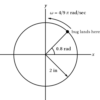 In the pictures below, a bug has landed on the rim of a jelly
jar and is moving around the rim. The location where the bug
initially lands is described and its angular speed is given. Impose
a coordinate system with the origin at the center of the circle of
motion. In each of the cases, answer these questions.
Case 1
Case 2
Case 3
(a) Find an angle θ0 in standard central position
that gives the bug's initial location....
In the pictures below, a bug has landed on the rim of a jelly
jar and is moving around the rim. The location where the bug
initially lands is described and its angular speed is given. Impose
a coordinate system with the origin at the center of the circle of
motion. In each of the cases, answer these questions.
Case 1
Case 2
Case 3
(a) Find an angle θ0 in standard central position
that gives the bug's initial location....
A 1.6 kg particle moves in a circle of radius 3.1 m. As you look down...
A 1.6 kg particle moves in a circle of radius 3.1 m. As you look down on the plane of its orbit, the particle is initially moving clockwise. If we call the clockwise direction positive, the particle's angular momentum relative to the center of the circle varies with time according to L(t) = 10 N · m·s - (5.0 N · m)t. (a) Find the magnitude and direction of the torque acting on the particle in N · m. Is...
Exercise 0.2. Consider a particle moving around in a circle according to the position function -...
 Exercise 0.2. Consider a particle moving around in a circle according to the position function - F(t) Rcos i+Rsin where R is the radius of the circular trajectory and a is a constant with units of radians per second-squared. (a) What is the velocity function, ö(t), for this particle? Is the velocity perpendicular to the position as in the previous problem? HINT: To do this, you will need to make use of the chain rule. (b) What is the particle's...
2. A toy car with a mass of 35g (0.035kg) is moving clockwise around a loop-the-loop (a track in the shape of a circle that causes the toy car to travel along a circular trajectory) with a radius of...
 2. A toy car with a mass of 35g (0.035kg) is moving clockwise around a loop-the-loop (a track in the shape of a circle that causes the toy car to travel along a circular trajectory) with a radius of R- 13cm (0.13m) as depicted in the diagram below. At the point shown (the - on the diagram below) its instantaneous speed (the magnitude of its velocity) is 1.5m/s and its speed is increasing at a rate of 7.1m/s2. (a) (4...
Shown below is a small particle of mass 19 g that is moving at a speed...
 Shown below is a small particle of mass 19 g that is moving at a speed of 10 m/s when it collides with and sticks to the edge of a uniform solid cylinder. The cylinder is free to rotate about the axis through its center and perpendicular to the page. The cylinder has a mass of 0.4 kg and a radius of 20 cm and is initially at rest. 10 m/s Before After (a) What is the angular velocity (in...
The mass of the symmetrical wheel shown below is m = 4 kg and its radius...
 The mass of the symmetrical wheel shown below is m = 4 kg and its radius of gyration about its center is kg = 0.25 m. The outer radius of the wheel is r2 = 0.4 m. The radius of the inner hub, where a cable is wrapped around it, is rı = 0.2 m. The wheel rolls without slipping. The force P, applied to the cable, is increased slowly according to the linear relation P = at, where P...
Shown below is a small particle of mass 33 g that is moving at a speed...
Shown below is a small particle of mass 33 g that is moving at a speed of 10 m/s when it collides with and sticks to the edge of a uniform solid cylinder. The cylinder is free to rotate about the axis through its center and perpendicular to the page. The cylinder has a mass of 0.4 kg and a radius of 18 cm and is initially at rest. (a) What is the angular velocity (in rad/s) of the system...
A common amusement park ride is a Ferris wheel (see figure below, which is not drawn to scale). Riders sit in chairs that are on pivots so they remain level as the wheel turns at a constant rate.
 A common amusement park ride is a Ferris wheel (see figure below, which is not drawn to scale). Riders sit in chairs that are on pivots so they remain level as the wheel turns at a constant rate. A particular Ferris wheel has a radius of 27 meters, and it makes one complete revolution around its axle (at location A) in 24 s. In all of the following questions, consider location A (at the center of the axle) as the...
1. A car with constant acceleration of 2.3 m/s2 drives toward east (positive x-axces). (a)How much...
1. A car with constant acceleration of 2.3 m/s2 drives toward east (positive x-axces). (a)How much time in seconds is required for the car to change its speed from 10 m/s to 35 m/s? (b)Calculate the total distance in meters, covered during that time (c) Calculate the average speed during that time interval (d) Find x- and y- components of the vector of acceleration 2. From the top of a tower, a person drops a pebble. The peble strikes the...
2. As shown below a uniform disk of radius R 10.0 cm and mass M 0.850...
 2. As shown below a uniform disk of radius R 10.0 cm and mass M 0.850 kg is attached to the end of a uniform rigid rod of length L = 500 mm and mass m = 0.210 kg. Take positive θ in the counterclockwise direction, and positive angular velocity ω as into the page. Assume small angle deflection (a) When the disk is suspended from a pivot as sown what is the period of its motion? (b) If this...
 In the pictures below, a bug has landed on the rim of a jelly
jar and is moving around the rim. The location where the bug
initially lands is described and its angular speed is given. Impose
a coordinate system with the origin at the center of the circle of
motion. In each of the cases, answer these questions.
Case 1
Case 2
Case 3
(a) Find an angle θ0 in standard central position
that gives the bug's initial location....
In the pictures below, a bug has landed on the rim of a jelly
jar and is moving around the rim. The location where the bug
initially lands is described and its angular speed is given. Impose
a coordinate system with the origin at the center of the circle of
motion. In each of the cases, answer these questions.
Case 1
Case 2
Case 3
(a) Find an angle θ0 in standard central position
that gives the bug's initial location....
 Exercise 0.2. Consider a particle moving around in a circle according to the position function - F(t) Rcos i+Rsin where R is the radius of the circular trajectory and a is a constant with units of radians per second-squared. (a) What is the velocity function, ö(t), for this particle? Is the velocity perpendicular to the position as in the previous problem? HINT: To do this, you will need to make use of the chain rule. (b) What is the particle's...
 2. A toy car with a mass of 35g (0.035kg) is moving clockwise around a loop-the-loop (a track in the shape of a circle that causes the toy car to travel along a circular trajectory) with a radius of R- 13cm (0.13m) as depicted in the diagram below. At the point shown (the - on the diagram below) its instantaneous speed (the magnitude of its velocity) is 1.5m/s and its speed is increasing at a rate of 7.1m/s2. (a) (4...
 Shown below is a small particle of mass 19 g that is moving at a speed of 10 m/s when it collides with and sticks to the edge of a uniform solid cylinder. The cylinder is free to rotate about the axis through its center and perpendicular to the page. The cylinder has a mass of 0.4 kg and a radius of 20 cm and is initially at rest. 10 m/s Before After (a) What is the angular velocity (in...
 The mass of the symmetrical wheel shown below is m = 4 kg and its radius of gyration about its center is kg = 0.25 m. The outer radius of the wheel is r2 = 0.4 m. The radius of the inner hub, where a cable is wrapped around it, is rı = 0.2 m. The wheel rolls without slipping. The force P, applied to the cable, is increased slowly according to the linear relation P = at, where P...
 2. As shown below a uniform disk of radius R 10.0 cm and mass M 0.850 kg is attached to the end of a uniform rigid rod of length L = 500 mm and mass m = 0.210 kg. Take positive θ in the counterclockwise direction, and positive angular velocity ω as into the page. Assume small angle deflection (a) When the disk is suspended from a pivot as sown what is the period of its motion? (b) If this...
Most questions answered within 3 hours.
-
Where is the error in this code sequence?
String s1 = "Hello";
String s2 = "ello";...
asked 10 months ago -
Financial data for Joel de Paris, Inc., for last year
follow:
Joel de Paris, Inc.
Balance...
asked 10 months ago -
Consider this reaction:
Al2(SO4)3 (aq)+ BaCl3
(aq) Al2Cl6 (aq)- +
3BaSO4(s) . What is the...
asked 10 months ago -
Suppose that Savneet is considering increasing her
recent random sample from 20 car rentals to 40...
asked 10 months ago -
Trucks arrive at an unloading terminal at an average rate of 120
per hour.
Trucks arrive...
asked 10 months ago -
Why are methanol and ethanol completely soluble in water while
octanol is not very little soluble....
asked 10 months ago -
A facilities manager at a university reads in a research report
that the mean amount of...
asked 10 months ago -
When the CuSO4 is rehydrated by adding water to the anhydrous
compound, is this an endothermic...
asked 10 months ago -
A ray of sunlight is passing from diamond into crown glass; the
angle of incidence is...
asked 10 months ago -
A block of mass 0.249 kg is placed on top of a light, vertical
spring of...
asked 10 months ago -
how do the kidneys compensate in the presences of acidosis
a) trigger hyperventilate
b) reserve acid...
asked 10 months ago -
Question 501 pts
The rental rate of capital to the firm increases. Which of the
following...
asked 10 months ago