Analysis of an Antacid Using the Ideal Gas Law - Experiment Why must you equalize the...
Analysis of an Antacid Using the Ideal Gas Law - Experiment
Why must you equalize the pressures before taking any volume measurements in this experiment?
Homework Answers
When the water level inside and outside the gas collection tube are equal, the pressure of the air and the collected gas are equal. Therefore, the measured air pressure can be used for the pressure of the mixture of gases in the collection tube after equalizing the water levels you can go through the volume measurement .that's why it is important to equalize the pressure before taking volume measurement.
Add Answer to:
Analysis of an Antacid Using the Ideal Gas Law -
Experiment
Why must you equalize the...
Analysis of an Antacid Using the Ideal Gas Law - Experiment What are the hazards associated...
Analysis of an Antacid Using the Ideal Gas Law - Experiment What are the hazards associated with the different chemicals and equipment in this experiment? Explain.
Experiment 9 Analysis of an Antacid using the ideal gas law. Calculations: 1) Find moles of...
 Experiment 9 Analysis of an Antacid using the ideal gas law.
Calculations:
1) Find moles of CO2
2) Find moles of NaHCO3
3) Find mass of NaHCO3
4) Find mass % of NaHCO3
5) Find average mass % NaHCO3 in Alka-Seltzer
Sheet 23° torr Atmospheric pressure, mmHg 755.0 Temperature of H,O, "C Vapor pressure of H.O at this temperature 21.1 Calculated pressure of CO, in the system, mmHg 733.9 Balanced reaction of NaHCO, and HCl (see Pre-Laboratory Question 4a) =...
Experiment 9 Analysis of an Antacid using the ideal gas law.
Calculations:
1) Find moles of CO2
2) Find moles of NaHCO3
3) Find mass of NaHCO3
4) Find mass % of NaHCO3
5) Find average mass % NaHCO3 in Alka-Seltzer
Sheet 23° torr Atmospheric pressure, mmHg 755.0 Temperature of H,O, "C Vapor pressure of H.O at this temperature 21.1 Calculated pressure of CO, in the system, mmHg 733.9 Balanced reaction of NaHCO, and HCl (see Pre-Laboratory Question 4a) =...
Using the Ideal Gas Law (PV = nRT) and the data you gathered in your experiment,...
Using the Ideal Gas Law (PV = nRT) and the data you gathered in your experiment, calculate the number of moles (n) of oxygen (O2) produced in this reaction. (show your calculation) If you are not sure how to do it, please ask me questions before you submit the assignment. ============================ Remember to use the following units: temperature: in kelvin (K) volume: in liters (L) pressure: in atmospheres (atm) constant R = 0.0821 atm/mol x K Data gathered from experiment:...
Can someone help me fill out this chart in this experiment "Antacid using ideal gas law"...
 Can someone help me fill out this chart in this experiment
"Antacid using ideal gas law"
btw. the mass of sample is the NaHCO3
thank you!!
Atmospheric pressure, mmHg 755. 1mmitg Temperature of H,0.C zle 22.0°C Vapor pressure of H,O at this temperature 19.8 mm Hg Calculated pressure of Co, in the system, mmHg 735.3 mmity Balanced reaction of NaHCO, and HCl (see Pre-Laboratory Question 4a) = Na HCO3 laq) + HCl(aq) – NACI Cagit CO2(g) + H2Oles Trial 1...
Can someone help me fill out this chart in this experiment
"Antacid using ideal gas law"
btw. the mass of sample is the NaHCO3
thank you!!
Atmospheric pressure, mmHg 755. 1mmitg Temperature of H,0.C zle 22.0°C Vapor pressure of H,O at this temperature 19.8 mm Hg Calculated pressure of Co, in the system, mmHg 735.3 mmity Balanced reaction of NaHCO, and HCl (see Pre-Laboratory Question 4a) = Na HCO3 laq) + HCl(aq) – NACI Cagit CO2(g) + H2Oles Trial 1...
Name Section/CRN EXPERIMENT 8 THE IDEAL GAS LAW AND THE MOLECULAR MASS OF GASES PRE-LABORATORY QUESTIONS...
 Name Section/CRN EXPERIMENT 8 THE IDEAL GAS LAW AND THE MOLECULAR MASS OF GASES PRE-LABORATORY QUESTIONS The following preparatory questions should be answered before coming to lab. They are intended to introduce you to several ideas that are important to aspects of the experiment. You must turn in your work to your instructor before you will be allowed to begin the experiment. 1. State the ideal gas law in equation form. What does each symbol in the equation stand for...
Using the Ideal Gas Law (PV = nRT) and the data you gathered in your experiment,...
Using the Ideal Gas Law (PV = nRT) and the data you gathered in your experiment, calculate the number of moles (n) of oxygen (O2) produced in this yeast and hydrogen peroxide reaction. (show your calculation) If you are not sure how to do it, please ask me questions before you submit the assignment. Temp of water: 23 C Room Pressure: 0.99264 atm Initial vol of air: 60 mL Final vol of air (after reaction): 64.5 mL Vol of oxygen...
Experiment 9 Scientist. Drayter Lenteng Lab partner: Michal Lab Report: Using the Ideal Gas Law for...
 Experiment 9 Scientist. Drayter Lenteng Lab partner: Michal Lab Report: Using the Ideal Gas Law for an Analysis Barometric Pressure 765.6 mm Hg 1.01 atm Atmospheric Pressure 28.8°C °C Temperature 301.95 * 302.Ok Trial 1 Trial 1 Trial !!! 0.74 0.77_g Mass baking powder g Volume CO2 produced Moles CO2 Moles NaHCO: Mass NaHCO: % NaHCO3 in baking powder Average % NaHCO; Calculations (if necessary place on back of page): Conclusion
The ideal gas law describes the relationship among the volume of an ideal gas (V), its...
The ideal gas law describes the relationship among the volume of an ideal gas (V), its pressure (P), its absolute temperature (T), and number of moles (n): PV=nRT Under standard conditions, the ideal gas law does a good job of approximating these properties for any gas. However, the ideal gas law does not account for all the properties of real gases such as intermolecular attraction and molecular volume, which become more pronounced at low temperatures and high pressures. The van...
Question 1: Show your calculations from Experiment 1: Ideal Gas Law - Finding Percent H2O2 with...
Question 1: Show your calculations from Experiment 1: Ideal Gas Law - Finding Percent H2O2 with Yeast to determine the theoretical number of moles of O2 if the hydrogen peroxide were a 100% solution. NOTE: All work must be shown. Skipping steps or lack of clarity in steps will result in loss of points. All units must be properly labeled. QUESTION 2: Using the actual moles of O2 you determined from your experiment (n) and the theoretical moles of O2...
Using the ideal gas law, solve the following problem. If you must use the following reaction...
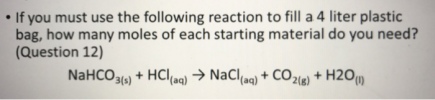 Using the ideal gas law, solve the following problem.
If you must use the following reaction to fill a 4 liter plastic bag, how many moles of each starting material do you need? (Question 12) NaHCO3(s) + HCl(aa)NaClaq)+CO2e)+ H20
Using the ideal gas law, solve the following problem.
If you must use the following reaction to fill a 4 liter plastic bag, how many moles of each starting material do you need? (Question 12) NaHCO3(s) + HCl(aa)NaClaq)+CO2e)+ H20
 Experiment 9 Analysis of an Antacid using the ideal gas law.
Calculations:
1) Find moles of CO2
2) Find moles of NaHCO3
3) Find mass of NaHCO3
4) Find mass % of NaHCO3
5) Find average mass % NaHCO3 in Alka-Seltzer
Sheet 23° torr Atmospheric pressure, mmHg 755.0 Temperature of H,O, "C Vapor pressure of H.O at this temperature 21.1 Calculated pressure of CO, in the system, mmHg 733.9 Balanced reaction of NaHCO, and HCl (see Pre-Laboratory Question 4a) =...
Experiment 9 Analysis of an Antacid using the ideal gas law.
Calculations:
1) Find moles of CO2
2) Find moles of NaHCO3
3) Find mass of NaHCO3
4) Find mass % of NaHCO3
5) Find average mass % NaHCO3 in Alka-Seltzer
Sheet 23° torr Atmospheric pressure, mmHg 755.0 Temperature of H,O, "C Vapor pressure of H.O at this temperature 21.1 Calculated pressure of CO, in the system, mmHg 733.9 Balanced reaction of NaHCO, and HCl (see Pre-Laboratory Question 4a) =...
 Can someone help me fill out this chart in this experiment
"Antacid using ideal gas law"
btw. the mass of sample is the NaHCO3
thank you!!
Atmospheric pressure, mmHg 755. 1mmitg Temperature of H,0.C zle 22.0°C Vapor pressure of H,O at this temperature 19.8 mm Hg Calculated pressure of Co, in the system, mmHg 735.3 mmity Balanced reaction of NaHCO, and HCl (see Pre-Laboratory Question 4a) = Na HCO3 laq) + HCl(aq) – NACI Cagit CO2(g) + H2Oles Trial 1...
Can someone help me fill out this chart in this experiment
"Antacid using ideal gas law"
btw. the mass of sample is the NaHCO3
thank you!!
Atmospheric pressure, mmHg 755. 1mmitg Temperature of H,0.C zle 22.0°C Vapor pressure of H,O at this temperature 19.8 mm Hg Calculated pressure of Co, in the system, mmHg 735.3 mmity Balanced reaction of NaHCO, and HCl (see Pre-Laboratory Question 4a) = Na HCO3 laq) + HCl(aq) – NACI Cagit CO2(g) + H2Oles Trial 1...
 Name Section/CRN EXPERIMENT 8 THE IDEAL GAS LAW AND THE MOLECULAR MASS OF GASES PRE-LABORATORY QUESTIONS The following preparatory questions should be answered before coming to lab. They are intended to introduce you to several ideas that are important to aspects of the experiment. You must turn in your work to your instructor before you will be allowed to begin the experiment. 1. State the ideal gas law in equation form. What does each symbol in the equation stand for...
 Experiment 9 Scientist. Drayter Lenteng Lab partner: Michal Lab Report: Using the Ideal Gas Law for an Analysis Barometric Pressure 765.6 mm Hg 1.01 atm Atmospheric Pressure 28.8°C °C Temperature 301.95 * 302.Ok Trial 1 Trial 1 Trial !!! 0.74 0.77_g Mass baking powder g Volume CO2 produced Moles CO2 Moles NaHCO: Mass NaHCO: % NaHCO3 in baking powder Average % NaHCO; Calculations (if necessary place on back of page): Conclusion
 Using the ideal gas law, solve the following problem.
If you must use the following reaction to fill a 4 liter plastic bag, how many moles of each starting material do you need? (Question 12) NaHCO3(s) + HCl(aa)NaClaq)+CO2e)+ H20
Using the ideal gas law, solve the following problem.
If you must use the following reaction to fill a 4 liter plastic bag, how many moles of each starting material do you need? (Question 12) NaHCO3(s) + HCl(aa)NaClaq)+CO2e)+ H20
Most questions answered within 3 hours.
-
Where is the error in this code sequence?
String s1 = "Hello";
String s2 = "ello";...
asked 11 months ago -
Financial data for Joel de Paris, Inc., for last year
follow:
Joel de Paris, Inc.
Balance...
asked 11 months ago -
Consider this reaction:
Al2(SO4)3 (aq)+ BaCl3
(aq) Al2Cl6 (aq)- +
3BaSO4(s) . What is the...
asked 11 months ago -
Suppose that Savneet is considering increasing her
recent random sample from 20 car rentals to 40...
asked 11 months ago -
Trucks arrive at an unloading terminal at an average rate of 120
per hour.
Trucks arrive...
asked 11 months ago -
Why are methanol and ethanol completely soluble in water while
octanol is not very little soluble....
asked 11 months ago -
A facilities manager at a university reads in a research report
that the mean amount of...
asked 11 months ago -
When the CuSO4 is rehydrated by adding water to the anhydrous
compound, is this an endothermic...
asked 11 months ago -
A ray of sunlight is passing from diamond into crown glass; the
angle of incidence is...
asked 11 months ago -
A block of mass 0.249 kg is placed on top of a light, vertical
spring of...
asked 11 months ago -
how do the kidneys compensate in the presences of acidosis
a) trigger hyperventilate
b) reserve acid...
asked 11 months ago -
Question 501 pts
The rental rate of capital to the firm increases. Which of the
following...
asked 11 months ago