Consider the following equations. 3 A + 6 B → 3 D, ΔH = -440. kJ/mol...
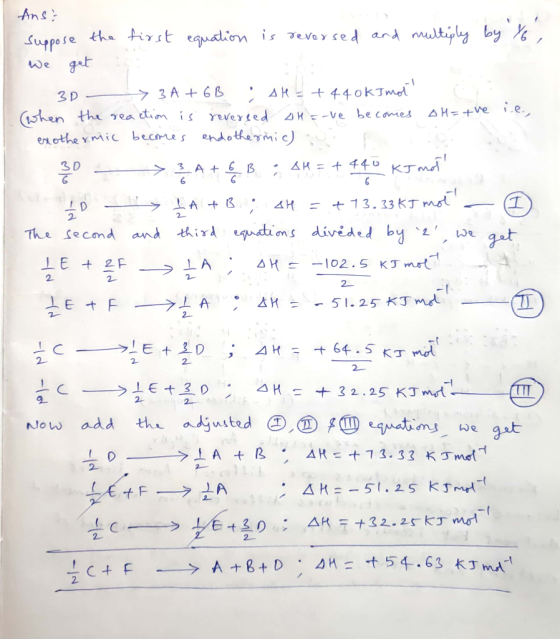
Consider the following equations.
3 A + 6 B → 3 D, ΔH = -440. kJ/mol
E + 2 F → A, ΔH = -102.5 kJ/mol
C → E + 3 D, ΔH = +64.5 kJ/mol
Suppose the first equation is reversed and multiplied by 1/6, the second and third equations are divided by 2, and the three adjusted equations are added. What is the net reaction?
Homework Answers
Add Answer to:
Consider the following equations.
3 A + 6 B → 3 D, ΔH = -440. kJ/mol...
Consider the following equations: 3A + 6B --> 3D ΔH = -403 kJ/mol E + 2F...
Consider the following equations: 3A + 6B --> 3D ΔH = -403 kJ/mol E + 2F --> A ΔH = -105.2 kJ/mol C --> E + 3D ΔH = +64.8 kJ/mol Suppose the first equation is reversed and multiplied by 1/6, the second and third equations are divided by 2, and the three adjusted equations are added. What is the net reaction and what is the overall heat of this reaction
1) State what is the net reaction. 2) What is the value for ΔH° for the...
 1) State what is the net reaction.
2) What is the value for ΔH° for the net reaction?
(kJ)
Consider the following thermochemical equations: (1) CH2OH() + O2(g) HCHO2(/) + H2O(1) AH°= -411 kJ (2) CO(g) + 2H2(g) –CH2OH() AH°=-128 kJ (3) HCHO2(1) CO(g) + H2O(1) AH°= -33 kJ Suppose Equation (1) is reversed and divided by 2; Equations (2) and (3) are multiplied by V2, and then the three adjusted equations are added.
1) State what is the net reaction.
2) What is the value for ΔH° for the net reaction?
(kJ)
Consider the following thermochemical equations: (1) CH2OH() + O2(g) HCHO2(/) + H2O(1) AH°= -411 kJ (2) CO(g) + 2H2(g) –CH2OH() AH°=-128 kJ (3) HCHO2(1) CO(g) + H2O(1) AH°= -33 kJ Suppose Equation (1) is reversed and divided by 2; Equations (2) and (3) are multiplied by V2, and then the three adjusted equations are added.
Now consider the following set of reactions: CO + 0.5 O2→CO2 , ΔH=−283 kJ/mol C +...
Now consider the following set of reactions: CO + 0.5 O2→CO2 , ΔH=−283 kJ/mol C + O2→CO2 , ΔH=−393 kJ/mol The equations given in the problem introduction can be added together to give the following reaction: overall: C + 0.5 O2→CO What is the enthalpy for the following reaction? overall: C + 0.5O2→CO
Consider the following two reactions: A → 2B ΔH°rxn = 456.7 kJ/mol A → C ΔH°rxn...
Consider the following two reactions: A → 2B ΔH°rxn = 456.7 kJ/mol A → C ΔH°rxn = -22.1 kJ/mol Determine the enthalpy change for the process: 2B → C Question 40 options: A) 434.6 kJ/mol B) -434.6 kJ/mol C) -478.8 kJ/mol D) 478.8 kJ/mol E) More information is needed to solve the problem.
Using the equations 2Sr(s)+O2(g) → 2 SrO (s) ΔH° = -1184 kJ/mol
Using the equations 2Sr(s)+O2(g) → 2 SrO (s) ΔH° = -1184 kJ/mol SrO (s) +CO2 (g) → SrCO3 (s) ΔH° = -234 kJ/mol CO2 (g) → C(s) +O2 (g) ΔH°= 394 kJ/mol Determine the enthalpy for the reaction 2 SrCO3 (s) → 2 Sr (s)+2 C(s)+ 3O2 (g). kJ/mol
Consider the following thermal equations: 2B (s) + 3H2(g) ⟶ B2H6 (g) ΔH = +36kJ/mol 2B (s)...
Consider the following thermal equations: 2B (s) + 3H2(g) ⟶ B2H6 (g) ΔH = +36kJ/mol 2B (s) + 3/2O2 (g) ⟶ B2O3 (s) ΔH = −1273 kJ/mol H2 (g) + 1/2O2 (g) ⟶ H2O (l) ΔH = −286 kJ/mol H2O (l) ⟶ H2O (g) ΔH = +44 kJ/mol Calculate ΔH for the combustion of borane, B2H6 (g) + 3O2 (g) ⟶ B2O3 (s) + 3H2O (g)
Consider the Haber synthesis of gaseous NH3 (ΔH∘f = -46.1 kJ/mol; ΔG∘f = -16.5 kJ/mol): N2(g)+3H2(g)→2NH3(g)...
Consider the Haber synthesis of gaseous NH3 (ΔH∘f = -46.1 kJ/mol; ΔG∘f = -16.5 kJ/mol): N2(g)+3H2(g)→2NH3(g) What are the equilibrium constants Kp and Kc for the reaction at 350 K ? You may assume that ΔH∘ and ΔS∘ are independent of temperature.
Consider the following reactions: B(g ) → A(g) ΔH = 27.9 kJ and C(g) → 2B...
Consider the following reactions: B(g ) → A(g) ΔH = 27.9 kJ and C(g) → 2B (g) ΔH = -18.0 kJ A. Calculate ΔH for the reaction 4A(g) →4 B(g) B. Using the two equations given Show how you would arrange the reactions so they add up to the equation 2A (g) → C (g), and then calculate ΔH for 2A (g) → C (g)
a. b. Consider the follow equations: A+B →D AH° = -70.0 kJ E +2 F →...
 a.
b.
Consider the follow equations: A+B →D AH° = -70.0 kJ E +2 F → A AH° = -20.0 kJ C + E +2D AH° = -300.0 kJ Calculate the AHⓇ for the reaction: C+2 F → 3 A +2 B Calculate the enthalpy of reaction for the process: D+FG+M A + B + C +G AH° = 100.0 kJ AC+F AH° = -300.0 kJ D+M+B AH° = -150.0 kJ
a.
b.
Consider the follow equations: A+B →D AH° = -70.0 kJ E +2 F → A AH° = -20.0 kJ C + E +2D AH° = -300.0 kJ Calculate the AHⓇ for the reaction: C+2 F → 3 A +2 B Calculate the enthalpy of reaction for the process: D+FG+M A + B + C +G AH° = 100.0 kJ AC+F AH° = -300.0 kJ D+M+B AH° = -150.0 kJ
Use the ΔH°f values provided to determine ΔH°rxn for the following reaction CH4(g) + 3 Cl2(g)...
Use the ΔH°f values provided to determine ΔH°rxn for the following reaction CH4(g) + 3 Cl2(g) → CHCl3(l) + 3 HCl(g) ΔH°rxn = ? ΔH°f (kJ/mol): -75 -134 -92 A. +662 kJ B. +117 kJ C. -151 kJ D. -335 kJ The equation that corresponds to the enthalpy of formation for NH3(g) is A. N(g) + 3H(g) → NH3(g) B. N(g) + 3/2 H2(g) → NH3(g) C. 1/2 N2(g) + 3H(g) → NH3(g) D. 1/2 N2(g) + 3/2 H2(g) →...
 1) State what is the net reaction.
2) What is the value for ΔH° for the net reaction?
(kJ)
Consider the following thermochemical equations: (1) CH2OH() + O2(g) HCHO2(/) + H2O(1) AH°= -411 kJ (2) CO(g) + 2H2(g) –CH2OH() AH°=-128 kJ (3) HCHO2(1) CO(g) + H2O(1) AH°= -33 kJ Suppose Equation (1) is reversed and divided by 2; Equations (2) and (3) are multiplied by V2, and then the three adjusted equations are added.
1) State what is the net reaction.
2) What is the value for ΔH° for the net reaction?
(kJ)
Consider the following thermochemical equations: (1) CH2OH() + O2(g) HCHO2(/) + H2O(1) AH°= -411 kJ (2) CO(g) + 2H2(g) –CH2OH() AH°=-128 kJ (3) HCHO2(1) CO(g) + H2O(1) AH°= -33 kJ Suppose Equation (1) is reversed and divided by 2; Equations (2) and (3) are multiplied by V2, and then the three adjusted equations are added.
 a.
b.
Consider the follow equations: A+B →D AH° = -70.0 kJ E +2 F → A AH° = -20.0 kJ C + E +2D AH° = -300.0 kJ Calculate the AHⓇ for the reaction: C+2 F → 3 A +2 B Calculate the enthalpy of reaction for the process: D+FG+M A + B + C +G AH° = 100.0 kJ AC+F AH° = -300.0 kJ D+M+B AH° = -150.0 kJ
a.
b.
Consider the follow equations: A+B →D AH° = -70.0 kJ E +2 F → A AH° = -20.0 kJ C + E +2D AH° = -300.0 kJ Calculate the AHⓇ for the reaction: C+2 F → 3 A +2 B Calculate the enthalpy of reaction for the process: D+FG+M A + B + C +G AH° = 100.0 kJ AC+F AH° = -300.0 kJ D+M+B AH° = -150.0 kJ
Most questions answered within 3 hours.
-
Where is the error in this code sequence?
String s1 = "Hello";
String s2 = "ello";...
asked 10 months ago -
Financial data for Joel de Paris, Inc., for last year
follow:
Joel de Paris, Inc.
Balance...
asked 10 months ago -
Consider this reaction:
Al2(SO4)3 (aq)+ BaCl3
(aq) Al2Cl6 (aq)- +
3BaSO4(s) . What is the...
asked 10 months ago -
Suppose that Savneet is considering increasing her
recent random sample from 20 car rentals to 40...
asked 10 months ago -
Trucks arrive at an unloading terminal at an average rate of 120
per hour.
Trucks arrive...
asked 10 months ago -
Why are methanol and ethanol completely soluble in water while
octanol is not very little soluble....
asked 10 months ago -
A facilities manager at a university reads in a research report
that the mean amount of...
asked 10 months ago -
When the CuSO4 is rehydrated by adding water to the anhydrous
compound, is this an endothermic...
asked 10 months ago -
A ray of sunlight is passing from diamond into crown glass; the
angle of incidence is...
asked 10 months ago -
A block of mass 0.249 kg is placed on top of a light, vertical
spring of...
asked 10 months ago -
how do the kidneys compensate in the presences of acidosis
a) trigger hyperventilate
b) reserve acid...
asked 10 months ago -
Question 501 pts
The rental rate of capital to the firm increases. Which of the
following...
asked 10 months ago