Consider the following thermal equations: 2B (s) + 3H2(g) ⟶ B2H6 (g) ΔH = +36kJ/mol 2B (s)...
Consider the following thermal equations:
2B (s) + 3H2(g) ⟶
B2H6
(g) ΔH
= +36kJ/mol
2B (s) + 3/2O2 (g) ⟶
B2O3
(s) ΔH = −1273
kJ/mol
H2 (g) + 1/2O2
(g) ⟶ H2O (l)
ΔH = −286 kJ/mol
H2O (l) ⟶ H2O
(g) ΔH
= +44 kJ/mol
Calculate ΔH for the combustion of borane,
B2H6 (g) + 3O2
(g) ⟶ B2O3 (s) +
3H2O (g)
Homework Answers

Add Answer to:
Consider the following thermal equations:
2B (s) + 3H2(g) ⟶
B2H6
(g) ΔH
= +36kJ/mol
2B (s)...
Calculate the enthalpy of the reaction 4B(s)+3O2(g)→2B2O3(s) given the following pertinent information: B2O3(s)+3H2O(...
Calculate the enthalpy of the reaction 4B(s)+3O2(g)→2B2O3(s) given the following pertinent information: B2O3(s)+3H2O(g)→3O2(g)+B2H6(g), ΔH∘A=+2035 kJ 2B(s)+3H2(g)→B2H6(g), ΔH∘B=+36 kJ H2(g)+12O2(g)→H2O(l), ΔH∘C=−285 kJ H2O(l)→H2O(g), ΔH∘D=+44 kJ
Part A Calculate the enthalpy of the reaction 2NO(g)+O2(g)→2NO2(g) given the following reactions and enthalpies of fo...
Part A Calculate the enthalpy of the reaction 2NO(g)+O2(g)→2NO2(g) given the following reactions and enthalpies of formation: 12N2(g)+O2(g)→NO2(g), ΔH∘A=33.2 kJ 12N2(g)+12O2(g)→NO(g), ΔH∘B=90.2 kJ Express your answer with the appropriate units. Part B Calculate the enthalpy of the reaction 4B(s)+3O2(g)→2B2O3(s) given the following pertinent information: B2O3(s)+3H2O(g)→3O2(g)+B2H6(g), ΔH∘A=+2035 kJ 2B(s)+3H2(g)→B2H6(g), ΔH∘B=+36 kJ H2(g)+12O2(g)→H2O(l), ΔH∘C=−285 kJ H2O(l)→H2O(g), ΔH∘D=+44 kJ Express your answer with the appropriate units.
(a) Diborane (B2H6) is a highly reactive borohydride that can be used as rocket fuel. Calculate Δ? for synthesis from th...
(a) Diborane (B2H6) is a highly reactive borohydride that can be used as rocket fuel. Calculate Δ? for synthesis from the elements as: 2B (s) + 3H2 (g) → B2H6 (g) Use the following data: 4B (s) + 3O2 (g) → 2B2O. (S) Δ? = -2546 kJ mol-1 B2H6 (g) + 3O2 (g) → B2O3 (s) + 3H2O (g) Δ? = -2035 kJ mol-1 2H2 (g) + O2 (g) → 2H2O (l) Δ? = -572 kJ mol-1 H2O (l) →...
a) Calculate the enthalpy of the reaction 2NO(g)+O2(g)→2NO2(g) given the following reactions and enthalpies of formation:...
a) Calculate the enthalpy of the reaction 2NO(g)+O2(g)→2NO2(g) given the following reactions and enthalpies of formation: 12N2(g)+O2(g)→NO2(g), ΔfH∘A=33.2 kJ mol−1 12N2(g)+12O2(g)→NO(g), ΔfH∘B=90.2 kJ mol−1 Express your answer with the appropriate units. b) Calculate the enthalpy of the reaction 4B(s)+3O2(g)→2B2O3(s) given the following pertinent information: B2O3(s)+3H2O(g)→3O2(g)+B2H6(g), ΔrH∘A=+2035 kJ mol−1 2B(s)+3H2(g)→B2H6(g), ΔrH∘B=+36 kJ mol−1 H2(g)+12O2(g)→H2O(l), ΔrH∘C=−285 kJ mol−1 H2O(l)→H2O(g), ΔrH∘D=+44 kJ mol−1
Using Hess's Law, calculate ΔH°R Equation: B2H6 (g) + 6 Cl2 (g) --> 2BCl3 (g) +...
Using Hess's Law, calculate ΔH°R Equation: B2H6 (g) + 6 Cl2 (g) --> 2BCl3 (g) + 6 HCl (g) Given these 3 equations: (please show all work) BCl3 (g) + 3H2O (l) --> H3BO3 (g) + 3HCl (g) (ΔH°R = -112.5 KJ/mol BCl3) B2H6 (g) + 6H2O (l) --> 2H3BO3 (g) + 6H2 (g) (ΔH°R = -493.4 KJ/mol B2H6) H2 (g) + Cl2 (g) --> 2HCl (g) (ΔH°R = -184.6 KJ/mol H2)
1)Consider the reaction B2H6(g) + 3 O2(g) → B2O3(s) + 3 H2O(g) ∆H = -2035 kJ/mol...
1)Consider the reaction B2H6(g) + 3 O2(g) → B2O3(s) + 3 H2O(g) ∆H = -2035 kJ/mol Calculate the amount of heat released when 37.1 g of diborane is burned. 2) Consider the reaction B2H6(g) + 3 O2(g) → B2O3(s) + 3 H2O(g) ∆H = -2035 kJ How much heat is released when a mixture of 9.71 g B2H6 and 1.53 g O2 is burned? 3)Consider the reaction B2H6(g) + 3 O2(g) → B2O3(s) + 3 H2O(g) ∆H = -2035 kJ...
Consider the reaction B2H6(g)+O2(g)=B2O3(s)+3H2O(g) delta heat -2035 kJ/mol calculate the amount of heat released when 2...
Consider the reaction B2H6(g)+O2(g)=B2O3(s)+3H2O(g) delta heat -2035 kJ/mol calculate the amount of heat released when 24.8g of diaborane is burned heat released=
Applications 4.85 How many g of B_Ho will react with 3.00 mol of Oz? B2H6(1) +...
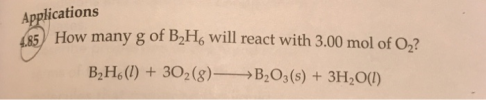 Applications 4.85 How many g of B_Ho will react with 3.00 mol of Oz? B2H6(1) + 302(8)—>B2O3(s) + 3H2O(l)
Hess's Law Given the following data: P(s) + 3/2H2(g) → PH3(g) ΔH°= +5.0 kJ PH3(g) +...
Hess's Law Given the following data: P(s) + 3/2H2(g) → PH3(g) ΔH°= +5.0 kJ PH3(g) + 2O2(g) → H3PO4(l) ΔH°= -1272.0 kJ 2P(s) + 5/2O2(g) → P2O5(s) ΔH°= -1492.0 kJ H2(g) + 1/2O2(g) → H2O(l) ΔH°= -286.0 kJ calculate ΔH° for the reaction: H3PO4(l) → 1/2P2O5(s) + 3/2H2O(l) ΔH°=?? also please explain how you found the answer
Calculate the enthalpy of the following reaction: C (s) + 2 H2 (g) --> CH4 (g)...
Calculate the enthalpy of the following reaction: C (s) + 2 H2 (g) --> CH4 (g) Given: C (s) + O2 (g) --> CO2 ΔH = -393 kJ H2 + 1⁄2O2 --> H2O. ΔH = -286 kJ CH4 + 2O2 --> CO2 + 2H2O ΔH = -892 kJ
 Applications 4.85 How many g of B_Ho will react with 3.00 mol of Oz? B2H6(1) + 302(8)—>B2O3(s) + 3H2O(l)
Most questions answered within 3 hours.
-
Where is the error in this code sequence?
String s1 = "Hello";
String s2 = "ello";...
asked 10 months ago -
Financial data for Joel de Paris, Inc., for last year
follow:
Joel de Paris, Inc.
Balance...
asked 10 months ago -
Consider this reaction:
Al2(SO4)3 (aq)+ BaCl3
(aq) Al2Cl6 (aq)- +
3BaSO4(s) . What is the...
asked 10 months ago -
Suppose that Savneet is considering increasing her
recent random sample from 20 car rentals to 40...
asked 10 months ago -
Trucks arrive at an unloading terminal at an average rate of 120
per hour.
Trucks arrive...
asked 10 months ago -
Why are methanol and ethanol completely soluble in water while
octanol is not very little soluble....
asked 10 months ago -
A facilities manager at a university reads in a research report
that the mean amount of...
asked 10 months ago -
When the CuSO4 is rehydrated by adding water to the anhydrous
compound, is this an endothermic...
asked 10 months ago -
A ray of sunlight is passing from diamond into crown glass; the
angle of incidence is...
asked 10 months ago -
A block of mass 0.249 kg is placed on top of a light, vertical
spring of...
asked 10 months ago -
how do the kidneys compensate in the presences of acidosis
a) trigger hyperventilate
b) reserve acid...
asked 10 months ago -
Question 501 pts
The rental rate of capital to the firm increases. Which of the
following...
asked 10 months ago