
Homework Answers
Add Answer to:
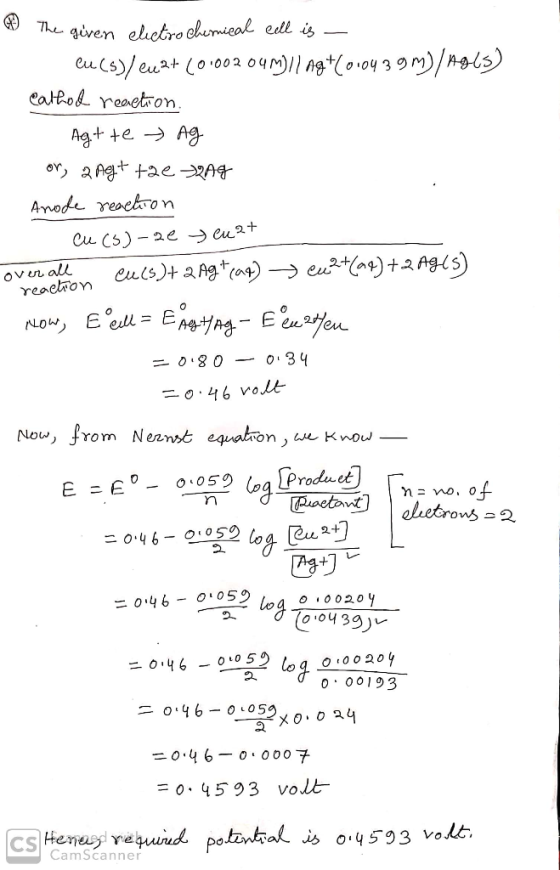
Calculate the potential of the electrochemical cell described below. Report the answer to the correct number...
answer #4 please. thank you! 3. Calculate the potential of the electrochemical cell described below. Report the answ...
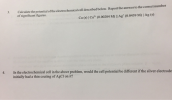 answer #4 please. thank you!
3. Calculate the potential of the electrochemical cell described below. Report the answer to the correct number of significant figures. Cu (S) Cu* (0.00204 M) || Ag+ (0.0439 M) Ag (s) 4. In the electrochemical cell in the above problem, would the cell potential be different if the silver electrode initially had a thin coating of AgCl on it?
answer #4 please. thank you!
3. Calculate the potential of the electrochemical cell described below. Report the answer to the correct number of significant figures. Cu (S) Cu* (0.00204 M) || Ag+ (0.0439 M) Ag (s) 4. In the electrochemical cell in the above problem, would the cell potential be different if the silver electrode initially had a thin coating of AgCl on it?
The electrochemical cell described by the balanced chemical reaction has a standard cell potential of -0.2...
The electrochemical cell described by the balanced chemical reaction has a standard cell potential of -0.2 V. Calculate the equilibrium constant (Kc) for the reaction at 298 K. Round your answer to 3 significant figures. H2SO3(aq) + H2O(l) → H2(g) + SO42-(aq) + 2H+(aq) The electrochemical cell described by the cell notation has a standard cell potential of -0.10 V. Calculate the value (kJ) for the ΔG˚ of the cell. Round your answer to 3 significant figures. Pt(s) l Cr3+(aq),...
pos Calculate the cell potential at 25°C from an electrochemical (galvanie) cell using Cu as the...
 pos Calculate the cell potential at 25°C from an electrochemical (galvanie) cell using Cu as the anode and MnO2 as the cathode. Give you swwe in V to 3 significant figures Standard reduction potentials are as follows: MnO2() (aq) - Mn2+ (aq) + 4H20 (1) E° (V) - 1.21V Cu? → Cu(s) E' (V) - 0.34V (aq)
A. Calculate the cell potential that would result in the following electrochemical cell at 25oC: ...
A. Calculate the cell potential that would result in the following electrochemical cell at 25oC: Pt | UO22+(0.10M),U4+(0.22M),H+(0.60M) || Ag+(0.034M) | Ag Line notation is anode || cathode Write Nernst equations for the anode and cathode separately. Then Ecell = Ecathode - E anode B. If the electrochemical cell Ag/AgCl || Zn2+(x M) | Zn(s) develops a potential of -1.039 volts at 25oC, what is the Zn2+ concentration in the solution? (Answer in decimal format) Ag/AgCl reference electrode has E=0.199...
Calculate the potential of the electrochemical cell and determine if it is spontaneous as written at...
 Calculate the potential of the electrochemical cell and determine if it is spontaneous as written at 25 °C Cu(s) Cu2+ (0.15 M) Fe2+ (0.0039 M) Fe(s) E =-0.440 V E+Cu = 0.339 V Fe2+/Fe Is the electrochemical cell spontaneous or not spontaneous -0.779 Ecell = as written at 25 C? not spontaneous spontaneous о Calculate the potential of the electrochemical cell and determine if it is spontaneous as written at 25 'C Pt(s) Sn2 (0.0024 M), Sn4+ (0.12 M) |...
A. Calculate the cell potential that would result in the following electrochemical cell at 25oC: Pt...
A. Calculate the cell potential that would result in the following electrochemical cell at 25oC: Pt | UO22+(0.10M),U4+(0.22M),H+(0.60M) || Ag+(0.034M) | Ag Line notation is anode || cathode Write Nernst equations for the anode and cathode separately. Then Ecell = Ecathode - E anode B. If the electrochemical cell Ag/AgCl || Zn2+(x M) | Zn(s) develops a potential of -1.039 volts at 25oC, what is the Zn2+ concentration in the solution? (Answer in decimal format) Ag/AgCl reference electrode has E=0.199...
Calculate the potential of the electrochemical cell and determine if it is spontaneous as written at...
Calculate the potential of the electrochemical cell and determine if it is spontaneous as written at 25 ∘ C . Cu ( s ) ∣ ∣ Cu 2 + ( 0.13 M ) ∥ ∥ Fe 2 + ( 0.0011 M ) ∣ ∣ Fe ( s ) E ∘ Cu 2 + / Cu = 0.339 V E ∘ Fe 2 + / Fe = − 0.440 V E cell = V
Calculate the potential of the electrochemical cell and determine if it is spontaneous as written at...
 Calculate the potential of the electrochemical cell and determine if it is spontaneous as written at 25 °C. Cu(s) Cu2+(0.14 M) | Fe2+(0.0044 M) Fe(s) Ecu?+Icu = 0.339 V Efez lfe = -0.440 V Ecell = v Is the electrochemical cell spontaneous or not spontaneous as written at 25 °C? O not spontaneous O spontaneous Calculate the potential of the electrochemical cell and determine if it is spontaneous as written at 25 °C. Pt(s) Sn2+(0.0048 M), Snº+(0.11 M) || Fe3+(0.12...
Electrochemistry - Equilibrium 1. The electrochemical cell described by the balanced chemical equation has a standard...
Electrochemistry - Equilibrium 1. The electrochemical cell described by the balanced chemical equation has a standard emf (electromotive force) of -0.08 V. Calculate the value (J) for the Wmax that the cell can do under standard conditions. Round your answer to 3 significant figures. St. Red. Pot. (V) Faraday's Constant Hg2+/Hg +0.85 F = 96485 C Fe3+/Fe2+ +0.77 2Fe3+(aq) + Hg(l) → 2Fe2+(aq) + Hg2+(aq) 2. The voltaic cell described by the balanced chemical equation has a standard emf of...
Calculate the cell potential of an electrochemical cell consisting of a Mg electrode in 0.10 M...
Calculate the cell potential of an electrochemical cell consisting of a Mg electrode in 0.10 M Mg (NO3) 2 (aq) and an Ag electrode in 0.20 M AgNO3 (aq)
 answer #4 please. thank you!
3. Calculate the potential of the electrochemical cell described below. Report the answer to the correct number of significant figures. Cu (S) Cu* (0.00204 M) || Ag+ (0.0439 M) Ag (s) 4. In the electrochemical cell in the above problem, would the cell potential be different if the silver electrode initially had a thin coating of AgCl on it?
answer #4 please. thank you!
3. Calculate the potential of the electrochemical cell described below. Report the answer to the correct number of significant figures. Cu (S) Cu* (0.00204 M) || Ag+ (0.0439 M) Ag (s) 4. In the electrochemical cell in the above problem, would the cell potential be different if the silver electrode initially had a thin coating of AgCl on it?
 pos Calculate the cell potential at 25°C from an electrochemical (galvanie) cell using Cu as the anode and MnO2 as the cathode. Give you swwe in V to 3 significant figures Standard reduction potentials are as follows: MnO2() (aq) - Mn2+ (aq) + 4H20 (1) E° (V) - 1.21V Cu? → Cu(s) E' (V) - 0.34V (aq)
 Calculate the potential of the electrochemical cell and determine if it is spontaneous as written at 25 °C Cu(s) Cu2+ (0.15 M) Fe2+ (0.0039 M) Fe(s) E =-0.440 V E+Cu = 0.339 V Fe2+/Fe Is the electrochemical cell spontaneous or not spontaneous -0.779 Ecell = as written at 25 C? not spontaneous spontaneous о Calculate the potential of the electrochemical cell and determine if it is spontaneous as written at 25 'C Pt(s) Sn2 (0.0024 M), Sn4+ (0.12 M) |...
 Calculate the potential of the electrochemical cell and determine if it is spontaneous as written at 25 °C. Cu(s) Cu2+(0.14 M) | Fe2+(0.0044 M) Fe(s) Ecu?+Icu = 0.339 V Efez lfe = -0.440 V Ecell = v Is the electrochemical cell spontaneous or not spontaneous as written at 25 °C? O not spontaneous O spontaneous Calculate the potential of the electrochemical cell and determine if it is spontaneous as written at 25 °C. Pt(s) Sn2+(0.0048 M), Snº+(0.11 M) || Fe3+(0.12...
Most questions answered within 3 hours.
-
Where is the error in this code sequence?
String s1 = "Hello";
String s2 = "ello";...
asked 11 months ago -
Financial data for Joel de Paris, Inc., for last year
follow:
Joel de Paris, Inc.
Balance...
asked 11 months ago -
Consider this reaction:
Al2(SO4)3 (aq)+ BaCl3
(aq) Al2Cl6 (aq)- +
3BaSO4(s) . What is the...
asked 11 months ago -
Suppose that Savneet is considering increasing her
recent random sample from 20 car rentals to 40...
asked 11 months ago -
Trucks arrive at an unloading terminal at an average rate of 120
per hour.
Trucks arrive...
asked 11 months ago -
Why are methanol and ethanol completely soluble in water while
octanol is not very little soluble....
asked 11 months ago -
A facilities manager at a university reads in a research report
that the mean amount of...
asked 11 months ago -
When the CuSO4 is rehydrated by adding water to the anhydrous
compound, is this an endothermic...
asked 11 months ago -
A ray of sunlight is passing from diamond into crown glass; the
angle of incidence is...
asked 11 months ago -
A block of mass 0.249 kg is placed on top of a light, vertical
spring of...
asked 11 months ago -
how do the kidneys compensate in the presences of acidosis
a) trigger hyperventilate
b) reserve acid...
asked 11 months ago -
Question 501 pts
The rental rate of capital to the firm increases. Which of the
following...
asked 11 months ago