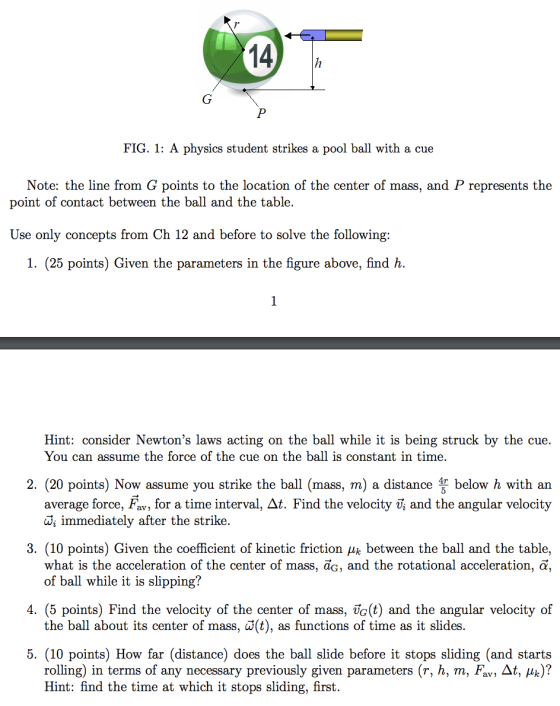
Consider the spot in which you can strike a pool ball with a cue
so that there is no friction between the ball and the surface.
Homework Answers
![no friction, Vem wir soat: m. Vem Fot. (n.o] = 2% my?w - mem (n.) = %my w = n wir (hor) = %my w = h - 75 ht:7*- -* Y! ac foot](http://img.homeworklib.com/questions/af27fdd0-725f-11ea-8bd0-8fae421d09ba.png?x-oss-process=image/resize,w_560)
Add Answer to:
Consider the spot in which you can strike a pool ball with a cue
so that...
A cue ball (mass = 0.160 kg) is at rest on a frictionless pool table. The...
A cue ball (mass = 0.160 kg) is at rest on a frictionless pool table. The ball is hit dead center by a pool stick, which applies an impulse of +1.50 N · s to the ball. The ball then slides along the table and makes an elastic head-on collision with a second ball of equal mass that is initially at rest. Find the velocity of the second ball just after it is struck.
A billiard ball that is initially at rest is given a sharp blow by a cue stick
A billiard ball that is initially at rest is given a sharp blow by a cue stick. The force is horizontal and is applied at a distance h = 2R/3 below the centerline, The speed of the ball just after the blow is v0 and the coefficient of kinetic friction between the ball and the billiard table is μk find angular velocity just after blow, velocity once roles without slipping, and KE just after hit.
On a billiards table a cue ball is initially at rest at the point O on...
 On a billiards table a cue ball is initially at rest at the point O on the table. It is struck by the stick so that it leaves the stick with a center of mass speed vo and reverse spin of angular speed oo. A kinetic friction force acts on the ball as it skids initially across the table. o da e a) Explain why the ball's angular momentum is conserved about the point。. b) Using the conservation of the...
Jeanette is playing in a 9-ball pool tournament. She will win if she sinks the 9-ball from the final rack, so she needs...
 Jeanette is playing in a 9-ball pool tournament. She will win if she sinks the 9-ball from the final rack, so she needs to line up her shot precisely. Both the cue ball and the 9-ball have mass m and the cue ball is hit at an initial speed of v1 Jeanette carefully hits the cue ball into the 9-ball off center, so that when the balls collide, they move away from each other at the same angle theta from...
Problem 4 A uniform solid spherical ball of mass M and radius R rests on a horizontal surface. Assume a constant coeffi...
 Problem 4 A uniform solid spherical ball of mass M and radius R rests on a horizontal surface. Assume a constant coefficient of friction (this means that the frictional force is equal to the normal force multiplied by u). The acceleration due to gravity is g. At time t 0, the bal is struck impulsively on center, causing it to go instantaneously from rest to initial rotation horizontal speed vo with a no (a) Find the horizontal speed, and the...
If a billiard ball is hit in just the right way by a cue stick, the...
 If a billiard ball is hit in just the right way by a cue stick,
the ball will roll without slipping immediately after losing
contact with the stick. Consider a billiard ball (radius
r, mass M) at rest on a horizontal pool table. A
cue stick exerts a constant horizontal force F on the ball
for a time t at a point that is a height h above
the table's surface (see the figure).(Figure 1) Assume that the
coefficient of...
If a billiard ball is hit in just the right way by a cue stick,
the ball will roll without slipping immediately after losing
contact with the stick. Consider a billiard ball (radius
r, mass M) at rest on a horizontal pool table. A
cue stick exerts a constant horizontal force F on the ball
for a time t at a point that is a height h above
the table's surface (see the figure).(Figure 1) Assume that the
coefficient of...
Jeanette is playing in a 9-ball pool tournament. She will win ifshe sinks the 9-ball from the final rack, so she need...
 Jeanette is playing in a 9-ball pool tournament. She will win
ifshe sinks the 9-ball from the final rack, so she needs to line
upher shot precisely. Both the cue ball and the 9-ball have
mass m,and the
cue ball is hit at an initial speed of vi.
Jeanette carefully hits the cue ball into the9-ball off center, so
that when the balls collide, they move awayfrom each other at the
same angle θ from the
direction in which the cue...
Jeanette is playing in a 9-ball pool tournament. She will win
ifshe sinks the 9-ball from the final rack, so she needs to line
upher shot precisely. Both the cue ball and the 9-ball have
mass m,and the
cue ball is hit at an initial speed of vi.
Jeanette carefully hits the cue ball into the9-ball off center, so
that when the balls collide, they move awayfrom each other at the
same angle θ from the
direction in which the cue...
PLEASE DO NOT ANSWER ASSUMING 1 AND 2 ARE EQUAL! I know I am supposed to...
 PLEASE DO NOT ANSWER ASSUMING 1 AND 2 ARE EQUAL!
I know I am supposed to use constant acceleration equations to
find omega, v, distance, time, etc. Any help here? Please solve a,
b, c, d, and e without assuming 1 and 2 are equal.
A billiard ball of radius H and mass "m is initially spinning counterclockwise about a horizontal axis with angular speed a and with a forward speed v The coefficient of kinetic friction between the ball...
PLEASE DO NOT ANSWER ASSUMING 1 AND 2 ARE EQUAL!
I know I am supposed to use constant acceleration equations to
find omega, v, distance, time, etc. Any help here? Please solve a,
b, c, d, and e without assuming 1 and 2 are equal.
A billiard ball of radius H and mass "m is initially spinning counterclockwise about a horizontal axis with angular speed a and with a forward speed v The coefficient of kinetic friction between the ball...
Sinking the 9-Ball
Jeanette is playing in a 9-ball pool tournament. She will win if she sinks the 9-ball from the final rack, so she needs to line up her shot precisely. Both the cueball and the 9-ball have mass m , and the cue ball is hit at an initial speed of v_i. Jeanette carefully hits the cue ball into the 9-ball off center, so that when theballs collide, they move away from each other at the same angle theta from the...
The figure on the right illustrates a ball which is a uniform solid sphere having mass M and radi...
 The figure on the right illustrates a ball which is a uniform solid sphere having mass M and radius R. The ball is initially traveling in the positive direction with pure translational motion along a friction-less region of a horizontal surface (i.e. it slips with angular speed ω0-0). The initial translational speed of the ball is Vo. The friction-less region extends to a region having coefficient of kinetic friction Figure for WAH #10 V. Friction Friction-less No longer slipping '...
 On a billiards table a cue ball is initially at rest at the point O on the table. It is struck by the stick so that it leaves the stick with a center of mass speed vo and reverse spin of angular speed oo. A kinetic friction force acts on the ball as it skids initially across the table. o da e a) Explain why the ball's angular momentum is conserved about the point。. b) Using the conservation of the...
 Jeanette is playing in a 9-ball pool tournament. She will win if she sinks the 9-ball from the final rack, so she needs to line up her shot precisely. Both the cue ball and the 9-ball have mass m and the cue ball is hit at an initial speed of v1 Jeanette carefully hits the cue ball into the 9-ball off center, so that when the balls collide, they move away from each other at the same angle theta from...
 Problem 4 A uniform solid spherical ball of mass M and radius R rests on a horizontal surface. Assume a constant coefficient of friction (this means that the frictional force is equal to the normal force multiplied by u). The acceleration due to gravity is g. At time t 0, the bal is struck impulsively on center, causing it to go instantaneously from rest to initial rotation horizontal speed vo with a no (a) Find the horizontal speed, and the...
 If a billiard ball is hit in just the right way by a cue stick,
the ball will roll without slipping immediately after losing
contact with the stick. Consider a billiard ball (radius
r, mass M) at rest on a horizontal pool table. A
cue stick exerts a constant horizontal force F on the ball
for a time t at a point that is a height h above
the table's surface (see the figure).(Figure 1) Assume that the
coefficient of...
If a billiard ball is hit in just the right way by a cue stick,
the ball will roll without slipping immediately after losing
contact with the stick. Consider a billiard ball (radius
r, mass M) at rest on a horizontal pool table. A
cue stick exerts a constant horizontal force F on the ball
for a time t at a point that is a height h above
the table's surface (see the figure).(Figure 1) Assume that the
coefficient of...
 Jeanette is playing in a 9-ball pool tournament. She will win
ifshe sinks the 9-ball from the final rack, so she needs to line
upher shot precisely. Both the cue ball and the 9-ball have
mass m,and the
cue ball is hit at an initial speed of vi.
Jeanette carefully hits the cue ball into the9-ball off center, so
that when the balls collide, they move awayfrom each other at the
same angle θ from the
direction in which the cue...
Jeanette is playing in a 9-ball pool tournament. She will win
ifshe sinks the 9-ball from the final rack, so she needs to line
upher shot precisely. Both the cue ball and the 9-ball have
mass m,and the
cue ball is hit at an initial speed of vi.
Jeanette carefully hits the cue ball into the9-ball off center, so
that when the balls collide, they move awayfrom each other at the
same angle θ from the
direction in which the cue...
 PLEASE DO NOT ANSWER ASSUMING 1 AND 2 ARE EQUAL!
I know I am supposed to use constant acceleration equations to
find omega, v, distance, time, etc. Any help here? Please solve a,
b, c, d, and e without assuming 1 and 2 are equal.
A billiard ball of radius H and mass "m is initially spinning counterclockwise about a horizontal axis with angular speed a and with a forward speed v The coefficient of kinetic friction between the ball...
PLEASE DO NOT ANSWER ASSUMING 1 AND 2 ARE EQUAL!
I know I am supposed to use constant acceleration equations to
find omega, v, distance, time, etc. Any help here? Please solve a,
b, c, d, and e without assuming 1 and 2 are equal.
A billiard ball of radius H and mass "m is initially spinning counterclockwise about a horizontal axis with angular speed a and with a forward speed v The coefficient of kinetic friction between the ball...
 The figure on the right illustrates a ball which is a uniform solid sphere having mass M and radius R. The ball is initially traveling in the positive direction with pure translational motion along a friction-less region of a horizontal surface (i.e. it slips with angular speed ω0-0). The initial translational speed of the ball is Vo. The friction-less region extends to a region having coefficient of kinetic friction Figure for WAH #10 V. Friction Friction-less No longer slipping '...
Most questions answered within 3 hours.
-
Where is the error in this code sequence?
String s1 = "Hello";
String s2 = "ello";...
asked 10 months ago -
Financial data for Joel de Paris, Inc., for last year
follow:
Joel de Paris, Inc.
Balance...
asked 10 months ago -
Consider this reaction:
Al2(SO4)3 (aq)+ BaCl3
(aq) Al2Cl6 (aq)- +
3BaSO4(s) . What is the...
asked 10 months ago -
Suppose that Savneet is considering increasing her
recent random sample from 20 car rentals to 40...
asked 10 months ago -
Trucks arrive at an unloading terminal at an average rate of 120
per hour.
Trucks arrive...
asked 10 months ago -
Why are methanol and ethanol completely soluble in water while
octanol is not very little soluble....
asked 10 months ago -
A facilities manager at a university reads in a research report
that the mean amount of...
asked 10 months ago -
When the CuSO4 is rehydrated by adding water to the anhydrous
compound, is this an endothermic...
asked 10 months ago -
A ray of sunlight is passing from diamond into crown glass; the
angle of incidence is...
asked 10 months ago -
A block of mass 0.249 kg is placed on top of a light, vertical
spring of...
asked 10 months ago -
how do the kidneys compensate in the presences of acidosis
a) trigger hyperventilate
b) reserve acid...
asked 10 months ago -
Question 501 pts
The rental rate of capital to the firm increases. Which of the
following...
asked 10 months ago