(Figure 1) shows the potential-energy diagram and the total energy line of a particle oscillating on a spring
(Figure 1) shows the potential-energy diagram and the total energy line of a particle oscillating on a spring. where r represents the length of the spring.
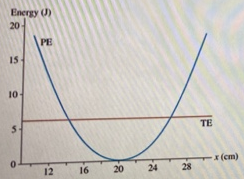
Part C
What is the particle's maximum kinetic energy?
Part D What will be the turning points if the particle's total energy is doubled?
Homework Answers


Add Answer to:
(Figure 1) shows the potential-energy diagram and the total energy line of a particle oscillating on a spring
2) The figure shows the potential energy diagram of a particle oscillating on a spring. a)...
 2) The figure shows the potential energy diagram of a particle oscillating on a spring. a) What is the spring's equilibrium length? b) The particle's turning points are at 16 cm and 24 cm. Draw the total energy line and label it Kinetic Energy (J) Potential Energy (J) 16 20 12 24 28 x(cm) Stuttga yom 1620 c) What is the particle's maximum kinetic energy? d) Sketch the particle's kinetic energy as a function of position. e) What will be...
A particle moves and has a potential energy that can be described by the equation U(x)...
 A particle moves and has a potential energy that can be described by the equation U(x) = 4 sin(2 x) where U(x) is in J. The total energy of the particle is E_tot = 2 J. Make a well-labelled graph of U(x)vs. x from x = 0 to x = pi. Draw a line corresponding to E_tot on your diagram. Assume the particle is moving in the positive x direction. Where is the particle speeding up? Make sure you solve...
Learning Goal: To be able to interpret potential energy diagrams and predict the corresponding motion of...
 Learning Goal: To be able to interpret potential energy diagrams
and predict the corresponding motion of a particle. Potential
energy diagrams for a particle are useful in predicting the motion
of that particle. These diagrams allow one to determine the
direction of the force acting on the particle at any point, the
points of stable and unstable equilibrium, the particle's kinetic
energy, etc. Consider the potential energy diagram shown. (Figure
1) The curve represents the value of potential energy U...
Learning Goal: To be able to interpret potential energy diagrams
and predict the corresponding motion of a particle. Potential
energy diagrams for a particle are useful in predicting the motion
of that particle. These diagrams allow one to determine the
direction of the force acting on the particle at any point, the
points of stable and unstable equilibrium, the particle's kinetic
energy, etc. Consider the potential energy diagram shown. (Figure
1) The curve represents the value of potential energy U...
The figure shows a plot of potential energy U versus position x of a 0.280 kg particle that can t...
 The figure shows a plot of potential energy U versus
position x of a 0.280 kg particle that can travel only
along an x axis under the influence of a conservative
force. The graph has these values: UA
= 9.00 J, UC = 20.0 J and
UD = 24.0 J. The particle is released
at the point where U forms a “potential hill” of “height”
UB = 12.0 J, with kinetic energy 5.00
J. What is the speed of the...
The figure shows a plot of potential energy U versus
position x of a 0.280 kg particle that can travel only
along an x axis under the influence of a conservative
force. The graph has these values: UA
= 9.00 J, UC = 20.0 J and
UD = 24.0 J. The particle is released
at the point where U forms a “potential hill” of “height”
UB = 12.0 J, with kinetic energy 5.00
J. What is the speed of the...
24&25 please The figure below shows the potential energy function U (r)for a particle moving along...
 24&25 please
The figure below shows the potential energy function U (r)for a particle moving along an axis labeled by the coordinate r. Values for energy and distance are in joules (j) millimeters (mm), respectively. The total energy of this particle is E = -4 J. Initially, the particle is at r = 1 mm and moving to the right (direction of increasing r) Which of the following statements best describes the subsequent motion of this particle? a. The particle...
24&25 please
The figure below shows the potential energy function U (r)for a particle moving along an axis labeled by the coordinate r. Values for energy and distance are in joules (j) millimeters (mm), respectively. The total energy of this particle is E = -4 J. Initially, the particle is at r = 1 mm and moving to the right (direction of increasing r) Which of the following statements best describes the subsequent motion of this particle? a. The particle...
mum Problem 1 (15 points) In an oscillating spring-mass system, the energy of the system is...
 mum Problem 1 (15 points) In an oscillating spring-mass system, the energy of the system is continually changing from kinetic energy to potential energy and back again. (Ignore the friction force). (5 points) Discuss in detail the energy conservation principle of the spring-mass system using your own words including the possible changes of both kinetic and potential energies during this motion? (5 points) At what point in the oscillation will the potential energy of the spring-mass system be highest? Why?...
A particle is moving to the right with initial kinetic energy To, subject to a force...
 A particle is moving to the right with initial kinetic energy To, subject to a force F(z)k function U(x) for this force ; (b) the kinetic energy and (c) the total energy of the particle as a function of its position; (d) find the turning points of the motion and the condition the total energy of the particle must satisfy if its motion is to exhibit turning points. (e) Sketch the potential, kinetic and total energy function (you can use...
Question 7 The figure shows a plot of potential energy U versus position x of a...
 Question 7 The figure shows a plot of potential energy U versus position x of a 0.220 kg particle that can travel only along an x axis under the influence of a conservative force. The graph has these values: UA = 9.00 J, Uc = 20.0 J and UD-24.0 J. The particle is released at the point where U forms a "potential hiir of "height" UB-12.0J, with kinetic energy 5.00 J. What is the speed of the particle at (a)x...
Up x (m) Figure 5 Figure 6 Figure 6 above shows a plot of potential energy...
 Up x (m) Figure 5 Figure 6 Figure 6 above shows a plot of potential energy U versus position x of a 0.200 kg particle that can travel only along an x axis under the influence of a conservative force. The graph has these values: UA 9.00 J, Uc-20.00 J, and UD- 24.00 J. The particle is released at the point where U forms a "potential hill" of "height" UB 12.00 J, with kinetic energy of 4.00 J. If it...
Please! Can anyone explain those answers to me? It would be better if you could demonstrate...
 Please! Can anyone explain those answers to me? It would be
better if you could demonstrate your process. Thanks!
Review Constants Periodic Tab (Figure 1) is the potential energy diagram for a 30g particle that is released from rest at 10 m Part A Will the particle move to the right in the positive direction or to the left in the negative direction, and why? Figure 1 of 1 Energy (J) • The particle will move to the left. Moving...
Please! Can anyone explain those answers to me? It would be
better if you could demonstrate your process. Thanks!
Review Constants Periodic Tab (Figure 1) is the potential energy diagram for a 30g particle that is released from rest at 10 m Part A Will the particle move to the right in the positive direction or to the left in the negative direction, and why? Figure 1 of 1 Energy (J) • The particle will move to the left. Moving...
 2) The figure shows the potential energy diagram of a particle oscillating on a spring. a) What is the spring's equilibrium length? b) The particle's turning points are at 16 cm and 24 cm. Draw the total energy line and label it Kinetic Energy (J) Potential Energy (J) 16 20 12 24 28 x(cm) Stuttga yom 1620 c) What is the particle's maximum kinetic energy? d) Sketch the particle's kinetic energy as a function of position. e) What will be...
 A particle moves and has a potential energy that can be described by the equation U(x) = 4 sin(2 x) where U(x) is in J. The total energy of the particle is E_tot = 2 J. Make a well-labelled graph of U(x)vs. x from x = 0 to x = pi. Draw a line corresponding to E_tot on your diagram. Assume the particle is moving in the positive x direction. Where is the particle speeding up? Make sure you solve...
 Learning Goal: To be able to interpret potential energy diagrams
and predict the corresponding motion of a particle. Potential
energy diagrams for a particle are useful in predicting the motion
of that particle. These diagrams allow one to determine the
direction of the force acting on the particle at any point, the
points of stable and unstable equilibrium, the particle's kinetic
energy, etc. Consider the potential energy diagram shown. (Figure
1) The curve represents the value of potential energy U...
Learning Goal: To be able to interpret potential energy diagrams
and predict the corresponding motion of a particle. Potential
energy diagrams for a particle are useful in predicting the motion
of that particle. These diagrams allow one to determine the
direction of the force acting on the particle at any point, the
points of stable and unstable equilibrium, the particle's kinetic
energy, etc. Consider the potential energy diagram shown. (Figure
1) The curve represents the value of potential energy U...
 The figure shows a plot of potential energy U versus
position x of a 0.280 kg particle that can travel only
along an x axis under the influence of a conservative
force. The graph has these values: UA
= 9.00 J, UC = 20.0 J and
UD = 24.0 J. The particle is released
at the point where U forms a “potential hill” of “height”
UB = 12.0 J, with kinetic energy 5.00
J. What is the speed of the...
The figure shows a plot of potential energy U versus
position x of a 0.280 kg particle that can travel only
along an x axis under the influence of a conservative
force. The graph has these values: UA
= 9.00 J, UC = 20.0 J and
UD = 24.0 J. The particle is released
at the point where U forms a “potential hill” of “height”
UB = 12.0 J, with kinetic energy 5.00
J. What is the speed of the...
 24&25 please
The figure below shows the potential energy function U (r)for a particle moving along an axis labeled by the coordinate r. Values for energy and distance are in joules (j) millimeters (mm), respectively. The total energy of this particle is E = -4 J. Initially, the particle is at r = 1 mm and moving to the right (direction of increasing r) Which of the following statements best describes the subsequent motion of this particle? a. The particle...
24&25 please
The figure below shows the potential energy function U (r)for a particle moving along an axis labeled by the coordinate r. Values for energy and distance are in joules (j) millimeters (mm), respectively. The total energy of this particle is E = -4 J. Initially, the particle is at r = 1 mm and moving to the right (direction of increasing r) Which of the following statements best describes the subsequent motion of this particle? a. The particle...
 mum Problem 1 (15 points) In an oscillating spring-mass system, the energy of the system is continually changing from kinetic energy to potential energy and back again. (Ignore the friction force). (5 points) Discuss in detail the energy conservation principle of the spring-mass system using your own words including the possible changes of both kinetic and potential energies during this motion? (5 points) At what point in the oscillation will the potential energy of the spring-mass system be highest? Why?...
 A particle is moving to the right with initial kinetic energy To, subject to a force F(z)k function U(x) for this force ; (b) the kinetic energy and (c) the total energy of the particle as a function of its position; (d) find the turning points of the motion and the condition the total energy of the particle must satisfy if its motion is to exhibit turning points. (e) Sketch the potential, kinetic and total energy function (you can use...
 Question 7 The figure shows a plot of potential energy U versus position x of a 0.220 kg particle that can travel only along an x axis under the influence of a conservative force. The graph has these values: UA = 9.00 J, Uc = 20.0 J and UD-24.0 J. The particle is released at the point where U forms a "potential hiir of "height" UB-12.0J, with kinetic energy 5.00 J. What is the speed of the particle at (a)x...
 Up x (m) Figure 5 Figure 6 Figure 6 above shows a plot of potential energy U versus position x of a 0.200 kg particle that can travel only along an x axis under the influence of a conservative force. The graph has these values: UA 9.00 J, Uc-20.00 J, and UD- 24.00 J. The particle is released at the point where U forms a "potential hill" of "height" UB 12.00 J, with kinetic energy of 4.00 J. If it...
 Please! Can anyone explain those answers to me? It would be
better if you could demonstrate your process. Thanks!
Review Constants Periodic Tab (Figure 1) is the potential energy diagram for a 30g particle that is released from rest at 10 m Part A Will the particle move to the right in the positive direction or to the left in the negative direction, and why? Figure 1 of 1 Energy (J) • The particle will move to the left. Moving...
Please! Can anyone explain those answers to me? It would be
better if you could demonstrate your process. Thanks!
Review Constants Periodic Tab (Figure 1) is the potential energy diagram for a 30g particle that is released from rest at 10 m Part A Will the particle move to the right in the positive direction or to the left in the negative direction, and why? Figure 1 of 1 Energy (J) • The particle will move to the left. Moving...
Most questions answered within 3 hours.
-
Where is the error in this code sequence?
String s1 = "Hello";
String s2 = "ello";...
asked 11 months ago -
Financial data for Joel de Paris, Inc., for last year
follow:
Joel de Paris, Inc.
Balance...
asked 11 months ago -
Consider this reaction:
Al2(SO4)3 (aq)+ BaCl3
(aq) Al2Cl6 (aq)- +
3BaSO4(s) . What is the...
asked 11 months ago -
Suppose that Savneet is considering increasing her
recent random sample from 20 car rentals to 40...
asked 11 months ago -
Trucks arrive at an unloading terminal at an average rate of 120
per hour.
Trucks arrive...
asked 11 months ago -
Why are methanol and ethanol completely soluble in water while
octanol is not very little soluble....
asked 11 months ago -
A facilities manager at a university reads in a research report
that the mean amount of...
asked 11 months ago -
When the CuSO4 is rehydrated by adding water to the anhydrous
compound, is this an endothermic...
asked 11 months ago -
A ray of sunlight is passing from diamond into crown glass; the
angle of incidence is...
asked 11 months ago -
A block of mass 0.249 kg is placed on top of a light, vertical
spring of...
asked 11 months ago -
how do the kidneys compensate in the presences of acidosis
a) trigger hyperventilate
b) reserve acid...
asked 11 months ago -
Question 501 pts
The rental rate of capital to the firm increases. Which of the
following...
asked 11 months ago